The discovery of ichthyosaur remains in Svalbard offers new insights into the evolution of ancient marine reptiles. New research suggests that ichthyosaurs may have existed earlier than dinosaurs, following one of the largest mass extinction events on Earth.
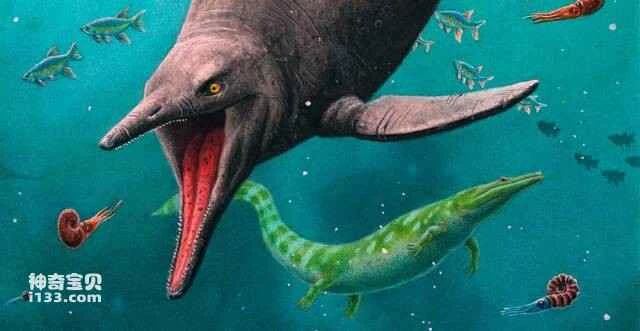
The earliest ichthyosaur fossils were discovered on the island of Spitsbergen in the Svalbard archipelago, dating back approximately 250 million years.
Ichthyosaurs were extinct marine reptiles that once roamed the world's oceans. They are believed to have evolved in the Early Triassic period and then dominated the seas throughout the Age of Dinosaurs.
However, the discovery of the earliest known ichthyosaur fossils may rewrite the evolutionary history of these marine reptiles.
A new study published in Current Biology suggests that ichthyosaurs evolved much earlier than previously thought, and may have even existed before the Permian-Triassic extinction event that wiped out about 90% of species.
"According to textbooks, ichthyosaurs evolved millions of years after the largest mass extinction event that occurred on our planet 252 million years ago," said Dr. Aubrey Roberts, associate scientist at the museum and co-author of the study.
"However, our latest findings suggest that this may not be the case."
"Our research shows that these fossils are 250 million years old and are the remains of a fully developed marine ichthyosaur, only two million years after the mass extinction event."
"For paleontologists, this is a very short period of time, suggesting that ichthyosaurs likely evolved before the mass extinction event."
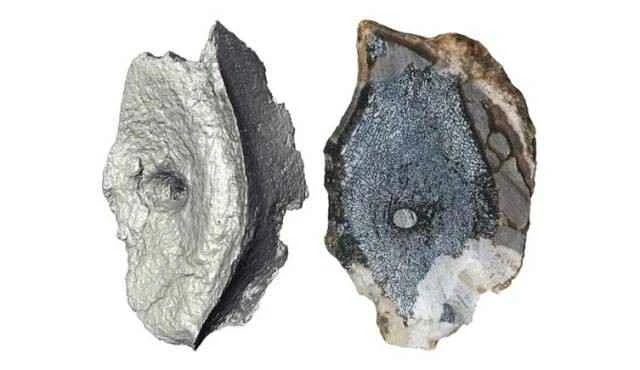
The cross-section shows the internal skeletal structure of the earliest ichthyosaur vertebrae.
How did ichthyosaurs evolve?
Ichthyosaurs were a group of marine reptiles that roamed the oceans for at least 160 million years. Their fossils date back to the Early Triassic to Late Cretaceous periods, approximately 90 million years ago.
Marine reptiles are not dinosaurs, but rather a separate group of marine vertebrates that resemble modern dolphins and whales in appearance, with streamlined bodies and powerful swimming tails.
They were adapted to be among the top predators in the ocean, possessing many sharp teeth perfectly suited for catching fish and squid. While some species were less than a meter long, others could reach an astonishing 25 meters, comparable to some modern whales.
Ichthyosaur fossils are among the earliest fossils discovered in Britain, with the first specimen found by Mary Anning and her brother Joseph in the early 1800s. In 2021, the largest ichthyosaur fossil ever discovered in Britain was found during routine maintenance at Rutlandwater.
Research suggests that reptiles evolved from terrestrial ancestors to a completely marine lifestyle, similar to how dolphins and other marine mammals evolved from terrestrial mammals, but no one is entirely certain what that ancestor looked like.
Despite the discovery of many well-preserved ichthyosaur fossils in Western Europe and North America, gaps in the fossil record make the evolutionary history of these animals uncertain.
A landscape photograph with two people searching for fossils in the foreground and the Svalbard mountains in the background.
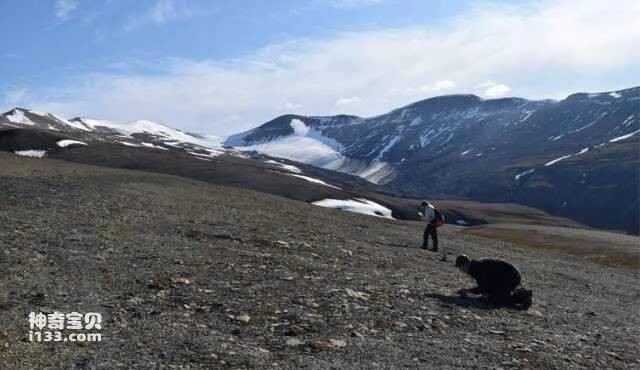
Team leader Professor Jørn Hurum (left) and team member Øyvind Enger (right) search for fossils in Flower Valley.
How were these early ichthyosaurs discovered?
In 2014, paleontologists embarked on an expedition to the Arctic to collect fossils from Flower Valley, west of Svalbard.
Meltwater from the surrounding mountains has created rushing rivers, exposing rocks that were once silt on the seabed 250 million years ago. Sediments accumulate around decaying animal remains on the ancient seabed, preserving them with spectacular three-dimensional detail.
The rock samples from Svalbard were then taken to the Natural History Museum at the University of Oslo for examination. Among the fossils of bony fish and crocodile-like amphibians was the remains of an ichthyosaur with 11 articulated caudal vertebrae.
Geochemical tests on the surrounding rocks confirmed that the fossils are approximately 2 million years old, following the end-Permian mass extinction.
Therefore, researchers initially thought these rocks were too old for ichthyosaurs and that the bones might belong to an earlier ancestor. However, analysis showed that these vertebrae were identical to those of younger, larger ichthyosaurs.
The preserved internal skeletal microstructure also suggests that the ichthyosaur had a faster metabolism and lived a completely marine lifestyle.
Although no earlier ichthyosaur fossils have yet been found, researchers believe that this discovery pushes back the origin and early diversification of ichthyosaurs to before the Permian-Triassic mass extinction, given the estimated timescales of marine reptile evolution.
If ichthyosaurs had already spread to marine environments before their extinction event, this would rewrite the prevailing view of the age of dinosaurs, specifically the timing of the emergence of major reptile lineages.
“The next step is for paleontologists to look for transitional fossils,” Aubry explained.
In other words, the ancestors of semi-aquatic ichthyosaurs existed in rocks before the Permian-Triassic extinction event. However, the challenge lies in finding fossil rocks from suitable environments that might have preserved them.