As one of the world's most important dinosaur-producing regions, China boasts numerous dinosaur fossil discoveries across its vast territory, with each region renowned for its abundant finds. However, compared to dinosaur-rich provinces like Yunnan, Sichuan, and Xinjiang, Heilongjiang is relatively unknown. But did you know that my country's earliest scientifically named dinosaur fossil was discovered near a small fishing village on the banks of the Heilongjiang River in Heilongjiang Province? This small fishing village is Yuliangzi in Jiayin County.
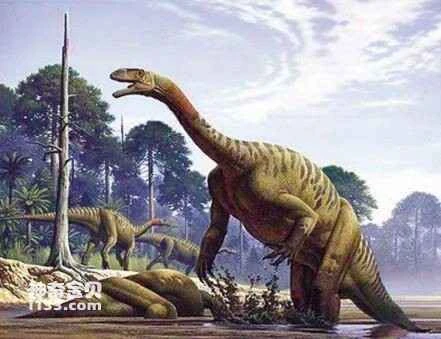
Manchuria Dragon
Due to the long-term erosion by the Heilongjiang River, the strata along both banks were constantly being eroded, exposing dinosaur fossils buried within them on the riverbanks. Local fishermen were astonished upon discovering these fossils, as they had never seen such large animal skeletons before. News spread quickly, reaching Russian officers on the opposite bank, who came to investigate and collect the fossils. Initially, the Russians mistook these large fossil bones for mammoths and reported on it in the Khabarovsk local newspaper. Attracted by this report, Russian geologists conducted a large-scale expedition and excavation in my country from 1915 to 1917, collecting a batch of dinosaur fossils. They repaired the fossils, created plaster models (one-third of the original size), and displayed them in the St. Petersburg Geological Museum. Research determined that it was a hadrosaur, 4.5 meters tall and about 8 meters long, which the Russian geologists named Manchuriaosaurus.

The Manchurian fossils unearthed in Jiayin are mostly dark brown or black in color, buried in conglomerate, highly fossilized, hard, and shiny black. This condition is likely due to the fact that the fossil-bearing gravel layer is an oil-bearing layer, and thus the fossils were soaked by underground oil for a long time.
Hadrosaurus, a relatively recent member of the dinosaur family, lived during the Late Cretaceous period and was a herbivorous plant-based dinosaur. Its two massive hind legs and long tail formed a tripod-like structure, supporting its heavy body. Its short forelimbs hung freely above its body, allowing it to grasp branches and leaves. On its high-held head was a flat, duck-like bill containing hundreds of small, prismatic teeth with long, thin roots, arranged in layers. This allowed lower teeth to grow in to replace worn-out upper teeth. Thus, hadrosaurus possessed highly efficient organs for grinding coarse-fiber foods, enabling them to self-repair and renew themselves. This may explain their remarkable adaptation to the Late Cretaceous environment, where soft ferns had declined, and coarse-fiber, harder gymnosperms and angiosperms had become the dominant vegetation.
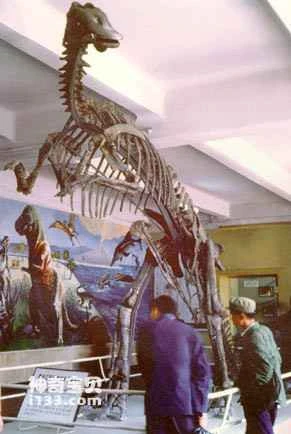
Not only were fossils of the Manchurianosaurus, a hadrosaur, unearthed in Jiayin County, but also fossils of ornithomimids and a large number of plant fossils were discovered. Research and analysis of this biological community indicate that the banks of the Heilongjiang River, which are now so cold, had a warm and humid climate and lush vegetation during the Late Cretaceous period 65 million years ago, with climatic conditions similar to those of modern Hainan Island.
To the deep regret of every Chinese person, the first scientifically named dinosaur unearthed in China was not preserved in China. Fortunately, since the 1970s, Chinese geologists and paleontologists have discovered new dinosaur fossil sites near that site, unearthing a new batch of Manchurianosaurus fossils. These fossils are now displayed in science museums such as the Heilongjiang Provincial Museum and the China University of Geosciences Museum, telling visitors the story of 65 million years ago.