In early 1957, the 4th Regiment of the 2nd Team of the Geological Survey Department of the Sichuan Petroleum Administration Bureau, led by geological team leader Xu Jiaren, arrived at Gulou Mountain in Taihe Township to explore for oil and natural gas in the Dashiqiao structure of Hechuan. Gulou Mountain is composed of a layer of red rock, with steep slopes and dense thickets. Geologist Hou Tengyun, undeterred by the difficulties, took the lead in climbing the mountain. When he reached the halfway point, he suddenly discovered a white stone shining brightly in the red rock layer. He tapped it with his geological hammer, and the white stone was surprisingly hard. He squatted down to examine it closely, and the more he looked at the stone, the more it resembled an animal skeleton. He immediately realized something and couldn't help but shout, "Come and see! There are dinosaur fossils here!"
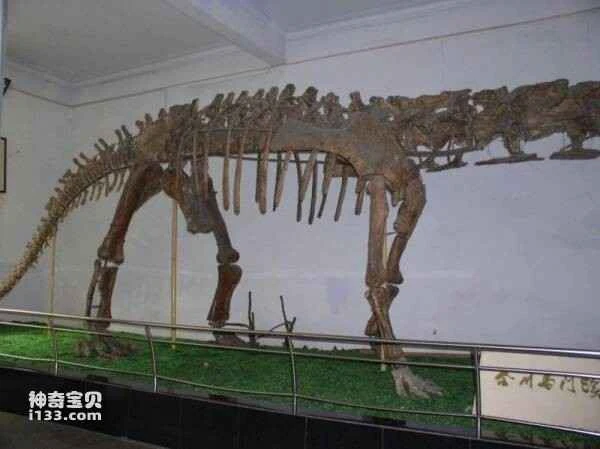
Mamenchisaurus
Upon hearing the shouts, everyone rushed over. After team leader Xu Jiaren confirmed that it was a dinosaur fossil, he immediately organized the entire team to begin excavation. Lacking suitable excavation tools, they had to use their hands to carefully remove pieces of rock surrounding the fossil to ensure its integrity. Some people even suffered cuts and scrapes on their fingers, but they didn't care, as the joy of discovering the dinosaur fossil overcame their fatigue and pain.
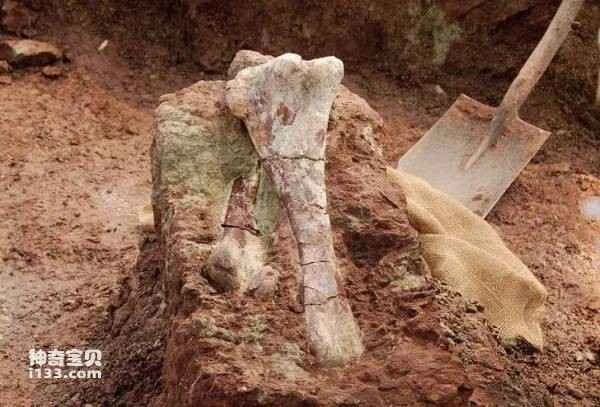
After a day of digging, the area of exposed fossils grew larger, and the difficulties of the excavation work increased. Team leader Xu Hesheng arrived upon hearing the news and, after understanding the situation, immediately assigned Tian Xitong, a technician who had just graduated from Northwest University, to organize laborers to assist in the excavation. The excavation work continued for several months until early May, when a complete dinosaur fossil skeleton was finally revealed to the public.
News of the discovery of a complete dinosaur fossil skeleton in Hechuan quickly spread throughout Sichuan and even reached Beijing, the capital city thousands of miles away. Visitors flocked to the site, and the Institute of Vertebrate Paleontology and Paleoanthropology of the Chinese Academy of Sciences, Chengdu University of Geology, and museums from various regions sent personnel to investigate.
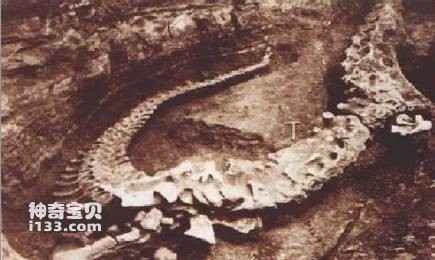
After research, scientists determined that this enormous dinosaur was buried at the top of the Upper Shaximiao Formation of the Chongqing Group of the Jurassic System, dating back approximately 120 million years. It belongs to the sauropod dinosaur family, one of the largest groups of dinosaurs, and lived in swampy areas, feeding on plants. After heated discussion, the excavation team unanimously agreed that it should be named after the place where it was discovered. Therefore, the scientists adopted their suggestion and named the dinosaur "Hechuan Mamenchisaurus". The discovery, excavation, and research of Hechuan Mamenchisaurus not only provides valuable materials for the study of the phylogenetic development of sauropod dinosaurs, but also provides important scientific evidence for the study of the paleogeography and paleoclimate of the Sichuan Basin.
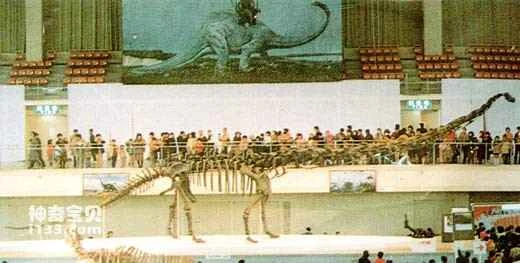
Later, scientists and paleontologists worked together to mount and display the Hechuan Mamenchisaurus. This colossal creature, measuring 22 meters in length, has long held the title of China's largest dinosaur. It has also been exhibited in countries and regions such as Japan, Hong Kong, Thailand, and Singapore, earning the admiration of people from all walks of life and becoming a world-renowned science popularization star.