In late 1996 and early 1997, numerous news media outlets around the world reported on the discovery of a "most primitive bird"—Sinosauropteryx—unearthed in Sihetun, Beipiao City, Liaoning Province, China. Researcher Ji Qiang, director of the Geological Museum of China and a researcher of Sinosauropteryx, pointed out that this fossil with "feathers" is the true ancestor of birds, dating back to the Late Jurassic period. Its characteristics prove that birds evolved from dinosaurs.
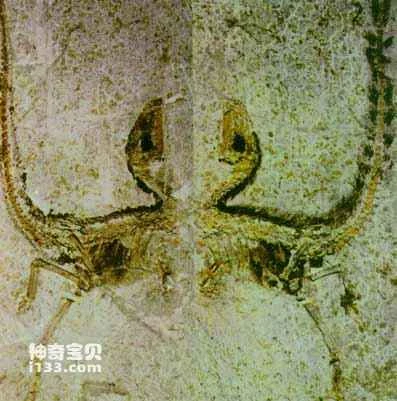
Sinosauropteryx fossil
However, almost simultaneously, on October 17, 1996, The New York Times published a photo of a "feathered dinosaur" also from Sihetun, presented by Chen Piji, a researcher at the Nanjing Institute of Geology and Paleontology, Chinese Academy of Sciences, at the 56th Annual Meeting of the Society of Vertebrate Paleontology and Paleoanthropology of North America. This photo aroused great interest among the attendees.
These reports caused a sensation in the international paleontological community. Many scientists published comments, engaging in heated discussions about the age and taxonomic status of Sinosauropteryx.
After verification, both the "Sinosauropteryx" and the "feathered dinosaur" indeed originated from Sihetun, Beipiao, Liaoning Province. The fossils were found in a 2-7 meter thick layer of lacustrine shale containing volcanic ash, located beneath a thick stratum known to geologists as the Yixian Formation of the Jehol Group. Furthermore, the "feathered dinosaur" is actually the holotype of the "Sinosauropteryx" fossil specimen; both are the same individual animal. It was originally unearthed by a farmer in Sihetun, who separated the fossil into two parts (the holotype and the negative type) along the bedding planes. Subsequently, the holotype was obtained by researcher Chen Piji, and the negative type by researcher Ji Qiang.
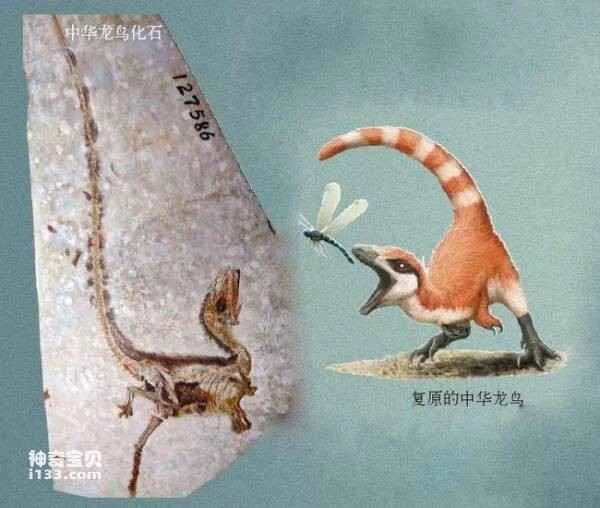
Research has shown that the morphological characteristics and body size of *Sinosauropteryx* are similar to those of *Compsognathus*, a small theropod dinosaur found in Germany, and they can be classified into the same group. *Sinosauropteryx* was a bipedal animal, and adults could grow up to 2 meters long. On its back, there was a row of skin derivatives resembling "hairs." Some paleontologists believe these are primitive "feathers," therefore, *Sinosauropteryx* should be considered a primitive bird; others believe that these skin derivatives do not possess feather characteristics, but are similar to the skin derivative structures on the backs of some extant reptiles (such as lizards)—keratinous bristles—or possibly fibrous tissue.
Judging from its fossil skeleton, *Sinosauropteryx* possessed many typical dinosaur characteristics: its skull was low and long, with a small cranium; it had a prominent postorbital bone behind its eye sockets, and a straight quadrate bone at the back of its jaw; its teeth were laterally flattened, shaped like small knives, and had serrated edges; its pubis was robust and extended forward in its pelvic girdle; its tail was quite long, with more than 60 caudal vertebrae, and well-developed neural spines and venous arcs on the caudal vertebrae; its forelimbs were particularly short, only one-third the length of its hind limbs, and the characteristics of its forelimbs indicated that it lived later than *Compsognathus* from Germany. Researchers including Chen Piji published a research paper in the British journal *Nature* on January 8, 1998, suggesting that *Sinosauropteryx* was a small theropod dinosaur. However, according to the rules of biological nomenclature, the name "Sinosauropteryx" originally given to it by Ji Qiang is still in use.
Paleontologists have discussed the function of the feather-like epidermal derivatives on Sinosauropteryx. Some believe it may have been an "ornament" indicating sex, while others think it was a thermoregulatory device. The latter explanation seems more plausible, as small dinosaurs and small Archaeopteryx would have needed a high metabolic rate for efficient activity, thus requiring the maintenance of body temperature. Therefore, the feather-like epidermal derivatives on Sinosauropteryx suggest that small dinosaurs may have been warm-blooded (i.e., homeothermic). Some paleontologists also speculate that these "feathers" are precursors to feathers, hence the term "professors." Currently, paleontologists are using new methods to further study them.
Interestingly, a small lizard fossil was found in the abdominal cavity of the Sinosauropteryx fossil skeleton. Clearly, this lizard was prey captured and swallowed by the Sinosauropteryx.
As for the era of Sinosauropteryx, based on recent in-depth research into the strata in which it was found, scientists have basically determined it to be the Early Cretaceous period, about 130 million years ago.