In 1993, some American paleontologists discovered a complete fossil skeleton of a carnivorous dinosaur in the Sahara Desert of Niger, Africa, and named it "African Hunter." "African Hunter" was nearly 10 meters long, with a long skull, powerful forelimbs, sharp, flexible claws, and a long, sturdy tail. "African Hunter" bears a striking resemblance to the succulent dinosaur that flourished in the western United States during the Late Jurassic period.
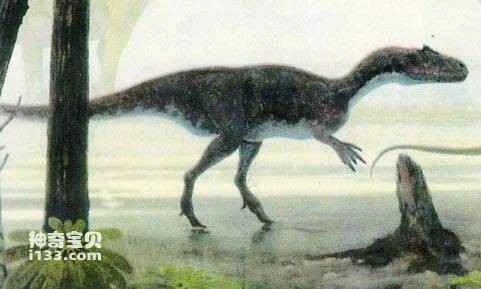
"African Hunter"
Along with the "African Hunter," several other sauropod dinosaurs were also discovered in the same area. These sauropods had broad, scabbard-shaped teeth. They were very similar to the succulents that flourished in western North America during the Late Jurassic period.
A question suddenly flashed through the minds of paleontologists: how could dinosaurs that are so closely related be found in Africa and North America, which are tens of thousands of kilometers apart?
At first, the evolutionary connection between dinosaurs in Africa and those in western North America was indeed incredible to paleontologists, but they soon found a reasonable explanation: continental drift.
It's possible that around 150 million years ago, during the Late Jurassic period, although Pangaea had begun to break apart, the southern continent (Gondwana), which included modern-day Africa, and the northern continent (Laurasia), which included modern-day North America and Europe, had not yet completely separated. A land bridge existed in the Gibraltar region of present-day Europe, connecting it to the African continent, allowing dinosaurs from these two ancient continents to interact. Since Europe and North America were connected at that time, it's not surprising that closely related dinosaur groups existed between North America and Africa.
Later, in the early Cretaceous period, Gondwana and Laurasia drifted further apart, completely isolating Africa from Laurasia to the north. Furthermore, Africa gradually separated from other landmasses within Gondwana, such as South America, truly becoming an island continent. From then on, African dinosaurs evolved in their own unique direction.