Hanauma Bay on the southern coast of Victoria, Australia, is a famous dinosaur fossil site on the Australian continent, but excavating fossils here is not easy. Although the fossils are often very well preserved, they are buried in hard sandstone, siltstone and mudstone, and can only be excavated with appropriate excavation tools such as sledgehammers, drills and even blasting equipment.
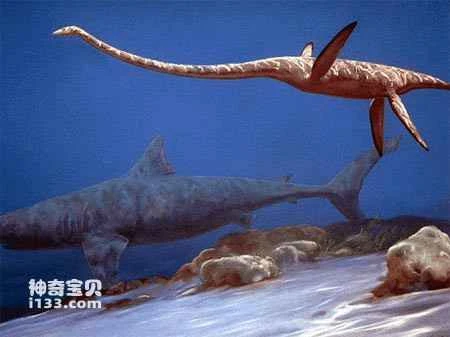
Plesiosaur
In 1987, an Australian excavation team conducted a long and tedious fieldwork here. Two months passed, and despite using various methods such as drilling and blasting, they found very few fossils.
With the field season drawing to a close, the expedition team decided to try their luck one last time. They dug two parallel tunnels into a cliff face along an ancient stream channel to search for and excavate bones deposited in that ancient riverbed 100 million years ago. After completing the two parallel tunnels, they decided to dig a third tunnel perpendicular to them to connect them. This proved to be a lucky decision, because while the expedition was digging this third transverse tunnel, they finally discovered the dinosaur fossils they had been longing for.
After drilling and blasting to remove the covering rock, the team members carefully removed the fossil-containing rock blocks from the bottom of the "dinosaur mine" as if they were newborns, afraid of damaging even the slightest specimen.
On this day, an excavation team member, while examining freshly split rocks in a dark tunnel, made a surprising discovery of an unusual fossil. Due to the narrow, dark, and damp space of the tunnel, and the specimen's own brownish color, it was difficult to spot within the dark gray rock and had been overlooked in previous inspections. Upon closer examination, it was determined to be the top of the skull of a small dinosaur, possibly smaller than a chick. The exposed section indicated that there should be more related to this fossil nearby. After careful searching, the team found a corresponding part in a previously abandoned rock—a fragment of the top of another skull, which had been inadvertently peeled away like an orange peel during the excavation. After the two fossils were glued together, a rather large dinosaur brain fossil became clearly visible. Notably, the pineal foramen—the pituitary gland responsible for vision—appeared unusually large. This is extremely rare among all known dinosaur species.
Next, the excavation team unearthed the entire preserved skull. Their good fortune continued the following day; less than a meter from where they found skull fragments, they discovered fossils of remaining vertebrae, a pelvic girdle, and leg bones. The size, shape, and burial condition of the fossils indicated that these postcranial bones belonged to the same dinosaur individual as the skull, a hypothesis later confirmed by laboratory studies and restoration work. Research showed that this intelligent, large-eyed dinosaur was small, bipedal, and agile. It lived 160 million years ago and fed on plants and insects.
The discovery of this precious dinosaur fossil, along with other subsequent discoveries, has provided scientists with important clues to understanding the life that lived in this region 160 million years ago.
Prior to this, the fossil record of dinosaurs and other terrestrial vertebrates on the Australian continent between approximately 65 million and 220 million years ago was almost entirely blank. As early as 1900, a geologist discovered the first dinosaur bone fossil on the Victorian coast. However, more than 90 years later, no new dinosaur bone fossils had been found there before this excavation; the only evidence of mammals that could reflect the existence of the Australian continent during that period consisted of only two jawbone fragments. The abundance of imprint fossils and the relatively small number of skeletal fossils discovered suggest that the dinosaur family on the Australian continent was once very prosperous and dominant. However, the available skeletal fossil evidence was indeed remarkably scarce. Starting in the 1960s, Australian scientists began explorations hoping to discover specimens to fill this gap in their understanding of the continent's paleontology.
Hanauma Bay is a major fossil-bearing area in southern Australia. The exposed rocky areas along the southeast and southwest coast of Melbourne are less affected by the climate, and therefore the fossils there are not as susceptible to severe weathering as those found in other parts of the continent. The area in Victoria where dinosaur fossils are found covers only a few square kilometers. Here, the waves crash against the rocks, gradually exposing the dinosaur skeletons. Less than 100 meters inland, the same rocks are severely eroded, making it difficult to find fossils there.
To the north of Hanauma Bay lie the lower Otway Mountains, and to the south, the vast South Australian Sea; less than 3,000 kilometers further south lies the Antarctic continent across the sea. When the dinosaurs lived here, the landscape was completely different. Back then, the South Australian Sea didn't exist, and Hanauma Bay was merely the bottom of a rift valley. It was precisely at that time that the Australian and Antarctic continents, once connected as part of the ancient supercontinent Gondwana, began to separate. The bottom of this great valley was relatively flat; if you lived then, you could hike from what is now Hanauma Bay directly to Antarctica, and then stand there looking north, you could see the canyon walls on the Australian side of the horizon.
During the Early Cretaceous, southeastern Australia was located within the Antarctic Circle, approximately at 80°S. Fossil specimens of plants and vertebrates from that era, collected from Hanauma Bay and other parts of Victoria, indicate that while the climate wasn't as cold as the present-day polar regions, it was still highly variable. The excavated plant fossils show prominent annual rings, reflecting distinct seasonal climate changes. Oxygen isotope decay rate measurements of rocks from the Hanauma Bay area suggest that the average annual temperature in southeastern Australia during the Early Cretaceous was only 5-6 degrees Celsius, possibly even as low as -8 degrees Celsius. Summers may have been relatively warm, but during the long winter nights, temperatures were consistently well below freezing. Studies of paleovalley sediments in this region indicate that the area frequently experienced periodic flooding, likely caused by the melting of snow from high-altitude areas due to seasonal climate changes.
Before the 1970s, apart from some footprint fossils discovered in the Spitsbergen area, whether dinosaurs ever lived in polar regions remained a mystery. Later, hadrosaur skeleton fossils were discovered in northern Alaska, followed by numerous fossil specimens found in high-latitude regions of both the Northern and Southern Hemispheres, including Alaska, Canada, Siberia, New Zealand, and the Antarctic Peninsula. These discoveries provided scientists with increasing clues to study and understand the living conditions of dinosaurs in cold regions.
Because Hanauma Bay and its surrounding area provided a favorable living environment for a variety of organisms during the Mesozoic Era, the various animal and plant fossils discovered in this area have provided scientists with an opportunity to try to reconstruct the polar environment at that time and explore how the various animals and plants living in Hanauma Bay, including dinosaurs, survived the long, warm summers and the equally long but unusually cold winters.
Besides dinosaurs, scientists have also discovered 150 other species in Victoria, including spiders and pterosaurs, ferns, and conifers. For the Antarctic Circle, such abundant biodiversity must have been enough to make the landscape vibrant and lush. Large gymnosperms such as Chilean pine, ginkgo, and podocarpus formed the dominant plant communities, while abundant ferns and mosses, along with low shrubs and even herbaceous plants, constituted the understory. Peat moss and a primitive vascular plant grew in open swamps, while algae, sedges, and feathery tubular plants were the producers in the water. New angiosperms had appeared, though they were quite rare at the time; they didn't become the dominant plant group on Earth until about 65 million years ago, after the extinction of the dinosaurs.
In the highlands of Tasmania and the mountains of southeastern Australia, many of those ancient plant relatives still live today. They thrive in both cold, snow-covered winters and warmer environments. Therefore, scientists speculate that their Mesozoic ancestors could also have lived in what modern people call Hanauma Bay, successfully adapting to the cold winters of that time.
The fauna at that time also included more than 80 species of invertebrates. Fossils of aquatic shellfish, freshwater bryozoans, spiders, various crustaceans, and earthworm-like animals have been found in the ancient lake sediments of the region. Insect fossils belong to as many as 12 orders, with beetles, flies, and bedbugs being the most numerous, including some well-preserved juvenile individuals.
At that time, many fish species, including lungfish, lived in the rivers of ancient Australia, which was located within the Antarctic Circle. Modern lungfish have a very narrow range, existing only in equatorial Africa, South America, and northeastern Australia.
Fossils of amphibians, turtles, and lizard-like reptiles were also discovered here, with plesiosaur-like teeth fossils revealing traces of these long-necked creatures. Interestingly, although plesiosaurs are primarily marine animals, those found on the Australian continent lived in freshwater. This phenomenon leads scientists to believe that plesiosaurs during the Cretaceous period likely frequently swam into inland rivers and lakes, only venturing further afield in Australia. Furthermore, some feather fossils also reveal the presence of birds in this region.
Scientists have also discovered a remarkable phenomenon: many species, such as labyrinthine amphibians and some bipedal carnivores, which went extinct in other parts of the world much earlier, have survived for longer periods here. It is highly likely that the ancient Australian continent's location in the Antarctic region provided a refuge for many different kinds of flora and fauna.
Scientists also discovered that more than half of the nearly 200 dinosaur fossils were juvenile dinosaurs. They speculate that the dinosaurs were not merely passing through; they likely used the area as a breeding ground, utilizing the abundant plant resources produced by the 24-hour sunshine of the polar summer.
In-depth and meticulous exploration and excavation have yielded scientists an increasingly rich collection of plant and animal fossils, discoveries that have changed our understanding of Earth's climate 100 to 120 million years ago. While global temperatures were generally rising at that time, life in polar regions still faced harsh climates during the cold seasons. Some dinosaurs adapted to these environments and thrived within them. Understanding the conditions in which they lived and how they adapted to them will undoubtedly be helpful in studying why dinosaurs disappeared completely from the Earth at the end of the Cretaceous period. Studying these dinosaurs and other creatures that lived in the Antarctic climate 106 million years ago will also provide scientists with insights into the timing and speed of various climate changes that led to the modern Ice Age.