Madagascar hedgehogs are mammals belonging to the family Araneidae, resembling hedgehogs in appearance. Most are endemic to Madagascar and primarily feed on small vertebrates and invertebrates, such as worms, insects, and their larvae. Interestingly, some species can enter a state of temporary paralysis or hibernation, which is very rare among mammals in tropical climates. If you would like to learn more about the characteristics, species, habitats, diet, and other interesting facts about Madagascar hedgehogs, please continue reading this article.
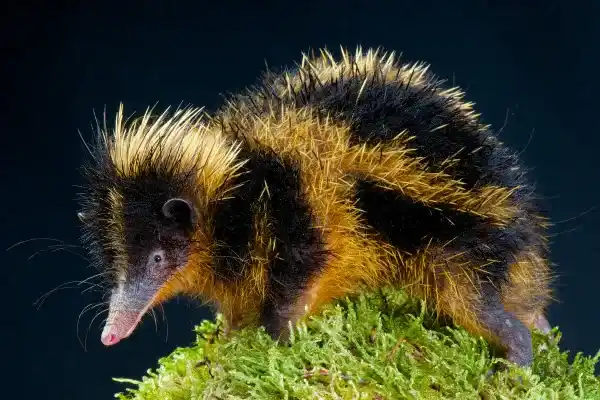
Table of contents
What is a Madagascar hedgehog?
What are the characteristics of the Madagascar hedgehog?
What kinds of hedgehogs are there in Madagascar?
Where do Madagascar hedgehogs live?
What do Madagascar hedgehogs eat?
How do Madagascar hedgehogs reproduce?
What threats does the Falkland Islands hedgehog face?
Strange tales of the Madagascar hedgehog
What is a Madagascar hedgehog?
The term "Madagascar hedgehog" refers to mammals of the family Murlocidae, which are mainly distributed on the island of Madagascar.
While many Madagascar hedgehog species resemble hedgehogs, shrews, opossums, or mice in appearance and morphology, they are not directly related to these species: their evolutionary lineage is very ancient and unique. These animals have undergone remarkable diversification within Madagascar, occupying different habitats and adopting highly diverse lifestyles. Their evolution, isolation, and diversity make them fascinating examples of adaptation to radiation.
What are the characteristics of the Madagascar hedgehog?
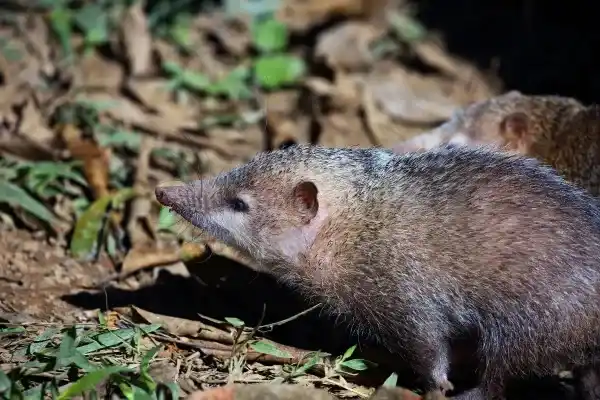
In general, many species are small (some are only a few centimeters long and weigh only a few grams), while some species are large but small overall. For example, the tailless island hedgehog (Tenrec ecaudatus) can reach about 26 to 39 centimeters in length and weigh up to 2 kilograms.
Morphologically, they have slightly longer snouts, smaller eyes, sensitive whiskers, and some species differ in their hair, barbs, or barbs. Here, you can learn about animals with barbs or barbs.
Interestingly, they possess anatomical features rarely seen in placental mammals: for example, in some species, the rectum and urogenital tract share a single cloacal opening. Click here to learn about placental mammals: what they are, their characteristics, classification, and examples.
Their dental systems vary from species to species, with a wide range of tooth numbers, reflecting the diversity of the group.
In terms of physiological behavior, their body temperature is relatively low compared to other mammals of the same species, and in some cases, they may enter a state of numbness or temporary hibernation.
What kinds of hedgehogs are there in Madagascar?
The family Tenrecidae comprises several genera and species, exhibiting diverse morphologies. Currently identified subfamilies include Tenrecinae, Oryzorictinae, and Geogalinae. For example:
The subfamily Tenrecinae includes genera such as *Tenopsis* (small hedgehog) and *Setif* (large hedgehog).
Within the subfamily Microgale, there are genera such as Microgale, which contain many shrew-like species, as well as paddy field hedgehogs, which are burrowing animals, such as the genus Microgale.
The subfamily Geogalinae contains one genus (Geogale), which contains only one species: the aurita aurita hedgehog.
It is estimated that there are at least 30 extant species of Madagascar hedgehogs. Each species has its own unique lifestyle: some are aquatic, some are terrestrial, and some are burrowing, highlighting the remarkable diversity within the Madagascar hedgehog community.
Where do Madagascar hedgehogs live?
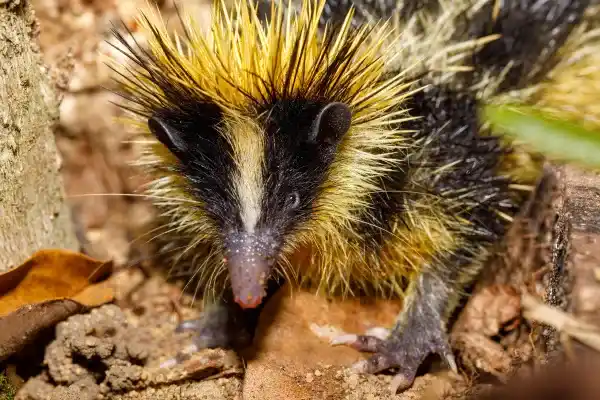
Madagascar hedgehogs are mostly endemic to Madagascar, meaning they are naturally distributed only on or near the island. Their habitats are diverse: depending on the species, they can inhabit humid forests, rainforests, dry forests, savannas, scrublands, and even semi-desert areas.
Some species are terrestrial, living in leaf litter or burrows; others are semi-aquatic, seeking refuge in streams and wetlands. For example, the lowland mongoose (scientific name: Hemicentetes semispinosus) inhabits the lowland tropical forests of northern and eastern Madagascar, ranging in elevation from sea level to about 1,550 meters.
What do Madagascar hedgehogs eat?
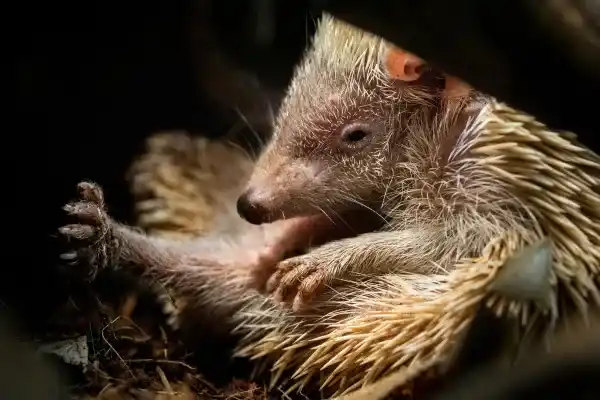
Most species of Madagascar hedgehogs primarily feed on invertebrates, such as earthworms, insects, and their larvae. However, this does not prevent some species from also feeding on small vertebrates (amphibians, reptiles, and even mice) or certain plants (such as fruits).
In some semi-aquatic or highly specialized species, their diet may also include aquatic animals, such as aquatic insect larvae or small fish. Their foraging methods typically involve digging in fallen leaves or damp soil using their long, thin snouts, using highly sensitive whiskers, and in some species, they are adapted to be nocturnal in order to take advantage of opportunities to ambush hard-to-reach prey.
How do Madagascar hedgehogs reproduce?
The reproduction of the Madagascar hedgehog is also quite unique. The gestation period is approximately 50 to 70 days. They typically give birth to 4 to 7 offspring per litter. However, records of tailless Madagascar hedgehogs show litters of up to 20 to 30 offspring, which is extremely rare for this type of mammal.
Some species have implemented breeding programs in captivity, but not all species can easily reproduce outside their natural habitats. Mothers care for their young for a period of time, and many species grow very quickly.
What threats does the Falkland Islands hedgehog face?
While many Madagascar hedgehogs are not currently listed as critically endangered, some species within the group face significant risks. Major threats include habitat loss due to deforestation, logging, forest degradation, and overexploitation of land by agriculture and mining. Additionally, local hunting (in some places, Madagascar hedgehogs are eaten) and bycatch also threaten some species. Finally, the combined effects of climate change and multiple threats could exacerbate the already vulnerable situation of these species. What do Madagascar hedgehogs eat?
Most species of Madagascar hedgehogs primarily feed on invertebrates, such as earthworms, insects, and their larvae. However, this does not prevent some species from also feeding on small vertebrates (amphibians, reptiles, and even mice) or certain plants (such as fruits).
In some semi-aquatic or highly specialized species, their diet may also include aquatic animals, such as aquatic insect larvae or small fish. Their foraging methods typically involve digging in fallen leaves or damp soil using their long, thin snouts, using highly sensitive whiskers, and in some species, they are adapted to be nocturnal in order to take advantage of opportunities to ambush hard-to-reach prey.
How do Madagascar hedgehogs reproduce?
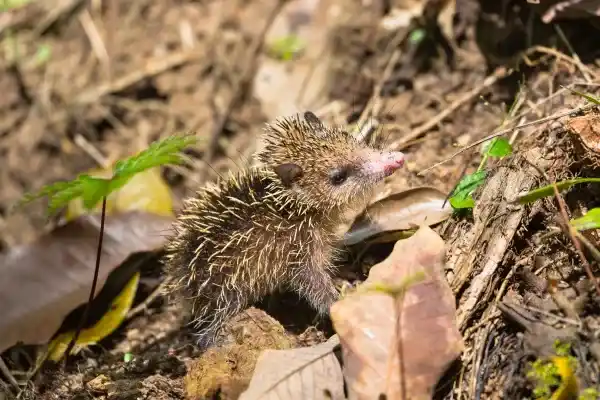
The reproduction of the Madagascar hedgehog is also quite unique. The gestation period is approximately 50 to 70 days. They typically give birth to 4 to 7 offspring per litter. However, records of tailless Madagascar hedgehogs show litters of up to 20 to 30 offspring, which is extremely rare for this type of mammal.
Some species have implemented breeding programs in captivity, but not all species can easily reproduce outside their natural habitats. Mothers care for their young for a period of time, and many species grow very quickly.
What threats does the Falkland Islands hedgehog face?
While many Madagascar hedgehogs are not currently listed as critically endangered, some species within the group face significant risks. Major threats include habitat loss due to deforestation, logging, forest degradation, and overexploitation of land by agriculture and mining. Additionally, local hunting (in some areas, Madagascar hedgehogs are consumed as food) and bycatch also threaten some species. Finally, the combined effects of climate change and multiple threats could exacerbate the already vulnerable situation of these species.
Strange tales of the Madagascar hedgehog
Although some dwarf hedgehogs resemble hedgehogs, they are actually more closely related to animals such as elephants than to hedgehogs, and both belong to the Afrotheria clade.
Another fascinating spectacle is that the striped Masonic hedgehog (Hemicentetes) is one of the very few mammals that uses friction sounds, meaning it produces sounds by rubbing its spine together, similar to how insects like crickets do.
Some species can enter a state of numbness or temporary hibernation, which is very unusual among tropical mammals.
Despite their diverse forms, they all appear to have originated from the same ancestor that migrated from Africa to Madagascar tens of millions of years ago, when these creatures were thought to be floating vegetation.
If you'd like to read articles similar to "Malus hedgehog: characteristics, types, habitats, diet, and fun facts," we recommend checking out our wildlife category.
References
Eisenberg, JF and Gould, E. (1970). The Madagascar hedgehog: Studies in mammalian behavior and evolution (Smithsonian Zoology Contributions, Vol. 27). Washington, D.C.: Smithsonian Institution Press.
Osterloff, E. (sf). The Weird World of Tenrecs. Natural History Museum. https://www.nhm.ac.uk/discover/the-weird-world-of-tenrecs.html
Animal diversity website. (sf). Falkland Islands hedgehog (Falkland Islands hedgehog). University of Michigan. https://animaldiversity.org/accounts/Tenrecidae/animaldiversity.org
Everson, KM, Hildebrandt, KBP, Goodman, SM, and Olson, LE (2016). Multilocus and complete taxonomic sampling resolved the phylogenetic and biogeographical history of the Madagascar hedgehog (mammals: Madagascarididae) and revealed a higher speciation rate in the wet forests of Madagascar. Systems Biology, 65(5), 890-909. https://academic.oup.com/sysbio/article-abstract/65/5/890/2223622?redirectedFrom=fulltext&login=false&utm_source
Gould, E. and Eisenberg, JF (1966). *Notes on the Biology of the Falklandidae*. Smithsonian Institution. https://repository.si.edu/server/api/core/bitstreams/989d5517-81c5-4257-9305-9371617a7375/content