In the animal kingdom, body structures vary greatly: some have an endoskeleton of bone or cartilage, while others are supported by an exoskeleton; some have four legs, while others have six, eight, or even dozens; some use bright colors to warn of "poison," while others rely on camouflage to hide themselves. "Carapace/shell" is one of many morphological adaptations—it serves both as protection and as an aid for movement.
When talking about "shells," many people first think of turtles, but turtles are not the only animals that actually have "shells"; the materials, locations, and formation methods of shells are completely different in different groups.
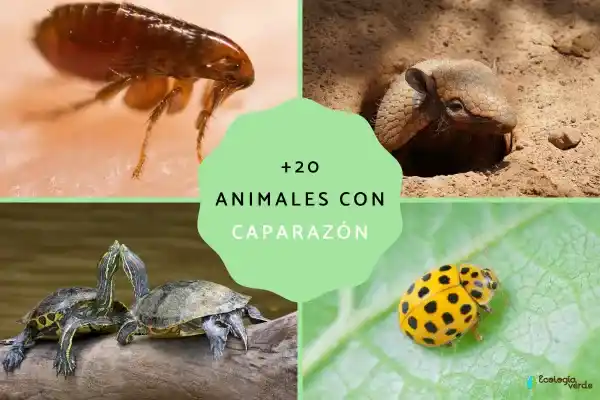
Table of contents
What is a "shell/outer shell"? What types are there?
The shell of turtles (carapace + plastron)
The "shell" of mollusks (Gastropoda/Bivalvia/Cephalopoda)
The "shell" (exoskeleton) of crustaceans.
Other common shelled animals (brief overview by taxonomic group)
What is a "shell/outer shell"? What types are there?
In a broad sense, "shell" refers to the hard structure that provides support and protection for the body . It can be part of the endoskeleton (such as the shell of a tortoise connected to the spine and ribs) or the exoskeleton covering the body surface (such as in crustaceans and insects). Key points regarding common materials and terminology:
Endoskeletal "shell" : originates from the skeleton itself and is firmly fused with the vertebrae and ribs (typical example: turtles).
Exoskeleton-like "shell" : composed of chitin/chitin and protein secreted by the epidermis, often hardened by calcification (typical examples: crustaceans such as crabs and shrimp; insects, etc.).
"Concha" : Commonly found in mollusks , formed by the layered deposition of calcium carbonate (calcite/aragonite) secreted by the mantle , often with a nacreous layer (such as conch, clam, oyster, nautilus).
Functions : mechanical protection, muscle attachment and leverage, reduction of water loss, hydrodynamic optimization (swimming/drilling), mineral storage, etc.
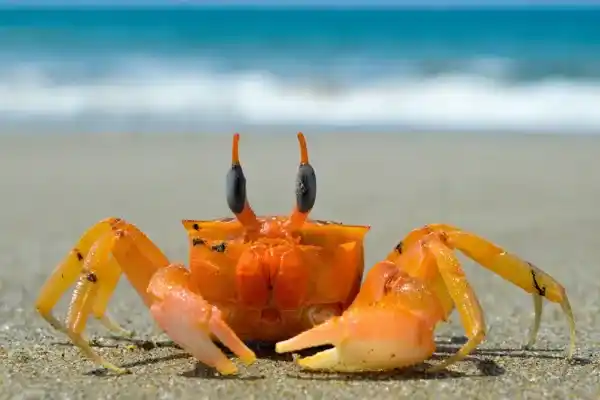
Tip: In Chinese, the hard shells of different groups are often all called "shell". Strictly speaking, turtles are called " carapace /plastron", mollusks are called " shell ", and the hard plate on the back of the cephalothorax of crustaceans is also called carapace .
The shell of turtles: carapace + plastron ( Testudines )
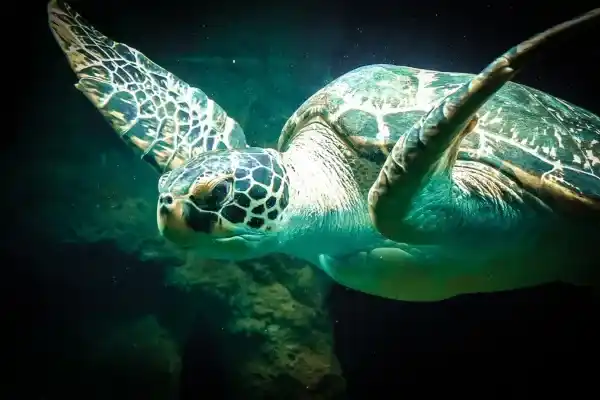
The turtle's shell is a unique endoskeleton among vertebrates, consisting of three parts:
The carapace and plastron are connected by a " bridge ". Its skeleton originates from the fusion of the everted ribs and vertebrae , and is covered with a layer of keratin scutes (the "shell" pattern we see). The shell does not fall off and heals slowly after injury.
Tortoises : Their shells are often high and domed , making them difficult to overturn or bite into (e.g., Mediterranean tortoise Testudo hermanni ).
Aquatic/sea turtles : Flatter, more streamlined shells reduce drag and facilitate high-speed swimming (e.g., loggerhead sea turtle Caretta , Florida painted turtle Trachemys scripta elegans ).
Additional features :
Thermoregulation (heat absorption from sunbathing/heat dissipation from water) and mineral storage (calcium).
Most species can retract their head, neck, and limbs into their shell; some species have foldable plastrons for reinforcement.
The "shell" of a mollusk ( Mollusca )
Mollusks have soft bodies and rely on their mantle to continuously secrete layers of calcium carbonate to build shells , which protect them from physical damage and resist the erosion of their soft bodies by acidic environments . Representative groups:
1) Gastropoda (snails/conch)
They have a single, spiral-shaped shell , with most species having the opening facing to the right; they are found in terrestrial, freshwater, and marine environments.
Typical: garden snails, conchs, etc.
Diverse life forms: herbivorous, detritivorous, predatory, burrowing, etc.
2) Bivalvia (clams/oysters/mussels)
The two symmetrical shell flaps open and close like hinges, connected by ligaments and the adductor muscle .
Most are filter feeders , making them important "purifiers" of water bodies.
Typical examples include mussels ( Mytiloida ), oysters ( Ostreoida ), and clams ( Veneroida ). Pearls are formed by the gradual formation of the nacreous layer within the shell.
3) Cephalopoda (such as nautilus)
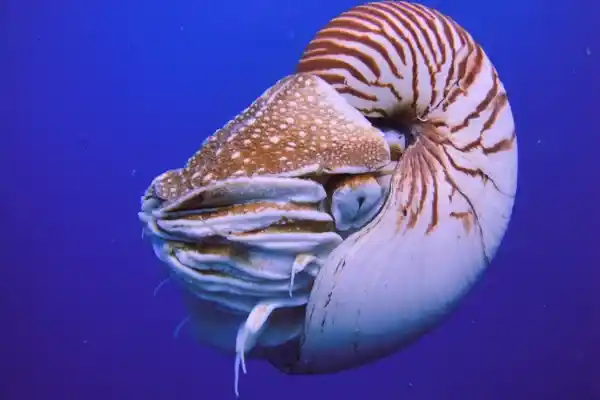
The nautilus retains its shell , which is a flat spiral divided into chambers (for buoyancy adjustment).
Octopuses, squid, and other species often have shells that have degenerated into internal shells (such as cuttlefish bones) in exchange for the ability to propel themselves nimbly and hunt.
The "shell" of crustaceans (the exoskeleton of a Crustacea )
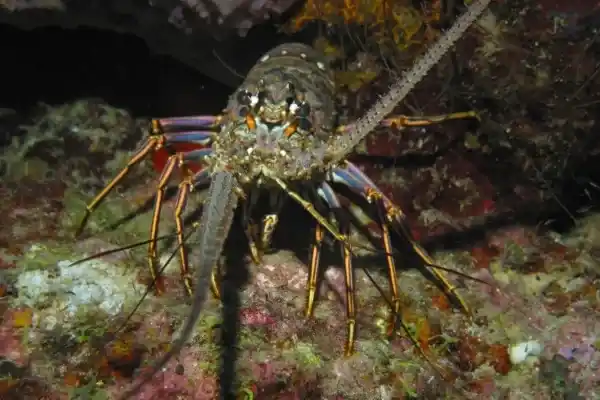
Crustaceans belong to arthropods, and their exoskeleton is mainly made of chitin , often calcified to increase its hardness; the dorsal side of the cephalothorax forms the carapace .
Because the exoskeleton cannot grow with the body, crustaceans must molt regularly, during which they are more vulnerable.
Common examples:
Crabs (many species in the Crabidae family)
Prawns/Tiger prawns and related groups
Norwegian lobster/white shrimp with a crested tail (commonly known as " cigra ")
Lobster/Claw Crayfish
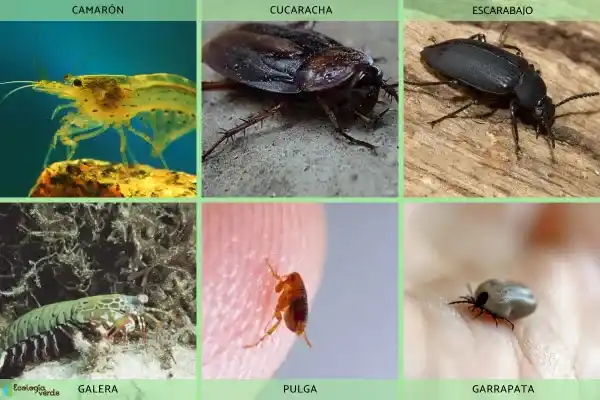
Mantis shrimp (order Stomatopoda, commonly known as "shrimp shrimp", called galera in the Mediterranean) : highly predatory, with chelipeds evolved into "boxes/spears", and a thick carapace.
Key features : The exoskeleton serves as both "armor" and a lever for muscle attachment and movement; it also reduces water loss and enhances resistance to predation.
Other common "shelled/armored" animals (expanded explanations based on the original list)
The shells/shells listed below vary in material and origin—some are bony plates or keratinous scales , some are chitinous exoskeletons , and others are calcium carbonate shells or echinoderms . The major category is indicated in parentheses for quick reference.
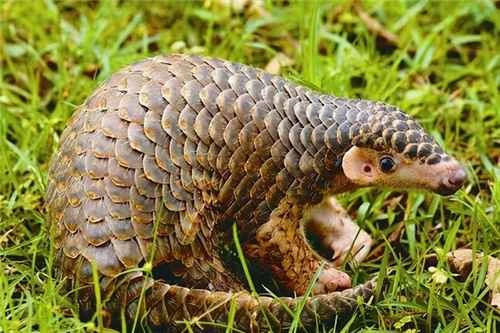
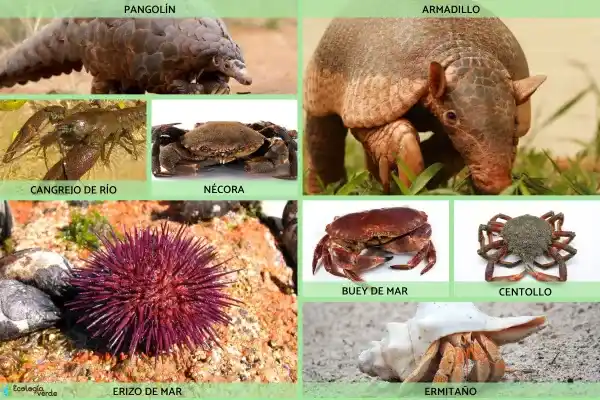
Pangolins (mammals) are covered in keratinous scales . When in danger, they can curl up into a ball. Although it is not a "shell", it has excellent armor .
Armadillos (mammals) – covered with bony skin plates and keratin, which allow them to curl up and protect their ventral side.
Freshwater crayfish (crustaceans) – typically have a chitinous exoskeleton and carapace.
Velvet crab ( nécora ) – small in size, highly mobile, with a hard carapace.
Sea urchins (echinoderms) have a unique chewing apparatus consisting of a calcareous shell (bone plate) and movable spines, and an "Ausch's jaw".
Brown crab ( Buey de Mar ) – with a thick carapace and powerful claws.
Spider crab centollo (crustacean) – with long legs and a carapace often covered with seaweed for camouflage.
Hermit crabs (crustaceans) have soft abdomens and use their shells as "replaceable shields".
Prawns (crustaceans) – with a lightweight exoskeleton and carapace, they are excellent swimmers.
Cockroaches (insects) – chitinous exoskeleton, with leathery forewings for protection.
Beetles (including ladybugs) (insects) - the forewings harden into elytra , protecting the flight wings and back (ladybugs are also beetles).
Fleas (insects) – tough exoskeleton + bouncy hind legs; flat body facilitates parasitism between the hairs of the host.
Ticks (Arachnida) have a tough cuticle and mouthparts adapted for blood-sucking parasitism.
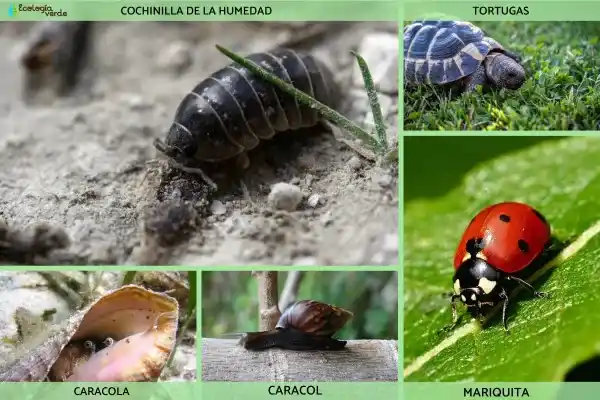
Woodlice/ cochinilla (Isopoda, crustaceans) – Terrestrial crustaceans that can curl into a ball (coiled woodlice).
Turtles (reptiles) – an internal skeletal shell consisting of a carapace and a plastron (see above).
Caracola ( molluscs) – Calcium carbonate shell , with diverse shapes.
Snails (molluscs) – terrestrial animals with a single spiral shell.
Ladybugs (insects) – a type of beetle with hard elytra and colorful spots that serve as a warning.
summary
The "shell" is not a single structure: a turtle's shell is part of its skeleton, a molluskaloid shell is made of calcium carbonate , and the "shell" of crustaceans/insects is a chitinous exoskeleton .
Together, they undertake the tasks of protection, support, and functional optimization (swimming, sand burrowing, water conservation, and resistance to predation), demonstrating the diverse adaptations of life to different environments.
References
Ponder & Lindberg (1997). Phylogeny of gastropod mollusks: a morphological analysis. Journal of the Linnean Society for Zoology, 119: 83-101.
S. Gordillo (1995). Southern Mollusks: An Illustrated Guide. Zaguier and Urruty Publishing House, Buenos Aires. Page 115.
T. Hirasawa, H. Nagashima & S. Kuratani (2013). Origin of the endoskeleton of the tortoise carapace. Nature Communications, Vol. 4.