Around 230 million years ago, during the Late Triassic period, the first dinosaurs evolved from some kind of reptile. They were one of many new animal groups on land at that time. Meanwhile, other new life forms also conquered the skies and seas during that era.
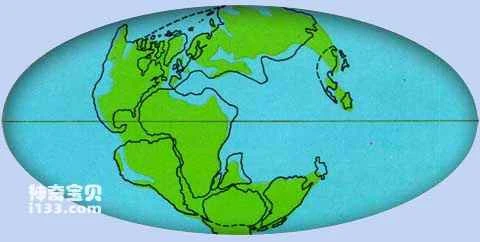
Earth in the Late Triassic period shows the supercontinent Pangaea.
At that time, slowly drifting landmasses on Earth coalesced along the equator to form a supercontinent called Pangaea by geologists. On Pangaea, the climate was warm throughout, gradually becoming drier. Conifers, cycads, and ferns flourished in areas with ample moisture. The grasses, flowering plants, and broad-leaved trees we know today hadn't even evolved yet.
The earliest dinosaurs were born in this kind of environment.
In northwestern Argentina lies a place called Valley of the Moon, where scientists have discovered many precious fossil skeletons of early dinosaurs and other large reptiles. While Valley of the Moon is now a barren desert, it was a warm, humid, and lush riverside area during the Late Triassic period, 230 million years ago.
As early as 50 years ago, scientists discovered a carnivorous dinosaur called Black-saurus here. However, it was only in the last decade or so, with the discovery of more fossil materials and the deepening of scientific research in the laboratory, that Black-saurus and many other animals discovered in this area began to be recognized by us.
For many years, fossilized skeletons of the Black-necked Dragon have been repeatedly discovered, but unfortunately, no skull fossils have been found. It's important to understand that for studying the origins and development of any animal, no skeletal fossil provides as many clues as a skull fossil.
One day in 1988, Dr. Serino, an American paleontologist who was exploring Luna Valley, discovered the first fossilized skull of a black scorpion while strolling through the desert. The skull was so well preserved that even the bone rings inside the eye sockets were intact.
The research in the laboratory was truly astonishing. The ossicles in the ears of the *Heliosaurus* suggest that this dinosaur may have possessed acute hearing; its long claws and jaws with sharp teeth indicate that it was a fearsome hunter and killer; its upright posture demonstrates that, for its time, the *Heliosaurus* was agile, nimble, and swift. The *Heliosaurus* could grow to 3 to 6 meters in length and weigh 360 to 450 kilograms, making it much larger than the largest modern land predators, such as lions and tigers.
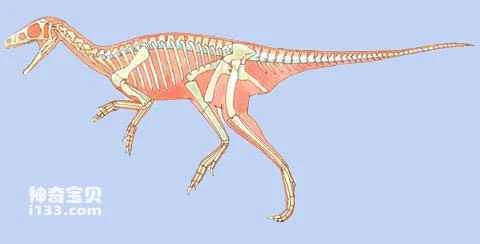
Eurasian skeleton
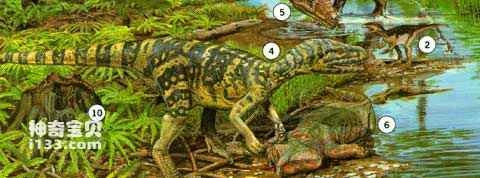
Black Ruilong
In 1993, Dr. Serino and his colleagues discovered a remarkably well-preserved, almost complete skeleton of a new dinosaur species during their second expedition to Luna Valley. They named it Eoraptor. Compared to Heliosaurus, Eoraptor was like a cat compared to a tiger, as it was only about 90 centimeters long, less than 1 meter, and weighed only 5 to 7 kilograms. Interestingly, on Eoraptor's upper and lower jaws, the hind teeth resembled grooved steak knives, similar to other carnivorous dinosaurs; however, the front teeth were leaf-shaped, similar to other herbivorous dinosaurs. This feature suggests that Eoraptor was likely both herbivorous and carnivorous.
Some characteristics of Eoraptor prove that it was one of the earliest dinosaurs to appear on Earth. For example, it had five "fingers," while the number of "fingers" of later carnivorous dinosaurs tended to decrease, with large carnivorous dinosaurs like Tyrannosaurus Rex only having two "fingers." Furthermore, Eoraptor had only three vertebrae supporting its small pelvic girdle, while later dinosaurs, as they grew larger, increased the number of vertebrae supporting their pelvic girdle.
However, Eoraptor also shares some characteristics with Blackaurus and various later carnivorous dinosaurs. For example, it lacks the additional connecting structure in the middle of its lower jaw found in some herbivorous dinosaurs. Also, its pubis is not particularly large.
The appearance of Eoraptor and Blackaurus in the Late Triassic period represents the dawn of the dinosaur era.