Carnivorous theropod dinosaurs also survived the devastation at the end of the Triassic period and further evolved in the Jurassic. The Silva, a theropod dinosaur that lived 200 million years ago and was discovered in Zimbabwe, was one such dominant species on Earth during the Early Jurassic.
The Paramecium was about 3 meters long and weighed less than 20 kilograms. Its appearance and features were similar to those of the Coelophysis found in the southwestern United States; it had a slender body, hollow bones, and long, crane-like legs. It possessed curved, sharp teeth and three-fingered, grasping hands. Its tailbone indicates that it also had a fairly long tail.
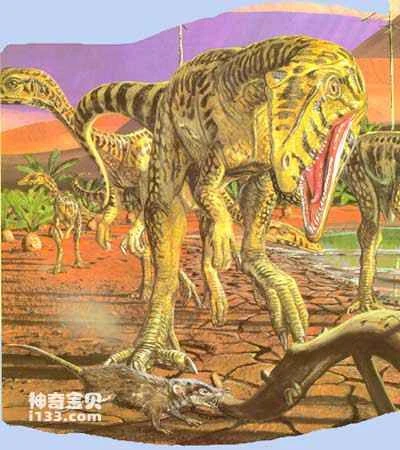
Paralleloid Dragon
Scientists have discovered fossilized skeletons of two types of adult synodontids in Zimbabwe, one type being about 15% larger and heavier than the other. Scientists therefore speculate that this indicates sexual dimorphism between male and female synodontids.
Compared to the later, gigantic carnivorous dinosaurs, the Paramecium seemed rather unassuming. However, in its era, few other animals could rival it. Yet, even this dominant predator, who always instilled fear in its neighbors, had its downfall. When unpredictable natural disasters struck, they too could not escape its clutches.
In 1972, paleontologist Dr. Mitchell was walking along an elephant trail towards a river in the Zambezi Valley. Suddenly, a scene before him sent chills down his spine. It was a pile of dinosaur bones, a result of a cataclysmic event 200 million years ago. Numerous skeletal remains of simian dinosaurs lay tragically scattered on the weathered ground, including complete skeletons of both adults and juveniles. These fossils, buried in fine sandstone, indicated that they had died on the dunes. Dr. Mitchell believed they had been drowned by a sudden flood.
Dr. Michel's reconstruction of the story takes place 200 million years ago. One day, as a large herd of conjoined dragons, young and old, were crossing a dusty plain, a sudden downpour brought a flash flood that swept through the mountains, quickly turning the plain into a vast swamp. The conjoined dragons swam frantically in the floodwaters, trying to escape the danger, but the flood was too fierce. Before they could find shelter, they were all drowned. Days later, when the flood receded, a layer of sand washed ashore covered the plain, burying the countless remains of conjoined dragons and other unfortunate creatures. Over the past 200 million years, minerals have seeped into the bones of these remains, fossilizing them and allowing scientists to study them.
These fossils are so well preserved that you can still see the grooves formed by blood vessels running through the body, as well as the traces of tendons attaching to the bones. Dr. Anusula-Chinsami, another scientist from South Africa, studied these fossils under a microscope, which greatly enriched our understanding of dinosaur growth, movement, energy utilization, and their death and fossilization processes.
The study of fossilized skeletons of *Syntopoda* and *Cynanchum* found at the same site has also provided new evidence for resolving a long-standing question that has intrigued scientists: were some dinosaurs warm-blooded (also known as endothermic animals)? Observations revealed that the skeletons of *Syntopoda* and *Cynanchum* have growth rings, similar to tree rings, which are often a hallmark of cold-blooded animals like reptiles.
What are the behavioral differences between warm-blooded and cold-blooded animals? Warm-blooded animals, like mammals and birds, have metabolic mechanisms to maintain a constant body temperature. They must also possess good endurance to sustain prolonged periods of rapid movement. Therefore, warm-blooded animals require large amounts of food to meet their energy needs. Cold-blooded animals regulate their body temperature through specific activities such as changing position in sunlight and shade. A cold-blooded dinosaur required relatively little energy.