In 1942, a large theropod dinosaur was discovered in the Early Jurassic strata of Arizona, USA. Because of a pair of thin V-shaped bony ridges on its head, scientists named it Diplodocus.
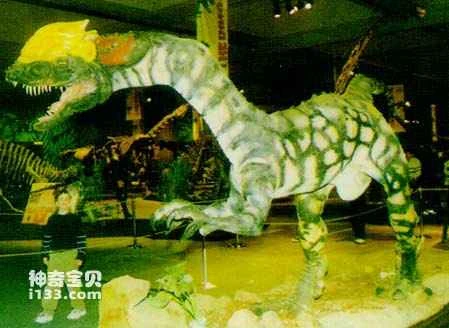
Diplodocus
Diplodocus had a robust body, a large skull, a well-developed jaw, and a wide mouth filled with teeth like sharp knives, with small serrations along the front and back edges. These features indicate that it could tear apart any prey it captured and then swallow large chunks of meat whole. Furthermore, Diplodocus had openings behind its eyes on its skull, which were used to better attach the muscles that moved the jawbone, suggesting that Diplodocus possessed an extremely powerful bite. Scientists speculate that Diplodocus may have been the most ferocious and brutal carnivore in the Early Jurassic ecosystem.
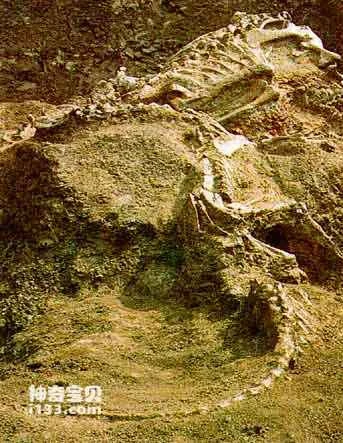
Diplodocus was buried with Archaeopod dinosaurs.
Diplodocus had powerful hind limbs with sharp claws on its feet, which it used to capture and tear apart prey. Around 200 million years ago, Diplodocus frequently roamed the highlands or jungles between rivers and lakes, hunting a variety of herbivores. They may have preferred to live a solitary life, sometimes hiding in inconspicuous places to ambush prey, and they may even have fed on the carcasses and rotting flesh of animals that died for various reasons, like modern hyenas.
Fossils of Diplodocus have also been discovered in Jinning County, Yunnan Province, my country.
In August 1987, the Kunming Municipal Museum's dinosaur excavation team unearthed a fossil of a Yunnanosaurus, a Paleopoda, in Xiyang Township, Jinning County, Yunnan Province. The news quickly spread, attracting people from all directions to see it. The local people were mostly Yi ethnic minority, and they had never heard of dinosaurs before. However, when they saw the fossils, some felt that the bone-shaped stones looked familiar. Some told the excavation team that they had seen similar stones on the hillside in Muganlang Village, Xiyang Township.
The excavation team followed the messenger to Muganlang Village, where, sure enough, a string of dinosaur vertebrae was exposed in a small gully. They decided to excavate there. A few days later, a shocking scene unfolded. There were two dinosaurs! And they were two complete dinosaur skeletons twisted together. One was an archaeopod, and the other was a carnivorous Diplodocus, its large jaws clamped onto the former's tail vertebrae. Based on this burial condition of the fossils, scientists speculated that the two dinosaurs might have died from two possible causes: one, they died in a life-or-death struggle; two, the archaeopod had been dead for several days, its flesh already decomposed, and the hungry theropod, only concerned with filling its stomach, unknowingly died from poisoning after eating the rotten flesh. Judging from their calm posture, the latter possibility seemed more likely.
The Diplodocus sinensis was the largest carnivorous dinosaur of the Early Jurassic period, nearly 4 meters long, with a long, pointed snout. It had a cleft at the front of its upper jaw, allowing the premaxilla to move. Scientists speculate that it primarily fed on the internal organs of other animals, as its pointed snout could penetrate the abdominal cavity of carcasses, and the two thin, plate-like crests on its head could support the cavity walls when its head was inside.
Diplodocus is also a member of the Tethys Ocean fauna, so the species found worldwide are largely similar. Their fossils have also been found in modern-day Antarctica, indicating that the now icy Antarctica was once a warm paradise for dinosaurs.