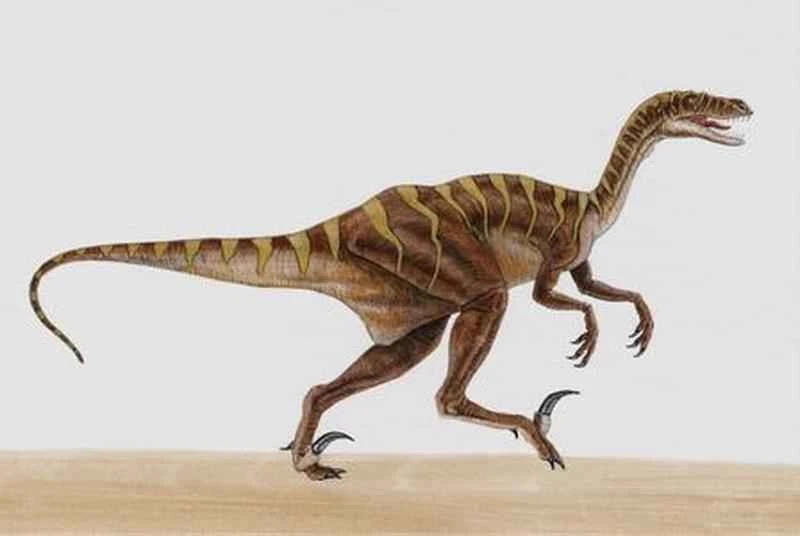
We say that Diplodocus was the ruler of the Early Jurassic because they were large carnivorous dinosaurs that roamed various continents, threatening other animals in every corner of the world at that time, including what is now the icy Antarctic. However, in Antarctica, Diplodocus's dominant position might have to be relinquished, because at that time, an even larger carnivorous dinosaur—Schorosaurus—also lived there.
Antarctica in the Early Jurassic period was not the frozen wasteland it is today. Back then, Antarctica was located further north on Earth, with a warm and humid climate.

Cool Dragon
Because dinosaur fossils have been found all over the world, scientists have long believed that dinosaurs must have lived in Antarctica. However, it wasn't until 1986 that scientists discovered fossil evidence of dinosaurs in Antarctica. These dinosaur fossils, now buried beneath ice-covered mountains, provide scientists with new clues to study the morphology and habits of carnivorous dinosaurs.
In the summer of 1991, American scientist Dr. Hammer and his colleagues, while conducting an expedition on Mount Kirkpatrick, 400 kilometers from the South Pole, discovered fossils of a gigantic carnivorous dinosaur previously unknown to the world. This carnivorous dinosaur had a distinctive crest on its head, somewhat resembling the beautiful crest of a peacock—how cool! However, this dinosaur's crest was not a feathered crest like a peacock's; rather, it was formed by bony protrusions. Scientists named this dinosaur after a Latin phrase meaning "cold-region crested dragon," which our museum's curator, Long Zi, translated as "Cool Dragon," taking both the "harsh" climate of the "cold region" and the "cool" aspect of its distinctive crest.
The Cruosaurus was 7.62 meters long and weighed approximately 680 kilograms. Two other carnivorous dinosaurs have also been discovered in Antarctica: one similar to the small Coelophysis that once lived in western North America, and the other belonging to the Diplodocus, the second largest carnivorous dinosaur of the Early Jurassic period. Measurements indicate that the Cruosaurus was 1.5 meters longer than the largest Diplodocus ever recorded.
Studies of Crocodiles and other carnivorous dinosaurs indicate that during the Jurassic period, carnivorous dinosaurs had already evolved towards larger sizes and more complex behaviors. The crests on Crocodiles and Dilophosaurus likely served to attract mates or compete with other males during mating. Like many modern animals, it's possible that only males possessed these crests. Of course, these crests could also have served to intimidate predators.
If the crest was indeed used for mating, then how did carnivorous dinosaurs like Coelophysis, which lacked a crest, conduct social behaviors similar to courtship? Scientists speculate that Coelophysis likely used skin color changes to attract mates. Other dinosaurs may have used vocalizations for social interaction.
How did scientists arrive at these inferences about the social behavior of dinosaurs? Actually, they based their conclusions on observations of many modern animals. Body shapes used solely as sexual displays are common in modern animals. For example, male deer possess large, complexly shaped antlers, which they display when they raise their heads and call to attract females.
As close relatives of dinosaurs, modern birds exhibit characteristics and behaviors related to color display. For example, when a male peacock wants to attract the attention of a female, it spreads and shakes its brightly colored tail feathers while leaping. The Chlorosaurus, on the other hand, likely resembled a blue finch, stretching its head forward to display its striking crest when vying for territory, declaring to its rival, "This is my territory!"
Many living reptiles also exhibit color-display behavior. Male and female lizards often look different, making it easy to distinguish their sexes during mating season. Typically, males are more colorful than females.
When Dr. Hammer discovered the Clow Dragon, he was reminded of the flamboyant hairstyle of a Rolling Stones singer named Elvis, so he jokingly called the Clow Dragon "Elvis Dragon".
At Kirkpatrick Mountain, Dr. Hammer and other scientists discovered an interesting phenomenon. They found teeth resembling those of a small carnivorous dinosaur, such as a Coelophysis, inside the fossilized bones of a Cruosaurus! A plausible explanation is that some smaller carnivorous dinosaurs broke some teeth while feeding on the dead Cruosaurus. Cruosaurus was one of the most formidable predators in its time, yet it could also have become prey for smaller predators. Could a 7-meter-long Cruosaurus really have been no match for a smaller Coelophysis? Scientists haven't yet found sufficient evidence to answer this question.
Are you interested in dinosaurs? If so, and if you're still a teenager, you have the opportunity to become a paleontologist and search for dinosaur fossil evidence to answer this question. Even if you already have a great other career, you can join the museum's dinosaur science expeditions during your vacations. You'll have the chance to search for and excavate fossils with dinosaur experts, and the fossils you discover might just solve some age-old mysteries.