The Indian giant squirrel (scientific name: *Ratufa indica*), also known as the Malabar giant squirrel, is a large arboreal squirrel endemic to India. Its enormous size, colorful fur, and unique ecological behaviors make it an important subject of biological and conservation ecology research. This article will provide a comprehensive overview of the Indian giant squirrel's scientific classification, morphological characteristics, habitat, daily activities, social behavior, diet, reproductive methods, conservation status, and cultural and economic value. By gaining a deeper understanding of this species, we can not only learn about its habits but also help raise public awareness of its conservation.
Scientific taxonomy of the Indian giant squirrel (Malabar giant squirrel)
The Indian giant squirrel, belonging to the order Rodentia and family Sciuridae, is scientifically named *Ratufa indica*. This species is a large, arboreal squirrel endemic to India, widely distributed in the Western Ghats, Eastern Ghats, and Satubula Mountains. Based on different physical characteristics and genetic variations, scientists have divided it into several subspecies:
Kingdom: Animalia
Phylum: Chordata
Class: Mammalia
Order: Rodentia
Family: Sciuridae
Genus: Ratufa
Species: Ratufa indica (giant Indian squirrel)
Subspecies:
R. i. indica: Found in the Western Ghats and central India, with a distinctive red tail.
R. i. centralis: mainly distributed in central and eastern India, small in size, with black shoulders and tail.
R. i. dealbata: Once distributed in southern and southwestern India, but may now be extinct due to habitat loss.
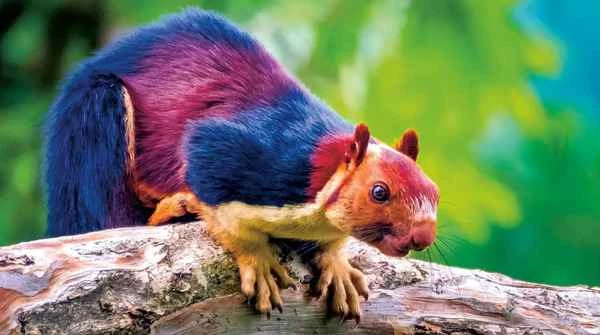
R. i. maxima: Found in the southern part of the Western Ghats, it is relatively large, with a tail that is almost entirely black and a distinct black area on its shoulders.
Zoological History of the Indian Giant Squirrel (Malabar Giant Squirrel): Historical Background of the Indian Giant Squirrel
The earliest descriptions of the Indian giant squirrel date back to the late 18th century . In 1777, the German zoologist Johann Erxleben formally recorded the species for the first time and named it Ratufa indica . " Ratufa " in the name belongs to the genus Ratufa and means "larger squirrel," while " indica " refers to its native habitat—India.
At this time, the Indian giant squirrel was not widely studied, and the academic community knew little about its ecological habits, lifestyle, and distribution range. It wasn't until the 19th century that more naturalists and zoologists began to describe it more systematically. By the late 19th century, the Indian giant squirrel had gradually attracted the interest of researchers. In 1897, the British naturalist Richard Blanford proposed a subspecies classification system for this species, describing differences in body size, fur color, and other characteristics across different regions, further revealing the diversity of this species.
In the early 20th century , as awareness of biodiversity and the ecological environment in India gradually increased, the Indian giant squirrel became one of the focal points of early conservation research. In particular, in 1913 , zoologist Ryley made a detailed record of its distribution in central India and put forward suggestions for habitat protection.
In the mid-20th century , with the acceleration of industrialization, the habitat of the Indian giant squirrel began to be severely threatened. Large-scale deforestation and habitat destruction led to a sharp reduction in the species' distribution range, especially in regions such as the Western Ghats of India, where forest area decreased significantly and the ecological environment was severely damaged.
During this period, the scientific community began to realize the enormous impact of habitat loss on species survival, and the ecological status and conservation needs of the Indian giant squirrel were increasingly recognized. Gradually, conservation efforts began to receive attention from governments and environmental organizations.
With the continuous advancement of molecular biology techniques, scientists have conducted in-depth research on the genome and population structure of the Indian giant squirrel, which has further deepened our understanding of its species classification. Genomic studies have revealed genetic differences between different subspecies, providing further scientific evidence for species conservation.
In recent years, rapid advancements in conservation biology have also spurred measures to protect the habitat of the Indian giant squirrel. For example, the establishment of numerous protected areas and national parks in southern and central India has strengthened the protection of this species' habitat. Furthermore, environmental organizations and research institutions are dedicated to conservation efforts including habitat restoration, anti-poaching, and public education.
Morphological characteristics and physical properties of the Indian giant squirrel (Malabar giant squirrel)
physical characteristics
The Indian giant squirrel is one of the largest squirrels in the world, with distinctive physical characteristics. Adults typically have a head and body length of 25–50 cm, with a tail approximately equal to or slightly longer than their body length, usually 25–55 cm. They weigh approximately 1.5–2 kg, with very few individuals reaching 3 kg.
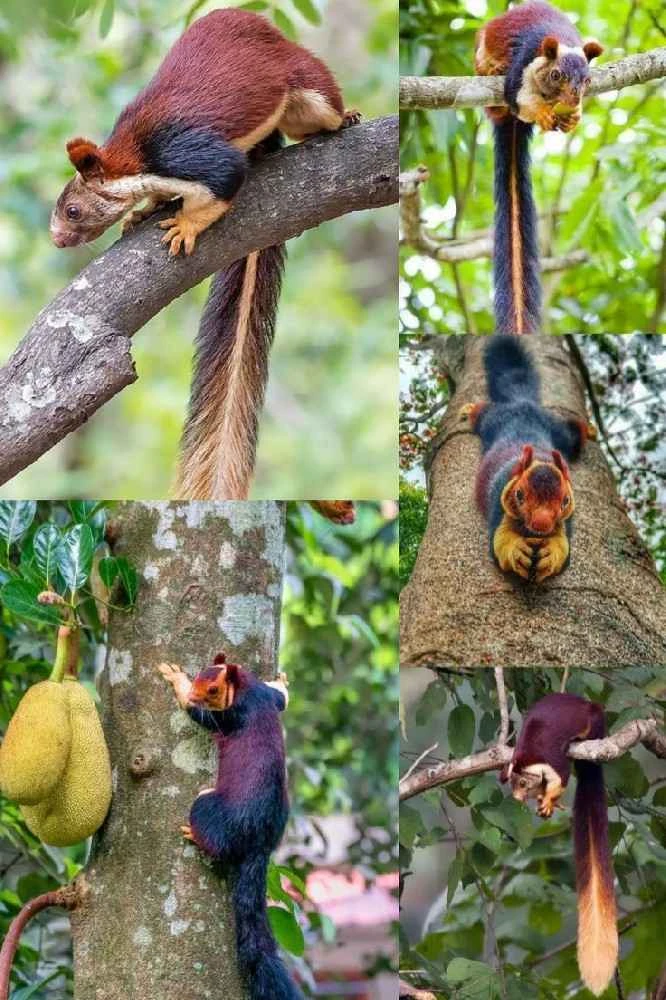
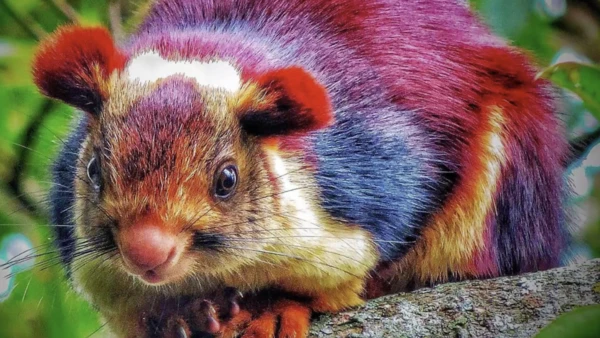
Its most striking feature is its colorful fur. The Indian giant squirrel's fur is multi-colored, ranging from red, orange, yellow, brown, and black, typically with light-colored spots on its belly and head. Different subspecies have different fur color characteristics; for example, *R. i. maxima* usually has a completely black tail, while *R. i. indica* has a light-colored tip on its tail.
Body shape and weight
The Indian giant squirrel is quite large, much larger than other squirrel species. Its average weight is between 1.7 and 1.8 kilograms, while larger individuals can reach 2.5 kilograms or even more. Its tail is often equal to or slightly longer than its body length, serving for balance and navigation, helping the squirrel move quickly between trees.
life
In the wild, the Indian giant squirrel has a lifespan of approximately 6 to 10 years, but its actual lifespan may be affected by habitat changes and predation pressure. In protected environments without human interference, this species can live even longer.
Global distribution and habitat of the Indian giant squirrel (Malabar giant squirrel)
Distribution area
The Indian giant squirrel is mainly distributed in the Western Ghats, Eastern Ghats, and Satubula Ranges of India, covering a wide range. It can be found in mountainous areas at altitudes ranging from approximately 180 meters to 2300 meters (590 feet to 7550 feet). These areas are mostly characterized by tropical monsoon climates and humid evergreen forests, ideal for the Indian giant squirrel's survival.
Habitat
Indian giant squirrels prefer to inhabit tall, dense trees, typically in the upper canopy of forests. They have high habitat requirements, needing ample branches and leaves to build nests. Indian giant squirrels generally choose trees 11 meters and above to avoid ground predators and habitat destruction. Because their habitat is highly sensitive to environmental quality, habitat degradation leads to a decline in their population.
Ecology and Behavior of the Indian Giant Squirrel (Malabar Giant Squirrel)
Daily activities and social behavior
The Indian giant squirrel is a diurnal arboreal animal, primarily active at dawn and dusk, and often resting in its nest during midday. Their activity is generally confined to the treetops, rarely venturing to the ground. They are remarkably strong jumpers, capable of leaping up to 6 meters between trees.
These squirrels are solitary animals and typically do not live in groups except during the breeding season. They find food and habitat by leaping and moving through the forest canopy. When threatened, Indian giant squirrels often remain motionless, even pressing their bodies against tree trunks, a behavior that helps them evade predators.
Diet and foraging strategies
Indian giant squirrels are omnivorous , their diet consisting of various plant seeds, nuts, fruits, leaves, and flowers, and occasionally insects and bird eggs. Unlike ground squirrels, Indian giant squirrels do not store food underground; instead, they store it in concealed locations high in the trees . They typically choose to build "food warehouses" on tree trunks or in narrower branches, hiding food under bark or in piles of leaves. This prevents food from being stolen by other animals and utilizes the depth of the forest to avoid predators on the ground.
Indian giant squirrels are incredibly agile when foraging, capable of leaping several meters from tree to tree. Their tails provide excellent balance, helping them maintain stability. They are most active in the morning and evening, especially at dawn when they actively leap and search for food.
Indian giant squirrel (Malabar giant squirrel) breeding
1. Breeding season and breeding cycle
The breeding cycle of the Indian giant squirrel is influenced by seasonal variations. They typically breed during specific seasons, especially when food resources are abundant in their habitat. According to research, the breeding season for Indian giant squirrels usually concentrates in March, April, September, and December each year , which are the months when local fruits and seeds are most plentiful.
Although Indian giant squirrels can breed year-round when habitat conditions are suitable, generally speaking, the more fixed breeding peaks occur in spring and autumn, which are suitable for the growth and development of the young.
2. Mate selection and courtship behavior
Indian giant squirrels exhibit distinct courtship behaviors during the breeding season, with males in particular using specific behaviors and calls to attract females. Male squirrels display their size advantage, tail wagging, and leaping skills between branches, behaviors that serve both to attract females and to demonstrate their territory to other males.
During courtship, males may exhibit significant aggressive behaviors , such as chasing, threatening, or fighting other competing males. These behaviors help ensure that the mate selects the superior genes and reduce the encroachment of competing males on resources.
3. Mating and Pregnancy
Mating typically occurs when a female accepts a male's courtship, and this behavior usually takes place high in the tree canopy, which helps avoid predators on the ground. After mating, the female Indian giant squirrel enters a gestation period. The gestation period for a female is typically 30 to 40 days , a length similar to that of other squirrel species.
4. Birth and early growth of cubs
After gestation, the female Indian giant squirrel builds a nest in a tree, usually choosing a high and secluded location to ensure the safety of her young. The nest is constructed by the squirrel using materials such as twigs, leaves, and vines, and its structure is typically spherical to protect it from wind, rain, and predators.
The number of offspring born at one time is usually one to three , but there are records of females giving birth to more in years with abundant resources. Newborn offspring weigh approximately 74.5 grams and are about 27.3 centimeters long. They have sparse fur, closed eyes, and rely on their mother's care and nursing. In the first few weeks after birth, the offspring will depend entirely on their mother's milk for growth and gradually develop strong jumping abilities.
5. Cub growth and independence
As time goes by, the young will gradually mature. Usually, around 6 to 8 weeks after birth, the young will begin to try eating solid foods, such as fruits, seeds, and leaves. The mother will help them through the early stages of growth by providing them with food.
Between approximately 6 months and 1 year of age , the young learn to forage and inhabit independently and begin to live independently. Around one year old, the Indian giant squirrel reaches sexual maturity and can begin to participate in courtship and reproduction activities. Males and females grow at roughly the same rate, but males usually reach sexual maturity earlier than females.
6. Parent-child behavior during the breeding season
Maternal behavior is an important part of the breeding process of the Indian giant squirrel. Females are extremely attentive to the protection and care of their young, and in the early stages after birth, mothers will do everything in their power to protect the nest from predators. Mothers also regularly provide food for their young and help them gradually learn how to jump in trees and find food.
In the social structure of the Indian giant squirrel, typically only females and their young live together, while males usually live alone or with other males. Males leave after mating with females during the breeding season and do not directly participate in the rearing process.
7. The impact of reproduction on populations
The reproductive strategies of the Indian giant squirrel are closely related to habitat quality. In stable habitats with abundant food, reproductive success rates and offspring survival rates are higher. However, factors such as habitat destruction, deforestation, and climate change can deteriorate reproductive conditions, impacting the species' reproductive capacity and offspring survival rates.
Conservation Status and Threats of the Indian Giant Squirrel (Malabar Giant Squirrel)
Protection level: Low risk
According to the assessment of the International Union for Conservation of Nature (IUCN), the Indian giant squirrel is listed as a species of Least Concern. Currently, their population is relatively stable, but habitat degradation and fragmentation pose potential threats to this species.
Major threats and natural enemies
Habitat loss: The habitat of the Indian giant squirrel is rapidly decreasing due to factors such as deforestation, agricultural expansion and urbanization.
Habitat fragmentation: Habitat fragmentation leads to the isolation of squirrel populations, reduces genetic diversity, and increases the risk of species extinction.
Predators: The main predators include birds of prey (such as owls) and large cats (such as leopards).
Protective measures
The Indian government and major environmental organizations have taken some protective measures:
Establishment of protected areas: The habitat of India's giant squirrel has been incorporated into several national parks and protected areas, such as Hazu National Park in Assam and Nagor National Park in Karnataka.
Strengthen habitat restoration: Provide more habitat space through afforestation and restoration of damaged forest ecosystems.
Anti-poaching and environmental protection policies: Strengthen the management of forest resources and reduce illegal hunting and habitat destruction.
In the 21st century, the conservation of the Indian giant squirrel has entered a more systematic and refined phase. According to the International Union for Conservation of Nature (IUCN), it is currently listed as a Least Concern species . Although its population is stable, it still faces threats such as habitat loss and climate change. Therefore, major environmental organizations and academic institutions have strengthened the protection and restoration of its habitat, promoting more stringent conservation measures.
Scientists have further understood the role of the Indian giant squirrel in forest ecosystems through ecological studies . Its role in promoting forest regeneration through behaviors such as seed dispersal makes it not only ecologically significant but also a symbol of global biodiversity conservation.
Ecological Value and Cultural and Economic Impact of the Indian Giant Squirrel (Malabar Giant Squirrel)
Ecological value
The Indian giant squirrel plays a vital role in its habitat. As a herbivore, it helps disperse plant seeds and fruits, promoting forest reproduction and diversity. Its habitat behavior also helps maintain nutrient cycling and interspecies balance within the ecosystem.
Cultural and economic value
In India, the giant squirrel is not only an important subject of study for ecologists, but it is also considered part of nature conservation and cultural heritage. For example, it was selected as the state animal of Maharashtra in southwestern India. Furthermore, as a representative species for ecotourism, the giant squirrel has boosted the local ecotourism industry and become a popular target for wildlife observation and photography enthusiasts.
Conclusion: The future and conservation of the Indian giant squirrel
Although the Indian giant squirrel is currently listed as a species of least concern, habitat destruction, fragmentation, and predation threats continue to threaten its population. To ensure the long-term survival of this species, it is essential to strengthen habitat protection, combat illegal hunting, and promote ecological restoration and species conservation efforts. Through scientific research and public education, we can create a safer future for the Indian giant squirrel and protect this precious ecological resource.