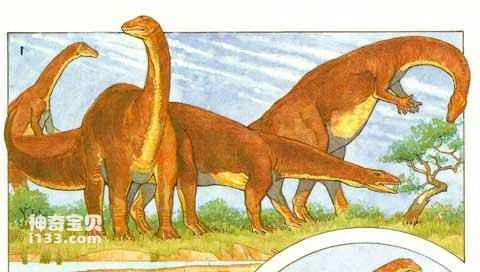
Less than 15 million years after the earliest dinosaurs—those small carnivores—herbivorous dinosaurs began appearing 215 million years ago in the fern forests and evergreen thickets along riverbanks and lakeshores. Geologically still in the Late Triassic period, these herbivorous dinosaurs had already grown quite large, becoming the largest animals in the world at that time. However, in the following 100 million years, these herbivorous dinosaurs would grow even larger.
Banlong
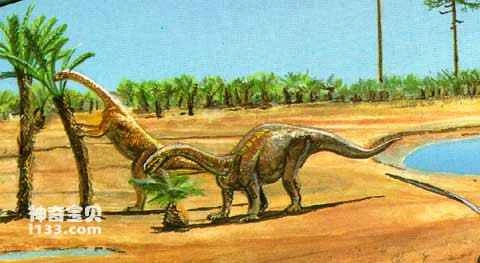
Plateosaurus used its forelimbs to climb trees and eat leaves from high trees.
Plateosaurus is the most important representative of these earliest herbivorous dinosaurs. This dinosaur could reach 6 to 8 meters in length and weigh 1 to 2 tons. They belonged to the Paleopoda.
Plateosaurus had a sturdy skull, but it appeared small compared to its enormous body. Correspondingly, its beak was also small, meaning its upper and lower jaws were quite small. Its jaws were covered with numerous small, leaf-shaped teeth, flat and serrated at the edges. These teeth were well-suited for tearing plants, but clearly ineffective at chewing plant matter. So how did they digest enough food to meet the nutritional and energy needs of such a large body? Like many herbivorous birds, they relied on their crop. Plateosaurus's crop was quite large, larger than a basketball. Moreover, the crop contained gastroliths, which easily ground up swallowed hard plants.
Dozens of fossil skeletons of dinosaurs, almost all of them Plateosaurus, have been unearthed in Late Triassic strata at numerous quarries in Central Europe. Many of these Plateosaurus fossils have perfectly preserved femurs, often standing upright within the rock strata. This unusual posture suggests that these dinosaurs died standing, and maintained this posture even after death. Something seems to have kept them from falling. Perhaps they were trapped and stuck in this position by silt that later transformed into mudstone.
Plateosaurus had longer and stronger hind legs than forelimbs, so scientists speculate that they relied on their hind legs to support their bodies, which could weigh up to 2 tons, and to walk. The weight of their head and forelimbs was balanced by their heavy tails, while their large and heavy stomachs were located almost at the center of their bodies.
The forelimbs of Plateosaurus may have served several purposes. The robust forepaws had a thumb and four other regular fingers, with a large, pointed claw on the thumb. Some scientists believe this large claw on the thumb was used for defense, while others think it was used to grasp food from trees or bushes. Perhaps it served both purposes.
However, compared to carnivorous dinosaurs, Plateosaurus's forelimbs appeared much more robust. Therefore, some scientists speculate that Plateosaurus had begun to move towards quadrupedal locomotion. However, when they needed to reach the leaves on higher trees, they could use their hind legs to support themselves on the ground while using their forelimbs to climb the tree trunk to reach the higher leaves.
Because Plateosaurus skeletons are often found in groups, many scientists speculate that this animal lived in small groups, like modern hippos and elephants.