The largest lizard on Earth is the Komodo dragon . The Komodo dragon, scientifically known as *Varanus komodoensis* (Ouwens, 1912), is an animal belonging to the genus *Varanus* in the family Varanidae. Also known as the Komodo monitor, it is the largest known living lizard species. Komodo dragons are ferocious; adults can eat their own juveniles and sometimes other adults. They are capable of rapid movement and occasionally attack humans; however, they primarily feed on carrion, venturing out of their burrows to hunt for food at locations several kilometers away each day.
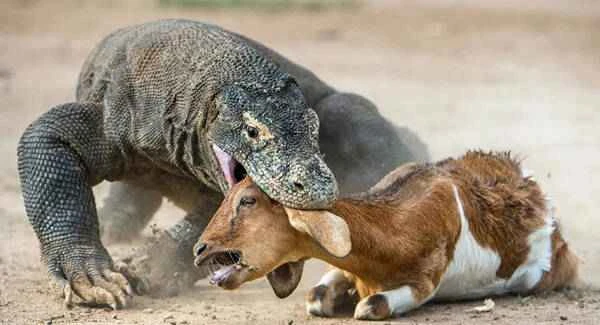
The Komodo dragon is the largest known lizard, averaging 2-3 meters in length; average weight: males 79-91 kg, females 68-73 kg, with the longest reaching 3.13 meters and weighing 166 kg (including undigested food). Captive Komodo dragons are usually heavier than those in the wild. Its tail is almost as long as its body, its limbs are as thick as an adult's arm, and its head is about the size of a volleyball. Juveniles have green, yellow, and black skin. Adult Komodo dragons are entirely dark brown.
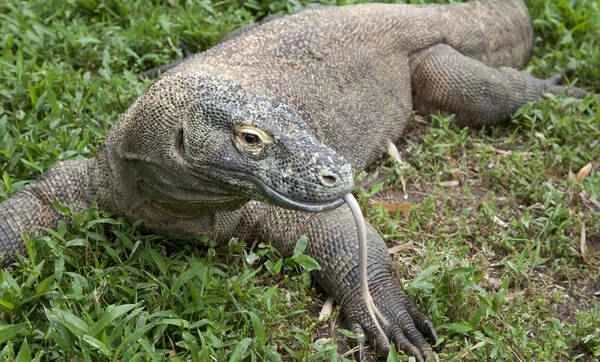
Komodo dragons are a species that survived from the age of dinosaurs. They prefer hot and dry environments, typically inhabiting dry, open grasslands, savannas, and low-altitude tropical forests. As carnivorous monitor lizards, they feed on wild boars, deer, monkeys, snakes, and sometimes prey on smaller members of their own species and young. They occasionally attack humans or scavenge human carcasses; as of 2010, approximately 12 people had died from venom inflicted by Komodo dragon bites.
Komodo dragons were once hunted for their tough, thick skin or captured for zoo exhibits. This has led to a population of fewer than 3,000 Komodo dragons remaining, making them one of the world's most endangered animals and a vulnerable species listed as a vulnerable species by the Indonesian National Conservation Union and the International Union for Conservation of Nature (IUCN). They are now protected in the national park on Komodo Island. In 1991, Komodo National Park was registered as a World Heritage Site.
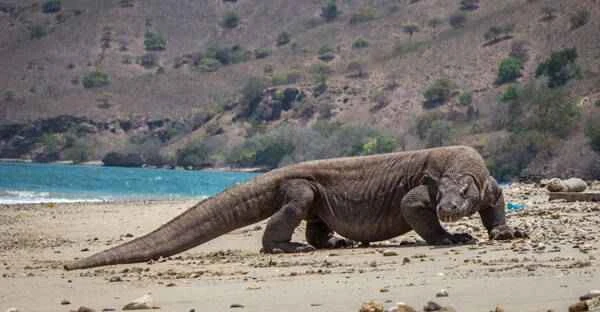
Komodo Island remained uninhabited for many years. Later, the Sultan of Sumbawa began exiling criminals to the island, where he discovered giant lizards, but no one believed him. In 1911, an American pilot flying a small plane low over Komodo Island inadvertently spotted the "monster." In 1915, the Indonesian government designated this animal, found nowhere else on Earth, as a national treasure and placed it under strict protection. In 1926, American Robert Burden filmed extensive footage of the natural scenery and lizards of Komodo Island, producing the film "King Kong" in 1931, which brought the Komodo dragon to the world's attention. In 1990, the Indonesian government established Komodo National Park and officially opened it to tourists.
On September 4, 2021, the International Union for Conservation of Nature (IUCN) updated its Red List of Threatened Species, raising the Komodo dragon's protection level from "Vulnerable" to "Endangered".
The world's largest lizard: The largest lizard is the Komodo dragon, with males averaging 2.59 meters in length and weighing approximately 79-91 kilograms. It is believed that the largest precisely measured specimen was a male donated by Sultan Bima to an American zoologist in 1928. In 1937, it was briefly exhibited at the St. Louis Zoo in Missouri, USA, where it measured 3.10 meters long and weighed 166 kilograms. (Guinness World Records)
![[Puffin Encyclopedia] Unveiling the Characteristics, Habitat, and Diet of the Atlantic Puffin](/upload/20260112/9cd8bf1a5560c0.webp)

