The Psittacosaurus, measuring 1.8 meters in length and about 1 meter in height, was a rather cute little dinosaur, named for its distinctive parrot-like beak. This dinosaur had a wide geographical distribution, primarily concentrated in the Early Cretaceous region from southern Siberia to Mongolia and northern China. Numerous Psittacosaurus fossils have been discovered, many of which are remarkably well-preserved. The Psittacosaurus fossil housed in the China Dinosaur Park is a typical example; it has a well-proportioned body, a thick head, well-developed forelimbs, strong hind limbs, and an upright posture. The ground and background are yellow sand, which, under the soft yellow light, gives it a sense of antiquity.
The earliest Psittacosaurus discovered was in the Gobi Desert of southern Mongolia. In 1922, the Third Central Asian Expedition, led by Andrews of the American Museum of Natural History in New York, collected numerous Psittacosaurus and Psittacosaurus eggs during their expedition. Dinosaurs unearthed from this stratum are often found alongside pterosaurs, and the strata are generally considered to date to the Early Cretaceous, forming a unique fauna in Asia—the Psittacosaurid-Pterosaur fauna.
Our introduction to Psittacosaurus begins with its "bird's beak." After studying the skull of Psittacosaurus in the dinosaur park, we discovered that it had 7-9 trilobed cheek teeth on each side of its upper and lower jaws, with smooth texture. Most striking is its massive, horny beak, whose shape and function are remarkably similar to that of a parrot's beak, hence its name. This massive beak helped it bite and chop plant stems and even nuts.
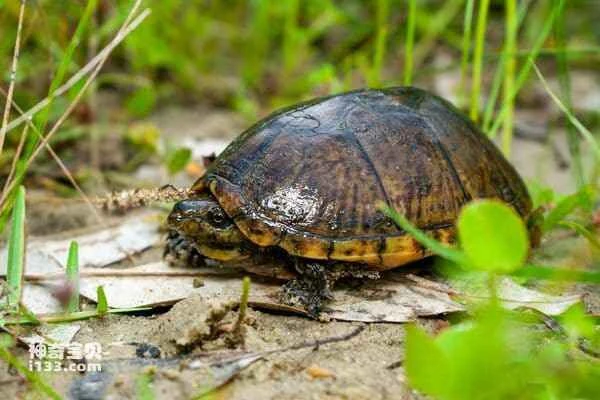
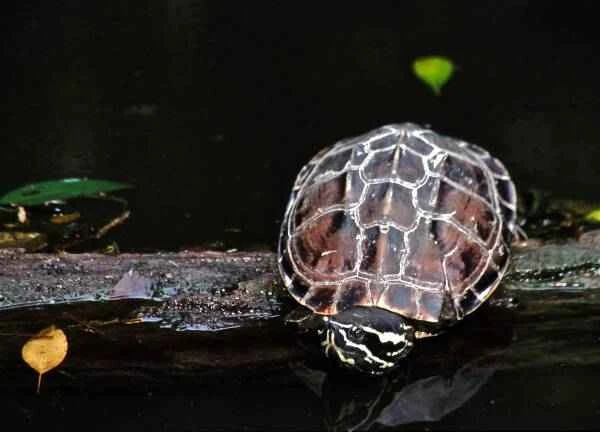
The immense bite force of a giant beak is beyond the imagination of paleontologists. Let's look at a modern reptile—the hawksbill turtle. The hawksbill turtle belongs to the Platysternidae family and mainly lives in Southeast Asia. Its head cannot retract into its shell, and its beak is covered with a hard, keratinous outer layer. Its upper jaw is pointed and curved, quite similar to the giant beak of a psittacosaurus. The hawksbill turtle's bite force is enormous. In the Jehol Biota of western Liaoning, China, a fossil of a mammal—a reptile—was discovered. Surprisingly, the stomach of this animal contained the skeleton of a juvenile psittacosaurus. This discovery overturns the image of weak Mesozoic mammals and also proves that the psittacosaurus lived in a perilous environment.
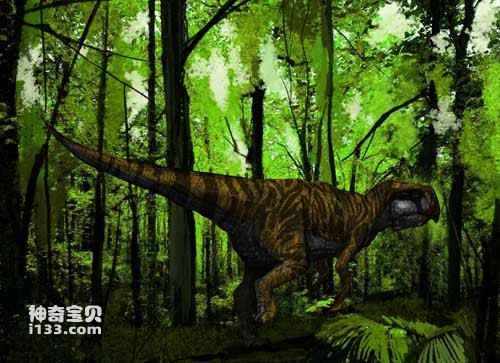
Chinese name: Psittacosaurus
Latin name: Psittacosaurus
Era: Early Cretaceous
Fossil sites: China, Mongolia, Siberia, Thailand
Physical characteristics: 1.8 meters long
Diet: Plants
Species: Ceratopsians
Meaning: A parrot-beaked lizard