The Styracosaurus was also a large ceratopsian. Its most striking difference from other ceratopsians lay in its neck frill, which was edged with a ring of sword-like bony spines, resembling a row of halberds thrust into the back of an ancient warrior; it was incredibly imposing. Apart from this, the Styracosaurus's head and body features were very similar to those of a unicorn. The horn above its nasal bone was very long, and there were slight protrusions above its eyes.
The Styracosaurus possessed formidable defensive and offensive capabilities. Its spiked neck frill not only provided protection but also reduced head weight, allowing for greater head mobility. The bony spikes on its horns and neck frill acted like sharp swords, formidable weapons for turning defense into offense, enough to terrify any ferocious predator. When fighting carnivorous dinosaurs, the Styracosaurus could simply raise its head sharply from below, and several of these "swords" would instantly pierce the chest of the oncoming intruder.
Even from a distance, adversaries wouldn't mistake a thyrsus for a stag. Like the massive antlers of a female stag, the distinctive spikes on its neck frill attracted mates and deterred its natural enemies. Thyrsus rarely engaged in combat, usually merely shaking its head—a subtle, intimidating tactic!
For a melee, the sharp horn on the head of the Triceratops was insignificant; however, it possessed another weapon that struck fear into its adversaries—its enormous nasal horn! The Triceratops would launch a surprise attack with its nasal horn, often inflicting devastating damage on large carnivores. Its nasal horn could pierce the exposed flesh of a carnivorous dinosaur, leaving a round, hole-like wound.
The cervical vertebrae of the Triceratops were very strong, which helped support its massive head. Longer than two small cars, the Triceratops walked on its powerful limbs, with its toes pointing outwards, which allowed it to stand steadily and easily support its body weight.
The Styracosaurus once roamed the Great Plains of North America, using its parrot-like curved beak to cut and feed on the branches and leaves of low-crowned plants. Overall, the Styracosaurus wasn't significantly different from the Triceratops, except for being slightly smaller. Its neck frill was wrinkled, with long, sharp spikes along the upper edge, resembling additional horns, and shorter spikes along the sides. These weapons provided excellent protection. When attacking other dinosaurs, its nasal horns could thrust directly into the enemy's body, while the neck frill protected its neck from sharp teeth and claws.
Dinosaur footprints discovered in Texas, USA, depict scenes of dinosaur families moving about: smaller, younger dinosaurs walking in the middle of the procession, while larger, adult dinosaurs flank them. Sometimes, the adults lead, with the cubs following behind. Many of the ceratopsian groups mentioned above led affectionate family lives. The discovery of a Styracosaurus in Canada proves that a family of Styracosaurus was foraging when a carnivorous dinosaur, Albertus saurus, suddenly rushed out of the nearby forest, intending to kill a young Styracosaurus. The family members immediately formed a circle, pointing their horns, like weapons, at the intruder. As the Chinese saying goes, "Brothers fight together, fathers and sons go to war together." Unable to defy the powerful force of kinship, Albertus saurus had no choice but to retreat quietly. It was this power of kinship that enabled ceratopsians to thrive at the end of the Cretaceous period, once again demonstrating the powerful vitality of dinosaurs. It is conceivable that although ceratopsians were among the last members of the dinosaur family to experience extinction, they disappeared from the earth amidst mutual care and rescue, and with great reluctance to part.
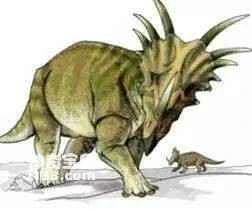
Chinese name: Triceratops
Latin name: Styracosaurus
Age of existence: Late Cretaceous
Fossil origin: Montana, USA; Canada
Physical characteristics: 5-6 meters in length
Diet: Plants
Species: Ceratopsians
Meaning: A lizard with a spear