A research team comprised of members from the Institute of Vertebrate Paleontology and Paleoanthropology of the Chinese Academy of Sciences and the Zhejiang Museum of Natural History discovered a fossil of a prehistoric flying fish, *Wushaichthys exquisitus*, dating back approximately 240 million years, in Guizhou Province. This discovery represents the most primitive and oldest fossil record of flying fish, providing new evidence for the study of their reproductive methods and the origins of aquatic gliding. Simultaneously, this discovery enhances our understanding of the ecological complexity of the Paleo-Tethys Ocean during the Middle Triassic and is of great significance for the study of paleoecological changes after the Permian-Triassic mass extinction. The latest issue of the Royal Society's *Biology Letters* published the research findings of Xu Guanghui and his colleagues Zhao Lijun and Shen Chenchen, attracting widespread media coverage both domestically and internationally.
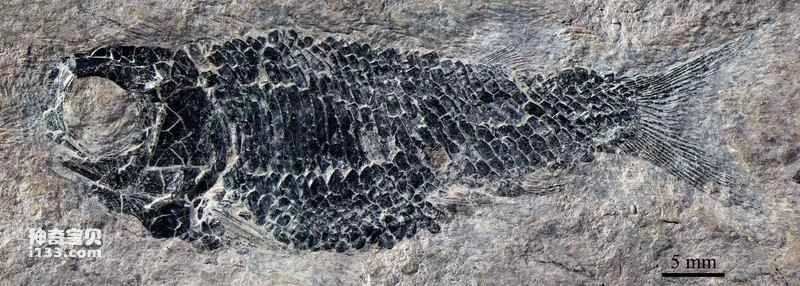
Figure 1: A male of the exquisite blackfish.
"The sea is wide enough for fish to leap, the sky is high enough for birds to fly." In the vast ocean, there is a renowned flying fish. They break through the waves, soaring through the air like flocks of birds, a true natural wonder. In the animal kingdom, many vertebrates can fly, but in the over 400 million-year evolutionary history of bony fish, the water gliding mechanism only appeared twice: once in the Thoracopteridae family over 200 million years ago, and again in the modern Exocoetidae family. Besides a pair of exceptionally large pectoral fins as "primary wings" and a pair of large pelvic fins as "secondary wings," flying fish also evolved a deeply forked and asymmetrical caudal fin (the lower lobe significantly stronger than the upper lobe). The rapid beating of this caudal fin generates powerful thrust, helping them leap out of the water and glide through the air using their broad pectoral fins. Because modern flying fish fossils are rare, we don't yet know how they developed this water gliding ability, but fossils of extinct flying fish species may offer some insight into how these creatures evolved this gliding ability. Based on the study of exquisite Wusha fish and other prehistoric flying fish fossils, Xu Guanghui et al. proposed a prehistoric flying fish evolution sequence of "head specialization - elongation of the lower tail lobe - enlargement of pectoral fins - scale degeneration". They believe that the water gliding of flying fish evolved gradually: first, their head specialization may have helped them live in the upper water layer, then they evolved asymmetrical tail fins to help them eject from the water, then they evolved large pectoral fins to help them glide in the air, and finally the degeneration of scales reduced their weight to improve the efficiency and maneuverability of gliding.
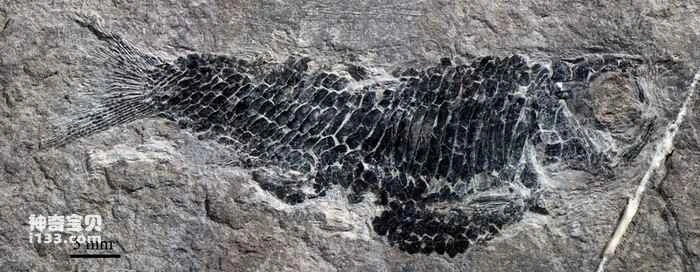
Figure 2: A female of the exquisite blackfish.
Vertebrate fertilization can be divided into external fertilization and internal fertilization. Most modern fish use external fertilization, but sharks, coelacanths, and a few teleosts use internal fertilization. These internally fertilized fish have evolved specialized reproductive fins to deliver sperm into the female's body. To adapt to life and reproduction in surface ocean waters, modern flying fish have unique spawning habits; their eggs need to attach to floating objects on the sea surface, such as under seaweed, or even floating bamboo poles or debris. Studies of *Ussula spp.* and other prehistoric flying fish fossils suggest that prehistoric flying fish, like modern flying fish, used internal fertilization. This means that prehistoric flying fish were born as live young, similar to humans, whales, and ovoviviparous teleosts. Well-preserved prehistoric flying fish fossils show that the male's anal fin rays were highly specialized, with a series of hooks at the end. Based on this, it is speculated that the mating process of prehistoric flying fish was similar to that of modern ovoviviparous teleost fish. The male fish's anal fin would erect with the help of muscles and extend forward into the cloaca under the female fish's body. The male fish would use the hooks at the end of the anal fin rays to grab the female fish and help complete the internal fertilization process.
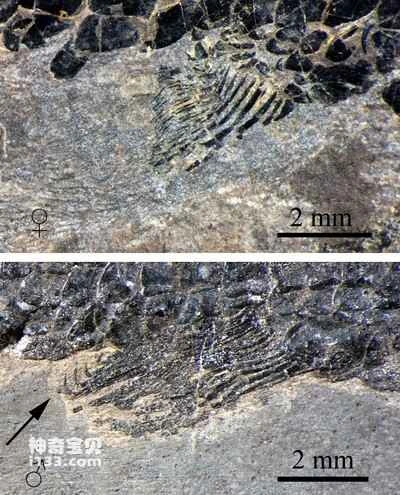
Figure 3: Comparison of the anal fins of male and female *Siniberis edulis*, with arrows indicating the hooks on the male's anal fin.