In the early 20th century, German scientist Alfred Wegener, based on the outlines of the Earth's continents and data from stratigraphy and paleontology, proposed the theory of continental drift. He argued that from the end of the Carboniferous period to the Triassic period, for a considerable time, at least the continents now mainly located in the Southern Hemisphere—Africa, South America, Australia, Antarctica, and the Indian subcontinent—were once a single supercontinent. He named this supercontinent Gondwana. Beginning in the Jurassic period, Gondwana broke apart and gradually drifted, eventually reaching its current locations.
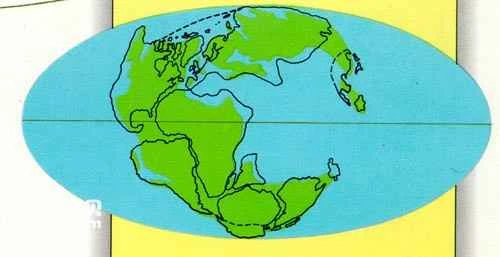
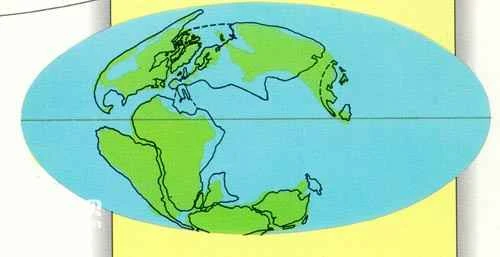
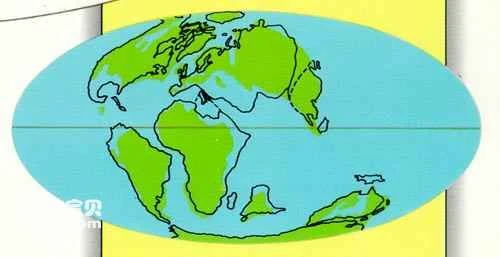
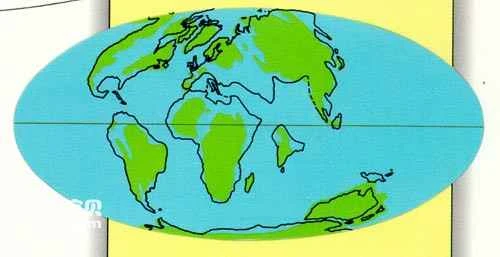
Continental Drift
By the 1960s, advances in marine geology and seafloor geophysics gave rise to the concepts of seafloor spreading and crustal subduction. This ultimately led to the late 1960s joint proposal of plate tectonics by French scientist Le Pichon, American scientist Morgan, and British scientist Mackenzie. This theory has not only made continental drift almost an indisputable fact, but also provided a series of explanations for the driving forces behind plate tectonic movements. Many perplexing problems in Earth science have been solved, and various disciplines, including paleontology, continue to corroborate and supplement it.
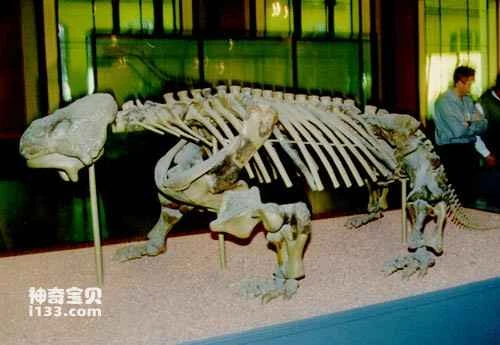
Water Dragon Beast
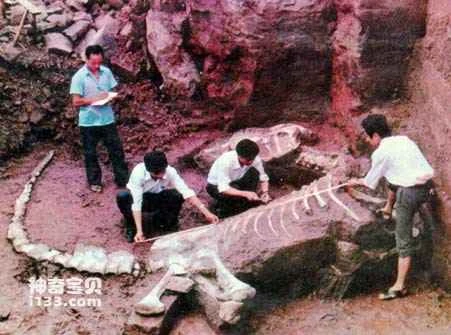
The Lystrosaurus, a dicynodont, is one of the most famous fossils serving as evidence for the theory of continental drift. Lystrosaurus was a mammal-like reptile about 1 meter long, and its fossils have been found in Antarctica, South Africa, India, and China.
The discovery of the same fossils on different continents greatly excited scientists who supported the theory of continental drift. From the 1950s onwards, new fossil evidence was discovered one after another, and reports followed in rapid succession.
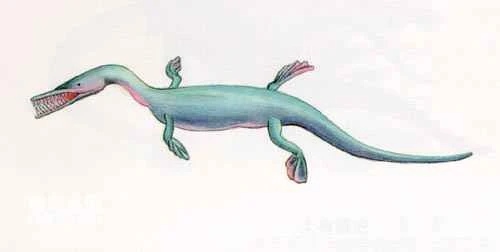
Zhonglong
A species of aquatic reptile called Mesosaurus was discovered in both South Africa and eastern South America. At the time, scientists believed that this small reptile lived in freshwater and could not have migrated or spread across the vast ocean between South Africa and South America. Therefore, they considered it strong evidence of continental drift.
Scientists believe that the Triassic period, dating from 230 million to 195 million years ago, was a crucial time for continental drift, and therefore they have devoted considerable effort to tracing fossils from this period. From the 1950s to the 1970s, in addition to the continuous discovery of Early Triassic Lystrosaurus fossils in Antarctica, South Africa, India, and Xinjiang, China, they also found many similarities between the Late Triassic *Twilight Crocodiles* and *Protosuchus* in Arizona, USA, and the *Pseudotwilight Crocodiles* and *Hymenosuchus* in Argentina, South America. Furthermore, scientists have also discovered fossils of a group of Late Triassic reptiles—stagfish—in the United States, Scotland, Germany, India, and Argentina.
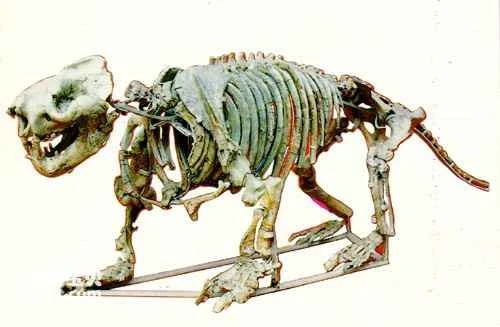
Oriental Poor Beast
Evidence found in my country extends beyond *Lystrosaurus*. The discovery of *Odontodon* in the Nanxiong Basin of Guangdong Province has significantly challenged the previous paleontological conclusion that "just as marsupials symbolize modern Australia, *Odontodon* symbolizes the ancient South American continent." Based on this, some scientists believe that the Nanxiong Basin in Guangdong was once part of the South American continent, later drifting thousands of miles to southern my country and joining the ancient continent there. Other evidence includes *Goulinia*, a primitive fish previously found in the Early Devonian strata of the Hengduan Mountains in Antarctica, which not only frequently appears in contemporaneous strata in southern my country but has also been found as far north as Jingyuan in Gansu Province.
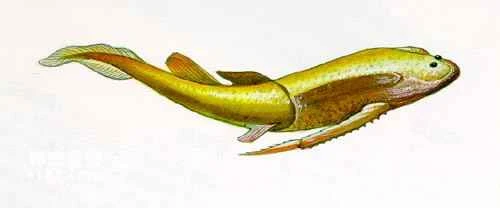
Scaled fish
Among fossil plants, the primitive gymnosperm Glossopteris is a world-renowned element supporting continental drift. This plant was once widely distributed in regions now largely separated from each other, including Australia, southern South America, the Falkland Islands, Antarctica, south-central Africa, and India. As a gymnosperm, Glossopteris seeds could not have been dispersed rapidly by wind or ocean currents; during its Permian period (280 to 230 million years ago), birds had not yet evolved and therefore could not have been carriers for the long-distance dispersal of these plant seeds across oceans.
Regarding invertebrates, some scientists have discovered, through analysis, that 20 species of freshwater ostracods that lived in the Early Cretaceous in the coastal basins of Brazil are identical to 20 species from the same period in the coastal basins of Gabon, Africa. Fossils of the famous *Bergstein's leaf-like ostracod*, which was once distributed in Australia, South America, and Africa, as well as a type of large-winged insect, have also been found in the Permian strata of the Ohio Mountains in Antarctica. Furthermore, 11 genera of trilobites identical to those found in my country during the same period have been discovered in the Cambrian strata of the Hengduan Mountains in Antarctica. These discoveries all provide evidence for continental drift.
Of course, the theories of continental drift and plate tectonics are not without flaws. In the field of paleontology, some scientists have expressed doubts or even refuted them using other evidence. This is a normal part of the scientific development process.