There is a city called Seymour in Texas, USA. In the north of the city, there are large areas of Early Permian sediments, where the famous fossil representative of the salamander, which is between a reptile and an amphibian, was discovered.
On the one hand, the lizard is very similar to a labyrindont amphibian called the carboniferous lizard. For example, the top of its skull is completely covered, and all the bone plates of the labyrindont skull are still preserved; it also has sharp teeth like labyrindonts on the edges of its upper and lower jaws, especially some of the large teeth typical of labyrindonts on its palatine bone; moreover, it has only one occipital condyle connecting its skull and cervical vertebrae, just like the carboniferous lizard.
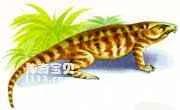
Salamander
On the other hand, the skeletal structure of the salamander (anatomically known as the postcranial skeleton) exhibits a series of advanced features similar to those of early reptiles. For example, the composition and shape of its vertebrae, the interclavicular bones in the shoulder girdle connecting the forelimbs and the spine, and the humerus are similar to those of reptiles; the ileum is much larger than that of amphibians; and there are two sacral vertebrae, unlike the single vertebrae found in amphibians. Although its ankle is still amphibian-type, the arrangement of its phalanges is similar to that of early reptiles: the thumb and big toe have two phalanges, the second phalanx has three phalanges, the third phalanx has four phalanges, the fourth phalanx has five phalanges, the little phalanx has three phalanges, and the little toe has four phalanges. This arrangement of phalanges is typical of primitive reptiles and can be represented numerically as 2-3-4-5-3 (4).
So, were salamanders amphibians or reptiles? The best answer to this question obviously depends on whether salamanders laid amniotic eggs on land like modern reptiles or returned to water to lay eggs like modern amphibians. Unfortunately, paleontology has not yet provided us with any clues on this issue. However, paleontologist Dr. White conducted detailed research on salamanders and found that many fossil materials show that salamanders exhibited sexual dimorphism—the first pulmonal arch protruding below the caudal vertebrae of some individuals was located far from the posterior edge of the pelvic girdle, while the corresponding pulmonal arch of other individuals was closer to the posterior edge of the pelvic girdle. Based on this, it is speculated that those individuals with a greater distance between the pulmonal arch and the posterior edge of the pelvic girdle indicate that there must have been a fairly large gap between the pulmonal arch and the posterior edge of the pelvic girdle. Such individuals represent females, and the large gap reflects an adaptation for the passage of large amniotic eggs through the cloaca. If this speculation is analyzed in conjunction with various reptilian features of the postcranial skeleton, salamanders should undoubtedly be classified as reptiles.
However, based on the characteristics of their skulls and teeth, it is indeed impossible to completely separate salamanders from amphibians. Moreover, some genera that are similar to salamanders retain some more obvious amphibian characteristics; for example, the juvenile disc lizards found in Europe still breathe with gills.
However, it is precisely this seemingly contradictory evidence that illustrates the true nature of animal evolution. Even the evolution of a single species is not a uniform process in all aspects. An animal may be advanced in some traits but primitive in others; this is called "mosaic evolution." The mosaic evolution characteristic of lizards demonstrates that they are a fascinating intermediate type between amphibians and reptiles. Therefore, we can more confidently speculate that reptiles originated from lizards or amphibians similar to lizards.