We already know that, based on the development of the temporal region of the skull, specifically the development and changes of the temporal foramen, scientists divide reptiles (class) into four subclasses: *Anomala*, *Singa*, *Broad-arched*, and *Diapa*. Building upon this, and based on other characteristics, scientists further subdivide reptiles into more detailed taxonomic ranks. This hierarchical classification, like a family tree, reflects the kinship relationships among various reptiles. The subclass and order classifications are as follows:
1. The subclass Apophora, also known as the subclass Apophora, is characterized by the absence of a temporal femur. It is further divided into three orders:

Protojaculate – an ancient type of turtle
Cuposaurs: The most primitive reptiles to have appeared in the early Permian period, and became extinct at the end of the Triassic period.
Testudines: Direct descendants of cephalosaurids, reptiles that have survived from the Permian period to the present day and have developed protective bony armor during evolution.
Mesocarpus: Its classification status is not yet clear, so it is temporarily set aside.
2. The subclass Monoarctica, also known as the Inferior Foramen subclass, is characterized by having only one lateral temporal foramen, bounded superiorly by the retroorbital bone and squamous bone. It is further divided into two orders:
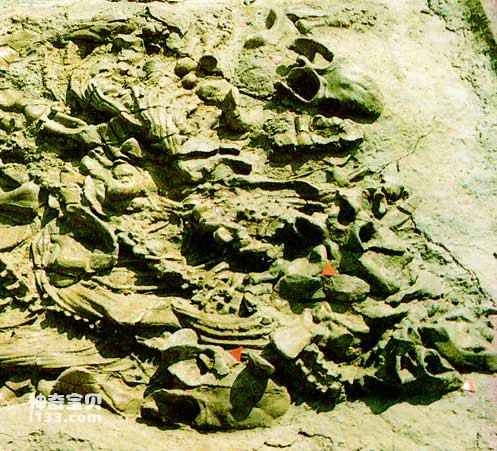
The "Nine Dragon Wall" inside the Paleozoological Museum of China features fossils of Kemp's wrathenium, a member of the therapsid order.
Pansauria: primitive single-arched reptiles whose era is limited to the Permian period.
Therapsids: A large group of mammal-like reptiles that flourished from the Middle Permian to the Triassic period, some of which eventually evolved into mammals.
3. The subclass Broad-Archoid, also known as the Temporal Fistula, is characterized by having only one superior temporal foramen, with its lower boundary formed by the retroorbital bone and squamous bone. It is further divided into four orders:
Protosauria: A branch that evolved from early cuposaurs in the Permian period, and went extinct in the Triassic period after losing competition with Diaporaptors.
Sauricera: Plesiosaurs and plesiosaurs, one of the dominant marine species of the Mesozoic Era.
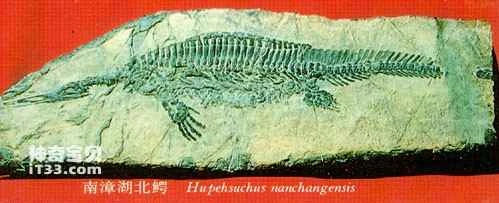
Nanzhang Hubei Crocodile – a species of sauripers
Shield-toothed Sauropoda: These were shallow-sea reptiles that lived only during the early Triassic period and fed on seabed shells.
Ichthyosaurs: The most well-adapted reptiles to marine life, originating from cuposaurs in the Middle Triassic and continuing into the Cretaceous.
4. The subclass Diapora, also known as the Diapora subclass, is characterized by having two temporal foramina, separated by the retroorbital bone and squamous bone. It is further divided into eight orders:
Eososuchia: Diplophora from the Permian to the Triassic period, from which all other Diplophora originated.
Rhinoceros-headed creatures: These creatures appeared in the early Triassic period and were once distributed throughout the world, but became extinct after the Triassic period. Only a very few species survived to the end, and they have remained largely unchanged for more than 100 million years.
Squamata: Lizards and snakes that diverged from them, the dominant reptiles from the Triassic period to the present.
Corydodon: Triassic archosaurs, ancestors of the dominant Diplodocus dinosaurs of the Mesozoic era.
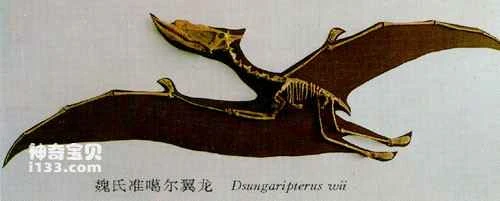
Pterosaur
Crocodilians: a group of semi-aquatic, ferocious reptiles that have existed since the Late Triassic period.
Pterosaurs: Flying reptiles from the Jurassic to the Cretaceous periods.
Saurischia: A group of dinosaurs with pelvises similar to those of lizards.
Ornithischians: Dinosaurs with pelvises similar to those of birds.