Chilodonts are mostly small amphibians adapted to shallow water and swampy environments; they first appeared in the Early Carboniferous and became extinct by the end of the Paleozoic Era, never flourishing. They are generally divided into three orders: Salamanders, Microsalamanders, and Anapsids.
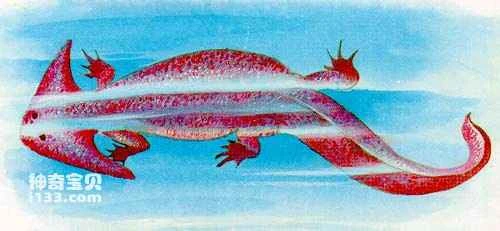
Lizard-headed salamander
The order Salamanders consists of small, primitive amphibians adapted to live in the water's edge, underground, or in swamps, while the order Amphipoda is specialized into small, slender, limbless snake-like amphibians.
The order Salamanders is the most diverse family of vertebrates in terms of numbers, species, and morphology. They began to evolve in two directions during the Late Carboniferous period. One branch evolved into slender, eel-like or snake-like amphibians; the other branch developed its body and skull in a flattened and broad direction. For example, the famous Permian salamander had bones on the sides and top of its skull that grew extremely laterally, so much so that the back of the skull seemed to grow triangular "horns" on both sides, making the entire skull resemble a conical hat, hence the name "conical salamander".
The lizard salamander also has a flat body and small, weak limb bones. Clearly, this animal is likely a benthic amphibian, probably spending most of its time at the bottom of streams or ponds.