From the Eocene to the Oligocene, the ancestors of modern mammals emerged from certain species within ancient mammalian groups, leading to the second adaptive radiation of mammals after the Cenozoic Era. This second explosion resulted in the complete replacement of ancient mammalian groups by these advanced mammalian groups. These advanced mammalian groups include:
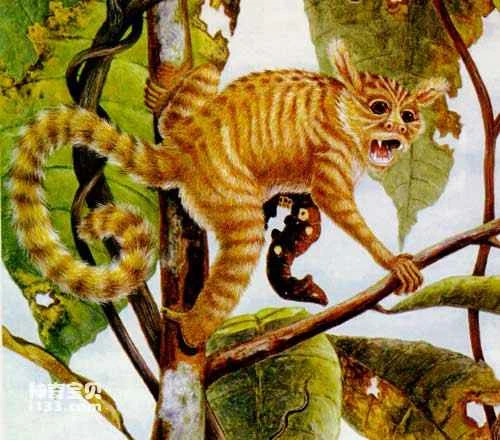
Ephemeris sinensis—the oldest higher primate
Modern types of Xenopterygii (order). These include giant glyptodonts and ground sloths that were widely distributed in North and South America during the Pleistocene, sloths and anteaters that still live in tropical America today, and armadillos, which have a wide distribution in the Americas.
Higher primates within the order Primates.
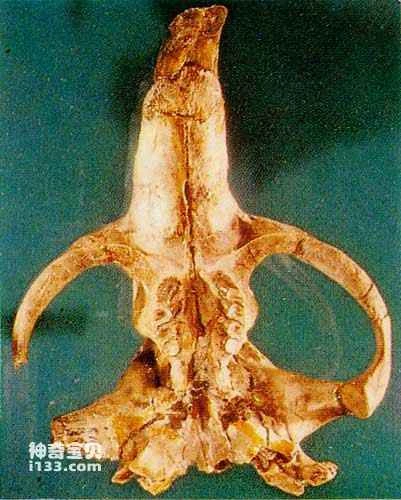
Jacquard rat—a fossil of an ancient rodent
Rodents (order).
Lagomorphs: Although the Protohae appeared in Mongolia as early as the Paleocene, this group truly flourished from the Oligocene onwards and continued into the present day.
Cetaceans (order): Diverging from the mesothelios of the early Eocene, they returned to the ocean, playing an ecological role similar to that of ichthyosaurs in the Mesozoic era, and successfully reproduced into modern mammals. This includes various whales, dolphins, and freshwater porpoises (such as the baiji). Due to the buoyancy of ocean water reducing the effects of Earth's gravity, coupled with excellent adaptations, many whales evolved into enormous creatures; the modern blue whale can reach lengths of 300 meters and weigh up to 150 tons, making it the largest animal ever to have lived on Earth.
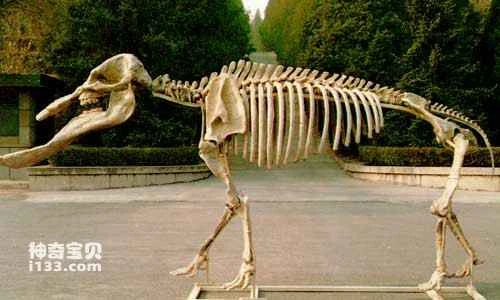
Shovel-toothed elephant – its lower teeth are shaped like a large shovel.
Ancient long-nosed dinosaurs
Carnivorous (order).
Tubularoids (order): evolved from ancient tarsiers, appearing in the late Miocene. They are pig-like animals that feed on termites and have survived in Africa to this day, known as native pigs.
Proboscidea (order): Starting with the ancestral elephant in the Fayoum fauna of Egypt, various elephant species have continuously increased in size, with their trunks becoming longer and more differentiated, and their incisors also becoming longer in various ways.
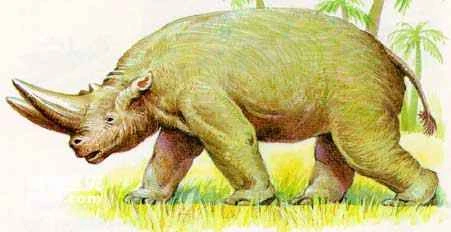
Heavy-footed beast
Baryopoda (order): Discovered in the Oligocene strata of Egypt, they were hoofed animals similar in size and appearance to modern rhinoceroses, with heavy skeletons, limbs and feet similar to elephants, and a pair of large, side-by-side bony horns. They may have been an early evolutionary experiment originating from an ancestor shared with proboscis, and left no descendants after the Oligocene.
Hyraxes (order): Appearing in the Fayoum biota of Egypt during the Oligocene, they then underwent radiation and evolution. Some Oligocene species, such as the giant hyrax, once evolved to the size of pigs. Later, the large hyraxes became extinct, while some smaller species have survived to this day in Africa and the Middle East, becoming herbivores that resemble rabbits but have hooves. They may share a common ancestor with the Elephant.
Manatees (order): A group of hoofed, herbivorous aquatic mammals that may share a common origin with the ancient elephant, but diverged in the late Eocene and have continued to exist to this day. Modern types include manatees and dugongs, the former inhabiting the coasts of Africa and the Americas on both sides of the Atlantic Ocean, and the latter inhabiting the coasts of the Pacific and Indian Oceans.
Cordodontidae (order): another aquatic ungulate branch with a common ancestor to proboscis, distributed along both sides of the Pacific Ocean during the Miocene, and likely an intermediate type between manatees and early proboscis.
Perissodactyls (order).
Even-toed ungulates (order).