Modern whales have smooth skin and streamlined bodies, their massive tails creating towering waves that propel them freely across the ocean. But did you know that in ancient geological times, whales were once terrestrial animals with well-developed limbs? A growing number of fossil discoveries have confirmed this.
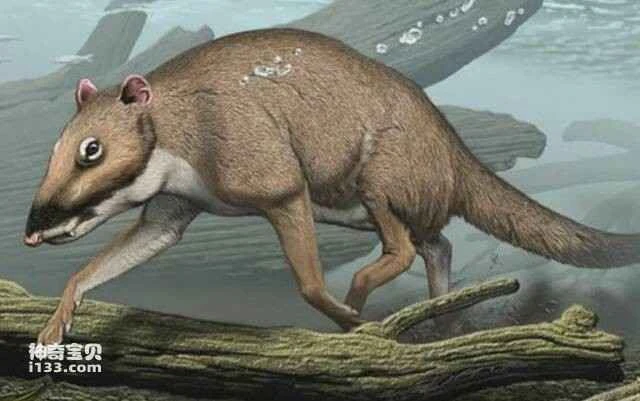
Scientists including Thewynn Severson from Ohio University's College of Pharmacy have unearthed a whale fossil in Pakistan, complete with limb and foot bones. Dating back 50 million years to the Eocene epoch, this is the first time scientists have discovered an ancient whale with large, functional hind limbs. Paleontologist Berta from San Diego State University praised the discovery, stating, "It shows us for the first time a whale with fully developed hind limbs, an animal that clearly locomotion using its hind limbs."
Scientists believe that modern whales originated from carnivorous quadrupedal mammals. These ancestors, somewhat like large wolves, roamed the continents and hunted prey. Around 57 million years ago, at the beginning of the Eocene epoch, these carnivores, facing the survival pressures of an arid environment, boldly ventured into the sea to carve out a new ecological niche, resulting in profound physical evolution. Gradually, their limbs and pelvis degenerated, while their tails became increasingly powerful and paddle-like, used to slap the water and propel these "sea behemoths" through the ocean.
Modern whales have lost their hind limbs, with only a few species retaining toe-like bones, showing traces of limb and hip bone degeneration, indicating they evolved from terrestrial tetrapods. Three years before the discovery of ancient whale fossils in Pakistan, Professor Gingerridge of the University of Michigan reported finding whale fossils in Egypt dating back 40 million years. However, the exolimb bones of this whale were too delicate and weak to aid in propulsion like those of terrestrial mammals. Professor Gingerridge believes that the animal's tiny hind limbs were only used to grasp its mate during mating.
If Professor Gingerridge's fossil whale discovery suggests it could almost live its entire life in water, then Sevison believes his fossil whale found in Pakistan was just capable of amphibious survival, much like a sea lion. The skeletal morphology of the Pakistan whale indicates relatively weak hind limbs, suggesting it might have been able to drag its massive body across land like a sea lion using its delicate appendages. In the sea, the up-and-down slapping of its flat feet would have propelled it forward in a wave-like motion, rather than the side-to-side swaying of a fish's body (primarily its tail). Modern whales also swim in a wave-like motion, but they have developed the ability to use their broad tails as propulsion.
Professor Berta believes that paleontologists must collect more fossils to obtain more definitive evidence to explain how this fossil whale actually swam. Because the fossils discovered in Seville lack a pelvis or pelvic fragments, it is still unclear how the limb bones and vertebrae of this type of whale were connected, which is a key factor in understanding how these animals moved.
In any case, Sevesen's discovery greatly advanced the study of early cetacean evolution, connecting a missing link in the evolutionary chain of aquatic cetaceans and their terrestrial ancestors, much like the important role that Archaeopteryx played in the early evolution of birds.