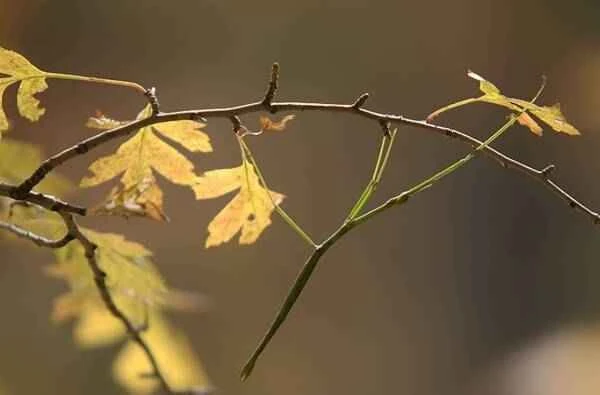
Stick insects are the longest insects on Earth, generally ranging from 6 to 24 centimeters in length, with the longest reaching 62.4 centimeters. Also known as bamboo whips, or simply "虫䗛" (a combined character, xiū), they belong to the order Orthoptera within the subclass Pterygota. Their heads are almost as wide as their bodies, and their slender, segmented bodies closely resemble bamboo twigs, hence their name. They may be winged or wingless. They are medium to large insects. The word "Phasmatodea" comes from the Greek word "phasma," meaning "ghost," aptly describing their ability to mimic surrounding branches or leaves.
Most stick insects are dark brown, with a few being green or dark green. They often reproduce parthenogenetically, with males being less common; unfertilized eggs mostly develop into females. When injured, the nymph's legs can detach and regenerate. High temperatures, low temperatures, and dim light can darken their body color, while the opposite can lighten it. Their body color differs between day and night, exhibiting rhythmic color changes.
Stick insects are mostly distributed in tropical and subtropical regions. They inhabit high mountains, dense forests, and complex environments, exhibiting typical mimicry and camouflage to blend into their habitats and avoid detection by predators. The stick insect closely resembles a tree twig, while its leaflets closely resemble tree leaves. They typically live in grass or on trees, feeding on leaves. Adults can overwinter, but most are unable or poor fliers.
There are approximately 2,200 species of stick insects worldwide, with about 20 species found in China. They live in forests or bamboo groves and are considered forest pests; some species also damage crops. Stick insects are diverse, and in my country, they are mainly distributed in tropical and subtropical regions, primarily in Hubei, Yunnan, and Guizhou provinces.
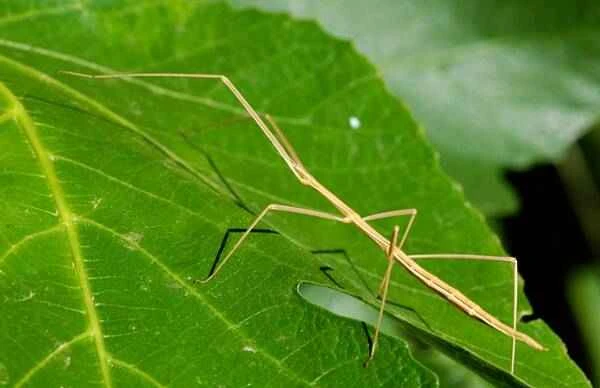
Stick insects are renowned masters of disguise. When perched on branches or bamboo twigs, they resemble dead branches or bamboo shoots, making them difficult to distinguish. This ability to mimic reality is known in biology as mimicry. Some stick insects, when startled and falling to the ground, can even feign death. In the forests of Indonesia lives a giant stick insect, reaching lengths of 33 centimeters, making it the longest insect among the million species in the insect kingdom.
Stick insects are masters of camouflage, possessing exceptional stealth abilities. When crawling on plants, they blend seamlessly with the plant's shape, mimicking branches or leaves with remarkable realism, making them difficult to spot without close inspection. Furthermore, they can change their coloration according to changes in light, humidity, and temperature, allowing them to completely blend into their environment, making them undetectable to predators such as birds, lizards, and spiders. The stick insect's remarkable camouflage surpasses that of other insects adept at mimicry. This crown of camouflage undoubtedly belongs to the stick insect.
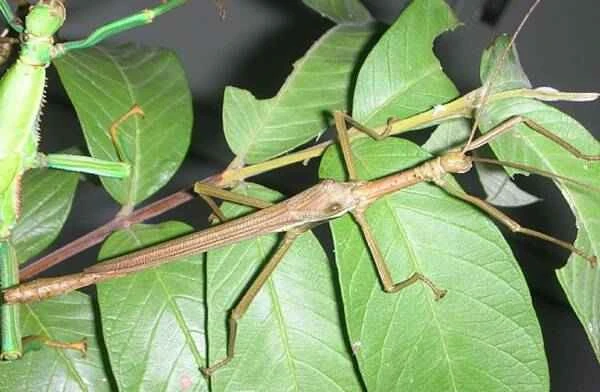
The world's longest insect: The spiny-footed stick insect is the longest insect ever recorded. They typically range in length from 6 to 24 centimeters, with the largest reaching 62.4 centimeters. Entomologists have described over 3,000 species of stick insects, and the spiny-footed stick insect is the largest of its kind ever discovered. (Guinness World Records)