The ghost moth is one of the most prolific insects on Earth, with a single female laying over 29,000 eggs. The ghost moth larvae are the foundation for the growth of Cordyceps sinensis. Taxonomically, it belongs to the family Hepialidae, genus Hepialus, and species *Hepialus cuspidatum*. Currently, through surveys, we know of more than 20 similar species, with variations depending on their habitat. The term "Ghost Moth" encompasses nearly 300 species distributed globally, including some of the largest moths with wingspans exceeding 22.5 cm. Species in Europe and North America are mostly brown or gray with silver spots on their wings; species in Africa, New Zealand, and Australia are brightly colored. They fly very quickly but without a fixed direction.
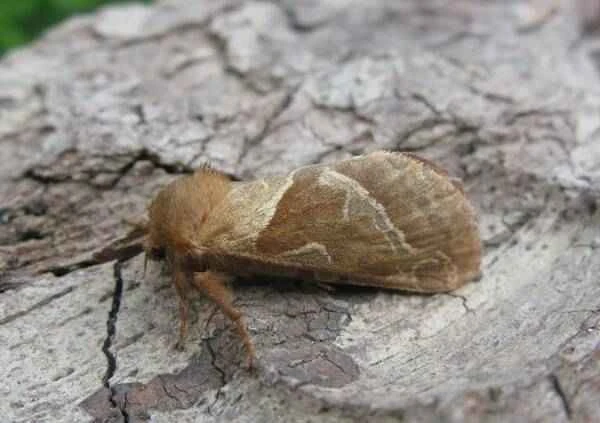
The larvae of the ghost moth burrow into stems or live underground, feeding on grass roots. Some people consider any fungal-to-plant hybrid, parasitized by a fungus of the genus *Cordyceps* and capable of producing fruiting bodies, to be *Cordyceps sinensis*. However, in traditional Chinese medicine, *Cordyceps sinensis* specifically refers to *Cordyceps sinensis*, a fungus found only in the Qinghai-Tibet Plateau and its surrounding high-altitude meadows of my country. The "insect" in *Cordyceps sinensis* refers to the ghost moth larva. The ghost moth larvae are a carrier of the *Cordyceps* fungus.
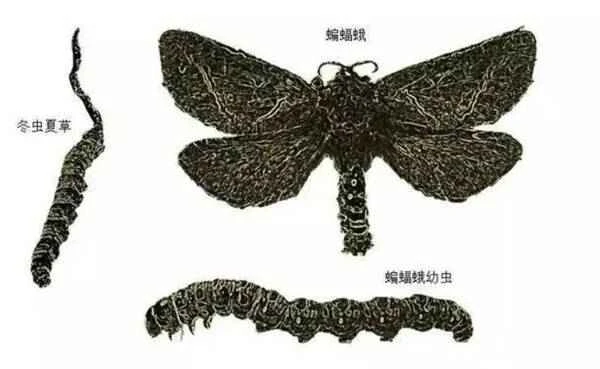
Adult ghost moths of 82 species in 7 genera in China. The dahlia ghost moth, also known as the oriental ghost moth, belongs to the order Lepidoptera, family Hepialidae. It is distributed and causes damage in Heilongjiang, Jilin, Liaoning, the former Soviet Union, and Japan. It damages various flowering trees. Damage symptoms: The larvae bore into branches and trunks, creating concave, ring-shaped tunnels filled with sawdust, forming sawdust bales.
Cordyceps fungi belong to the genus *Cordyceps* of the family Clavicipitaceae, encompassing many species such as *Cordyceps sinensis*, *Cordyceps militaris*, *Cordyceps cicadae*, *Cordyceps sinensis*, *Cordyceps militaris*, *Cordyceps hemiptera*, and *Cordyceps spp.*. China boasts a rich variety of Cordyceps species and abundant resources. Currently, 139 species are well-documented worldwide, with 58 known in China.
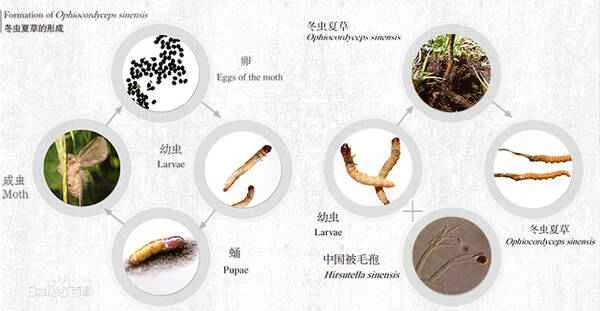
Cordyceps sinensis is mainly produced in alpine shrublands and meadows at altitudes of 3500–5000m, with an average annual temperature of around 1.5℃, a minimum temperature of -22℃, and an annual accumulated temperature of 1094.5℃. In this frigid environment, only low shrubs and meadow-like vegetation exist. The plant community structure is stable, with Polygonum capitatum as the dominant species, accompanied by plants of the genus *Polygonum*, *Pulsatilla chinensis*, *Stellaria media*, *Primula tianshanensis*, *Meconopsis integrifolia*, and *Pedicularis truncatula*, among others.