According to the Nanjing Institute of Geology and Palaeontology, Chinese Academy of Sciences, the family Staphylinidae, belonging to the order Coleoptera in the class Insecta, is currently the most species-rich family on Earth, comprising 32 extant subfamilies and 1 extinct subfamily, with at least 58,000 extant species described. The subfamily Olisthaerinae is one of the smallest subfamilies within Staphylinidae, containing only 2 extant species and 1 fossil species. Most Jurassic rove beetles have been reported in the Upper Jurassic strata of the Karatau region of Kazakhstan, while Middle Jurassic rove beetles have only been sporadically reported in my country.
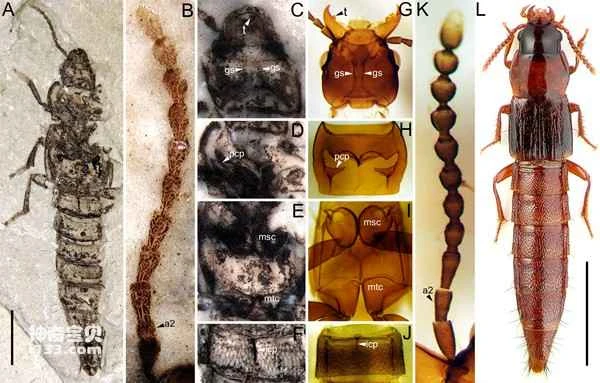
Morphological comparison between fossil smooth rove beetles and their extant counterparts
Recently, Dr. Chenyang Cai, a doctoral student at the Nanjing Institute of Geology and Palaeontology, Chinese Academy of Sciences, Researcher Diying Huang, and Dr. Robert Beattie from Australia discovered two groups of insects belonging to the subfamily Protolisthaerus in the Middle Jurassic strata near Daohugou Village, Ningcheng County, Inner Mongolia, and the Talbragar fish layer of the Upper Jurassic in Australia. Through detailed comparative studies with the only extant genus of the subfamily Protolisthaerus, *Olisthaerus*, the new genus and species of *Protolisthaerus* from the Daohugou biota (*Protolisthaerus jurassicus* Cai et al., 2014; Jurassic Protolisthaerus) is morphologically very similar to the extant *Olisthaerus substriatus* Paykull (Figure 1), with only minor differences in elytra characteristics and body size. The extant *Protolisthaerus* have a unique lifestyle; both extant species live under the bark of coniferous trees.
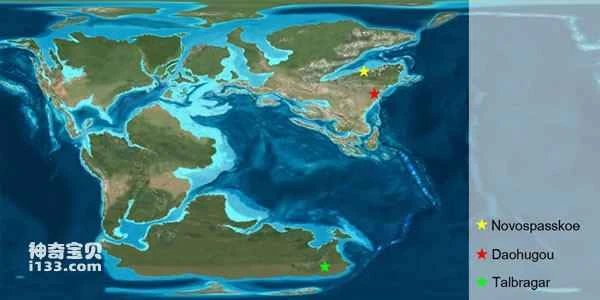
Geographical distribution of smooth rove beetles in the Middle Jurassic period
Based on morphological similarities, it is inferred that the Jurassic protoscientiae of the Daohugou Fauna (approximately 165 million years ago) may have had the same or similar lifestyle as extant types, meaning that the Jurassic protoscientiae may have also lived under the bark of conifers. The abundant conifer fossils (such as *Pityocladus* and *Yanliaoa*) found in the Daohugou area provide strong evidence for this inference. The long-term morphological stagnation of the rove subfamily may be attributed to the relatively small changes in its habitat and host plants. Furthermore, extant rove beetles are only distributed in the North Temperate Zone, including Northern Europe, Central Europe, Mongolia, and North America; however, the discovery of rove beetles in the Talbragar fish layer in Australia has greatly expanded the distribution range of this subfamily (Figure 2). The rove subfamily may have had a wider distribution during the Jurassic period than it does today, and the two extant rove beetle species are relict.