The Chinese Academy of Sciences discovered a fossilized egg in the Late Cretaceous strata of the Tiantai Basin in Zhejiang Province. The egg fossil is only 4.5 cm long, with a distinct pointed and blunt end. Its shape is very similar to a bird egg, but it displays the microstructure of a dinosaur eggshell.
The Tiantai Basin in Zhejiang Province yields a fossil assemblage of dinosaur eggs from the Early Late Cretaceous, characterized by honeycomb-like, reticulated, stalagmite-like, and mosaic-like forms. The newly reported egg fossil exhibits a shell with a barrel-shaped cone, irregular pores, and well-developed growth lines, closely resembling the shell structures of stalagmite-like, mosaic-like, and paracircular-like eggs. However, these fossil eggs are much larger and nearly round than the new specimen. Therefore, the new specimen represents a new genus and species of egg closely related to these fossils, named *Parvoblongoolithus jinguoensis*. This discovery enriches the composition of the Tiantai Basin dinosaur egg fossil assemblage and, more importantly, demonstrates that some bird egg characteristics, such as smaller size and oval shape, are also present in dinosaur eggs closely related to stalagmite-like, mosaic-like, and paracircular-like eggs.
Researchers also pointed out that since the egg fossils closely related to the new specimen are all relatively large, the smaller size of this egg fossil cannot be ruled out as being caused by a temporary physiological dysfunction during egg-laying in the dinosaur; similar phenomena have been reported in modern birds. Because there are no other egg fossils from the same nest for comparison, it has been preliminarily classified as a new genus and species of egg, without establishing a new family.
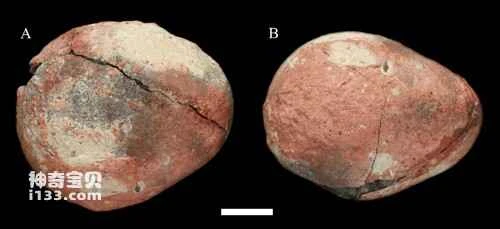
Figure 1. Holotype specimen of the jinguoensis oogen. et oosp. nov., scale bar = 10 mm.
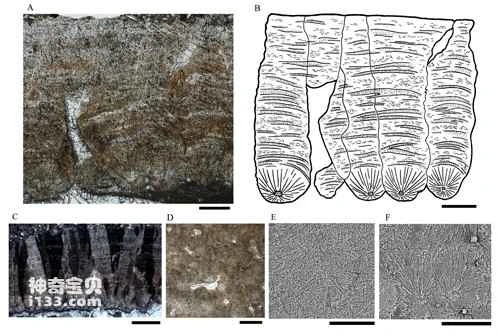
Figure 2. Microstructure of the eggshell of the jinguoensis oogen. et oosp. nov., A, B, E, F, scale bar = 0.2 mm; C, D, scale bar = 0.4 mm.