Three years ago, a farmer in Patagonia, southern Argentina, tripped over an incredible fossil in the desert near Patagonia. He and his family immediately reported the discovery to a nearby paleontology museum. Museum staff and archaeologists rushed to the site to excavate and clear the area. What awaited them was an astonishing discovery. Scientists speculate that what tripped the farmer might be the largest dinosaur ever discovered.
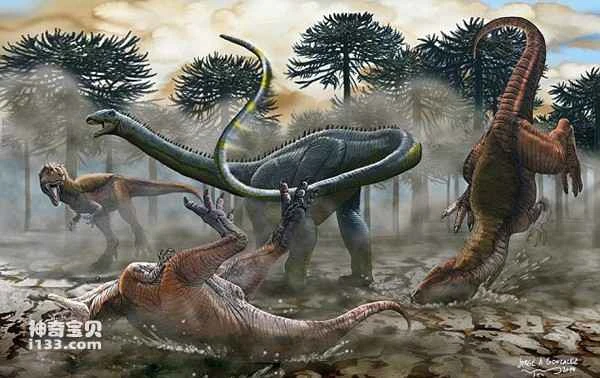
The largest dinosaur reconstruction ever discovered
I. Fossil size (weighing 77 tons, equivalent to 14 elephants)
It weighs about 77 tons, equivalent to the weight of 14 African elephants. It is about 40 meters long, and if it stands upright with its neck outstretched, it will be as tall as 20 meters, equivalent to the height of a 7-story building.
According to a report in the British Daily Mail on the 17th, Argentina recently unearthed the world's largest dinosaur skeleton fossil to date. Scientists believe this dinosaur may be the largest ever discovered, weighing approximately 77 tons, equivalent to the weight of 14 African elephants, and 7 tons heavier than the massive Argentinosaurus. It was about 40 meters long, and if it stood upright with its neck outstretched, it would have been 20 meters tall, equivalent to a seven-story building.
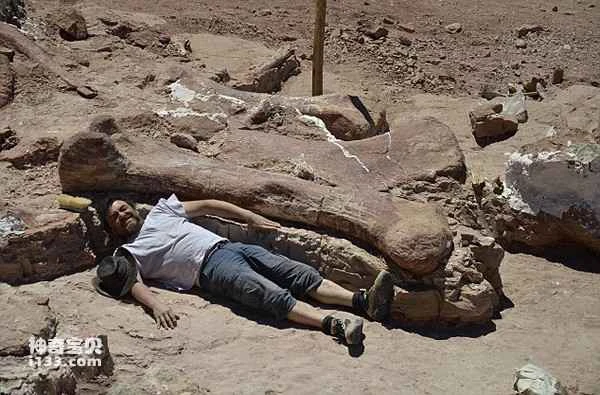
A researcher lies down next to a newly discovered dinosaur fossil and compares its height to his.
"Its length is like two large trucks with trailers, one following closely behind the other," said Dr. Caballido. The excavation of the giant dinosaur was led by Dr. Caballido and Dr. Polo.
"Based on the size of these bones, this new dinosaur may be the largest walking animal known to humankind on Earth," said researchers at the scene.
Dr. Roger, a paleontologist at Oxford University and a leading authority on Argentinosaurus, stated that the weight of Argentinosaurus is incredible. Scientists calculated the estimated weight of 426 dinosaur species using a formula based on the density of dinosaur leg bones, finding that dinosaurs could range in size from as heavy as Tyrannosaurus Rex to as small as birds.
The Tyrannosaurus Rex, weighing 7 tons, is the heaviest known carnivorous dinosaur, but compared to this newly discovered behemoth, it's practically dwarfed. Meanwhile, the Qilian Bird, discovered in China, is only the size of a sparrow and weighs a mere 15 grams. The previously discovered Argentinosaurus weighed approximately several million times that of the Qilian Bird, and both belong to the same dinosaur family. "This seems incredible," said Roger Benson.
Currently, they have discovered 150 bones, all in "well-preserved condition." These bones are believed to belong to seven dinosaurs. These dinosaurs are likely a newly discovered species of Brontosaurus. Based on the rocks surrounding the fossils, they lived during the Late Cretaceous period. Scientists believe that these seven dinosaurs may have died here simultaneously, possibly due to dehydration or becoming trapped in the mud.
Based on the 60 carnivorous dinosaur teeth fossils found at the site, Dr. Cabalido deduced that it's highly likely these carnivorous dinosaurs came along and devoured the carcasses of these herbivores. However, judging from these teeth, the carnivores also paid a price; some teeth were broken off when they tried to bite through the herbivores' tough skin.
II. Naming (The name should be related to the discoverer and its enormous size)
This giant dinosaur was also a huge and powerful herbivorous dinosaur. Its name should describe its enormous size and also be related to the place where it was discovered and the farmer who owned it.
Scientists have determined that this giant dinosaur was a huge and powerful herbivorous dinosaur. This new species lived in forests approximately 95 to 100 million years ago.
Scientists at the University of Maimonides in Buenos Aires, led by Pablo, believe this new type of dinosaur may belong to the Diplodocidae family. The newly discovered fossils would prove that Diplodocid dinosaurs arrived in South America during the Early Cretaceous. Pablo and his team believe these dinosaurs may have even reached South America before tectonic plate drift, much earlier than scientists previously thought.
“Diplodocid dinosaurs have never really been thought to have lived in the Cretaceous or in southern regions outside of Africa,” Pablo said. “This new discovery means that the earliest record of Diplodocid dinosaurs in South America has been found.”
Pablo's hypothesis has been echoed by some scientists. University College London paleontologist Umbridge believes this might mean that not all Diplodocid dinosaurs died in the Late Jurassic period.
John, a paleontologist at Mount Aloisius College in Pennsylvania, shares the same view. "Such discoveries are not just a data refresh; they could overturn our existing evidence on how species spread across the globe. We can use this information to verify how dinosaurs migrated globally based on their preferred environments and climates."
Currently, this behemoth has no name. Dr. Caballido and Dr. Polo say its name should describe its enormous size and also be related to the place where it was discovered and the farm owner.
III. Controversy (Too early to say the biggest one in the world)
Is the newly discovered dinosaur truly the largest? Some scientists point out that a thorough study and comparison should be conducted before drawing conclusions, as there are currently many methods for calculating dinosaur weight, and uncertainties exist.
While the outside world is exclaiming in astonishment at the discovery of the "largest" dinosaur, Dr. Paul, a dinosaur expert at the Natural History Museum in London, remains cautious. He stated that the newly discovered dinosaur is undoubtedly "enormous," but whether it is the largest requires further investigation.
“It was certainly a huge creature, but there are many similar large bones nearby,” Paul said. “We don’t have enough information right now, so we can’t jump to conclusions. One problem right now is to infer the weight based on the discovered Argentinosaurus and the fragmented specimens of the newly discovered dinosaur, because we haven’t found complete bones yet, which means we can only infer a part of the animal and then infer what it looked like in its entirety.”
Paul also stated that there are currently many methods for calculating dinosaur weight, some based on total mass and others on limb bones. However, due to the significant uncertainties involved, these methods sometimes yield contradictory conclusions. Therefore, careful research and comparison are essential to determine their true size.
Jack, a professor at Montana State University who served as a consultant for the film "Jurassic Park," also believes that we should be cautious about using words like "largest." "Every time I discover a new dinosaur, I get very excited, but it's like fishing. You always feel like you've caught a big fish, but then you find out there's an even bigger one."