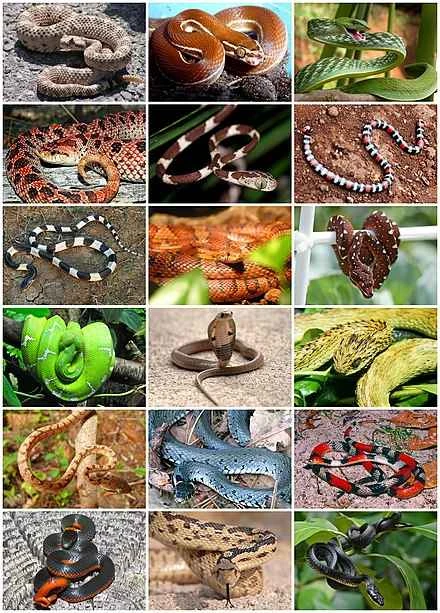
Snakes are members of the suborder Serpentes in the class Reptilia, and are found in most parts of the world except for the polar regions and some islands. Snakes have diverse subfamilies and species, and during evolution they lost their limbs, their bodies became elongated, and they specialized in a unique shape without prominent external ears and eyelids.
Basic features
Size : Snakes range in length from small snakes a few centimeters long (such as blind snakes) to extreme individuals such as pythons and boas that can exceed 10 meters in length.
Skull : The skulls of most snakes are very flexible, and the two halves of the lower jaw are not firmly connected, which allows them to swallow prey that is much larger than their own heads.
Skin : A snake's skin is covered with scales that help it move on the ground, and it sheds its skin regularly as it grows.
Lifestyle
Locomotion : Snakes move in various ways, including crawling, gliding sideways, moving in short, arched curves, and "striped sideways movement".
Hunting behavior : Different species of snakes have different hunting strategies; some ambush their prey, while others actively pursue them.
Diet : Most snakes are carnivorous, and their prey includes mammals, birds, insects and other reptiles. Some snakes also eat bird eggs or insects.
Hunting and venom : Some snakes are venomous, such as rattlesnakes, cobras, and various vipers, using venom to hunt or defend themselves. Other snakes, such as pythons and king snakes, kill their prey by strangling them.
Reproductive habits
Reproduction methods : Snakes reproduce in various ways. Most snakes are oviparous, meaning they lay eggs. However, some snakes, such as vipers, are viviparous, giving birth to live young inside their mothers.
Breeding season : The breeding season is usually during the warmer months to ensure that the young snakes can grow up before the cold season arrives.
Habitat
Diverse habitats : Snakes can adapt to various regions, including tropical rainforests, deserts, grasslands, forests, waterways, and even the ocean.
Low temperature environment : Snakes hibernate in low temperature environments.
Current situation and protection
Environmental threats : Habitat loss, environmental pollution, disease, and hunting by humans are the main threats facing snakes.
Conservation status : Many snakes are now listed as protected species, especially those threatened by the pet trade.
The relationship between humans and snakes
Cultural significance : In different cultures, snakes symbolize complex meanings such as wisdom, evil, healing, and revival.
Agricultural role : Snakes play an important role in agriculture because they can help control pests and rodents.
Venom Research : Snake venom has become an important source of biological research, including for drug development.
In conclusion, snakes are an important part of the diversity and functional diversity of ecosystems, and their protection is crucial for the balance of the natural environment.