According to the International Union for Conservation of Nature (IUCN) , species classified as "Critically Endangered (CR)" face an extremely high risk of extinction . Many sea turtles and tortoises fall into this category, such as the green sea turtle , leatherback sea turtle , and three-striped box turtle . Their endangerment is primarily due to human activities including habitat pollution and destruction , consumption of turtle eggs , hunting for meat and shells , and exploitation as a tourist attraction. Below, we systematically introduce the reasons for the endangerment of sea turtles and tortoises, key species , and possible actions .
Table of contents
Why are sea turtles/land turtles endangered? Main causes
Representative species that are endangered or vulnerable
Conclusions and what we can do
Why are sea turtles/land turtles endangered? Main causes
Direct development and utilization : In many areas, the collection of turtle eggs , consumption of turtle meat , and collection of turtle shells still occur; illegal trade has led to a rapid decline in the wild of some species.
By-catch (incidental catch)
One of the most challenging problems in recent years has been the accidental catch of sea turtles by fishing methods such as longline fishing and gillnetting. Turtles entangled in nets or hooks often die from drowning or severe injuries.Pollution and habitat destruction : Nearshore construction, coastal restoration, light pollution, marine debris (especially plastics), and chemical pollution reduce the sea turtles' foraging and breeding success rates ; beach hardening and coastal engineering destroy nesting sites.
Tourism Disturbance <br />Sea turtles are highly ornamental, attracting large numbers of tourists during their nesting season. Without proper management , actions such as handling hatchlings, photographing them under strong light, trampling their nests, noise pollution, and vehicle intrusion can all lead to high mortality rates and failed migrations.
Illegal hunting and ornamental use : In some countries and regions, turtle shells are used as ornaments, and turtle meat and eggs are considered "delicacies." A high-priced black market fuels continued poaching.
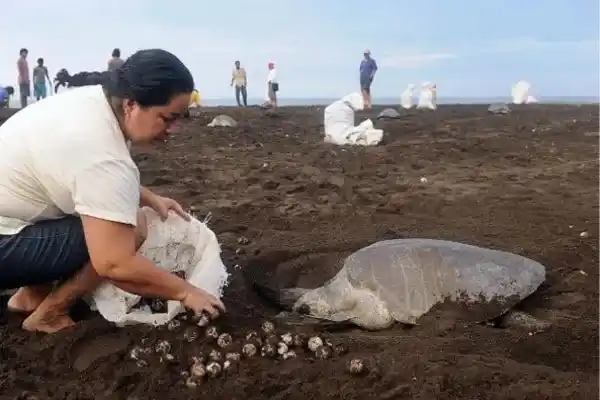
Important note: Many communities are transitioning from "predation on resources" to "ecotourism revenue." This requires scientific regulation and joint community management ; otherwise, tourism could become a new source of stress.
Representative species that are endangered or vulnerable
(The following summary is consistent with the original text, with added brief identification points to facilitate reader understanding. The actual threat level of each species is based on the latest IUCN assessment and national lists.)
Green sea turtle (Chelonia mydas)
A representative seagrass-algae feeder, commonly found in tropical to subtropical waters. Spawning sites are significantly affected by light pollution and coastal development.Kemp's tortoise/Kemp's turtle/Small-headed Kemp's tortoise (Lepidochelys kempii)
One of the world's smallest sea turtles, they often nest in groups and are vulnerable to one-off events (storms, trampling) and accidental capture .Hawksbill turtle (Eretmochelys imbricata)
Known as the "hawksbill turtle," it is often illegally hunted for decorative purposes ; it inhabits coral reefs and is threatened by coral degradation and fishing gear.Leatherback turtle (Dermochelys coriacea)
It is the largest in size and dives deep to feed on gelatinous organisms (such as jellyfish), easily mistaking plastic bags for food; it migrates long distances and often overlaps with deep-sea fishing.Loggerhead sea turtle (Caretta caretta)
With a large head and strong jaws, and a wide distribution, it is one of the main threats to longline fishing and bottom trawl by-products .Olive sea turtle (Lepidochelys olivacea)
They often exhibit "group spawning" phenomena, and their concentrated spawning sites are extremely sensitive to human disturbance and predators.Three-lined Box Turtle (Cuora trifasciata)
Typical Asian tortoise, its wild population is scarce due to long-term overhunting for the pet market and traditional uses .Apalone ater
Softshell turtles, which are distributed in North America, have limited habitats and are highly sensitive to water body alteration and pollution.Yangtze softshell turtle (Rafetus swinhoei)
This extremely rare, extra-large softshell turtle is critically endangered in both the wild and in captivity, and urgently needs genetic rescue and habitat restoration.
Further reading areas include topics such as whether leatherback turtles are endangered and why loggerhead turtles are threatened, which can be explored in the context of "management of accidental capture," "protection of spawning beaches," "light pollution control," and "plastic reduction initiatives."
Conclusions and what we can do
Sea turtles are among the oldest vertebrate groups on Earth, appearing approximately 110 million years ago and even surviving the extinction of the dinosaurs. Their ability to overcome the challenges of the Anthropocene depends on our ability to rapidly reduce threats, restore critical habitats, and replace predation with science and collaborative governance.
For individuals and tourists
Respect the rules of the nesting area : Do not turn on strong lights at night, do not touch the baby turtles, keep your distance from the nesting area, and follow the instructions of the guides.
Refuse to buy : Do not buy any wild turtle products such as turtle shell decorations, turtle eggs, and turtle meat.
Plastic reduction and waste sorting : Reduce single-use plastic products and avoid sending balloons, plastic bags, etc. into the ocean.
Rational maritime activities : When snorkeling/diving, do not touch or chase turtles; boats should slow down and avoid areas with high turtle density.
Reporting and participation : Immediately report any illegal fishing or trading to local law enforcement and protection organizations ; participate in beach cleaning and volunteer patrols.
Targeting communities and business owners
Standardize ecotourism : Establish restrictions on visitor numbers, speed limits, light limits , and buffer zones; use ticket revenue and guided tour revenue for patrols, rescue operations, and scientific research .
Friendly fisheries : Promote turtle traps (TEDs) , round hook alternatives, time and space avoidance and seasonal fishing moratoriums to reduce by-catch.
Nesting site management : control light at night, restrict vehicles and campfires, scientifically protect the nesting area, and guide young turtles into the sea in low light.
Science education : Schools and communities regularly conduct sea turtle conservation courses and public activities.
For government and cross-regional cooperation
Law and enforcement : Increase penalties for illegal trade and poaching ; strengthen cross-border cooperation to combat smuggling; regulate the pet market.
Key habitat protection : Integrate spawning beaches, foraging grounds and migration routes into marine/coastal protected area networks.
Pollution control and planning : control plastic waste and reduce wastewater discharge to meet standards, scientifically assess coastal engineering projects, and avoid destructive development.
Monitoring and research : satellite tracking of population migration, assessment of sex ratios (sand temperature affects sex determination), and establishment of rescue and genetic banks.
Special reminder: World Turtle Day
May 23rd is designated as " World Turtle Day " to raise public awareness of sea turtle conservation. Participation can be achieved through school activities, beach cleanups, special exhibitions, and online science education.
In conclusion , as long as the marine-coastal-estuary ecosystem remains healthy, sea turtles have hope for recovery. Transforming "seeing sea turtles" from a one-time novelty experience into a collective action to protect their life's journey is one of the most important choices our generation must make.