Ancient reptile egg fossils, especially dinosaur eggs, have been discovered in many parts of the world. Based on morphology, dinosaur eggs can be classified into short-round, oval, and oblong types. Dinosaur eggs vary greatly in size, shell thickness, internal and external ornamentation, shell structure, and the ratio of conical to columnar layers. To further study the internal characteristics of dinosaur eggs, scientists have employed advanced technologies and methods, such as scanning electron microscopy, X-ray diffraction, polarizing microscopy, and CT scanners. In recent years, Chinese scientists have, for the first time, used medical CT technology to conduct a non-destructive study of the internal structure of dinosaur egg fossils unearthed in Laiyang, Shandong Province, discovering that some of these fossils contained dinosaur embryos that could not be observed using other methods.
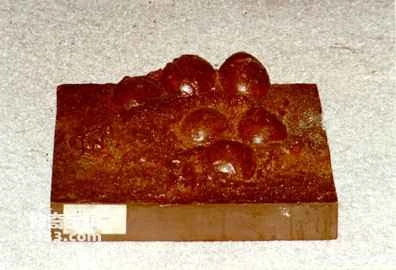
Laiyang Dinosaur Eggs
The dinosaur egg fossils from Laiyang, Shandong Province, are grayish-black in color, oval in shape, with one end blunt and the other pointed. The largest long diameter is 98 mm, the largest transverse diameter is 70 mm, and the smallest transverse diameter is 60 mm. The eggshell surface is rough with a few cracks. During the excavation, a small amount of eggshell fragments were removed, and a small amount of brownish-red silty mudstone adhered to the eggshell surface. The eggshell thickness is 2-3 mm. Cross-sectional scanning using a GE9800 medical whole-body CT scanner clearly distinguishes the outlines and positions of the eggshell, albumen, and yolk, and also allows observation of some very well-preserved gastrula blastodisciples. The blastodisciple is located on the more prominent side of the egg, near the edge of the albumen, and is approximately 80 mm long and 8 mm in diameter.
In-depth research on these dinosaur eggs has led researchers to believe that the extinction of dinosaurs was related to reproductive setbacks. These setbacks manifested as problems with the hatching of a large number of dinosaur eggs.
Based on dinosaur eggs found in the original stratigraphic layers, there is evidence that dinosaurs had the habit of laying eggs in clutches, ranging from a dozen to dozens. This high egg production rate is an ecological strategy that relies on quantity to ensure a normal number of hatchings and maintain a normal number of surviving offspring; in ecology, this is called the r-selection strategy.
In terms of the genetic characteristics of dinosaurs themselves, the homogeneity of the population must be considered. Large herbivorous dinosaurs mostly lived near lush vegetation and water sources, and their breeding grounds were not far from their habitat. Their massive size and dependence on water made long-distance migration inconvenient, and under relatively stable and favorable environmental conditions, they had no need for long-distance migration. This inevitably led to a reduction in the opportunities for hybridization within such dinosaur populations, resulting in population purification and the formation of many endemic genera and species. Evidence of this can be found in paleontological research. Population purification, to some extent, reduced the hatching rate of eggs. Dinosaurs laying eggs at too young or too old a age were detrimental to hatching, and their physical health also affected the hatching rate.
Regarding dinosaur eggs themselves, being too heavy or too light is detrimental to hatching. Since egg volume is directly proportional to its weight, eggs that are too large or too small for the same dinosaur species are less likely to hatch. Therefore, eggs of the same species with a large size variation will inevitably have a lower hatching rate than those with a small size variation. As for short-round and long-shaped eggs, the size variation of short-round eggs is smaller than that of long-shaped eggs; based on this alone, the hatching rate of long-shaped eggs should be lower than that of short-round eggs. Of course, dinosaurs that laid long-shaped eggs could compensate for this deficiency by increasing their egg production rate or improving eggshell structure. However, regardless of whether the egg is short-round or long, egg shape is another factor affecting hatching rate; eggs that are too long or too round have low hatching rates. Judging from the dinosaur eggs found in Laiyang, Shandong, these problems seem to have been present to varying degrees.
Eggshell thickness is another important factor affecting hatchability. Eggshell thickness generally varies within a certain range for similar eggs; for example, short, round eggs have a thicker shell, approximately 2 mm. However, among the short, round eggs discovered in Laiyang, those unearthed from lower strata have thicker shells, while those from upper strata show a significant decrease in thickness. The average shell thickness of oblong eggs is 0.9 to 2.0 mm, thinner than that of short, round eggs. Both excessively thin and excessively thick shells are detrimental to hatching. Existing data indicates that the phenomenon of dinosaur eggshells gradually thinning from bottom to top in strata is not unique to Laiyang but also observed in other regions of my country and Europe. Some eggshells are less than 1 mm thin, especially thin-shelled eggs from the Late Cretaceous. Such eggs are unlikely to hatch normally. Therefore, it is certain that a large number of dinosaur eggs failed to hatch by the time of the dinosaur extinction in the Late Cretaceous.
The internal quality of the egg also significantly impacts the hatching rate. Unlike birds, most reptiles do not actively incubate their eggs with their own body heat; instead, they rely primarily on solar heat. The incubation process is also influenced by environmental factors such as temperature and humidity. Based on the burial conditions of dinosaur egg fossils in their original stratigraphic layers, the strata generally underwent continuous deposition after the eggs were laid, without any signs of subsequent disturbance or transport. This suggests that dinosaurs, like crocodiles and other reptiles, likely covered their eggs with surrounding sand after laying to protect them from contamination or damage, leaving them to their own devices to enter the incubation stage. CT scans of dinosaur eggs from Laiyang, Shandong, do not appear to show the presence of air cells. The presence and size of air cells can indicate the duration of egg-laying. The absence of air cells in fossilized eggs indicates that these eggs ceased incubation shortly after being laid and died, subsequently entering the fossilization stage.
All of the above phenomena indicate that dinosaurs encountered serious problems with egg incubation during the Late Cretaceous, leading to reproductive setbacks. Researchers of these dinosaur eggs believe that this reproductive failure was likely the root cause of dinosaur extinction.