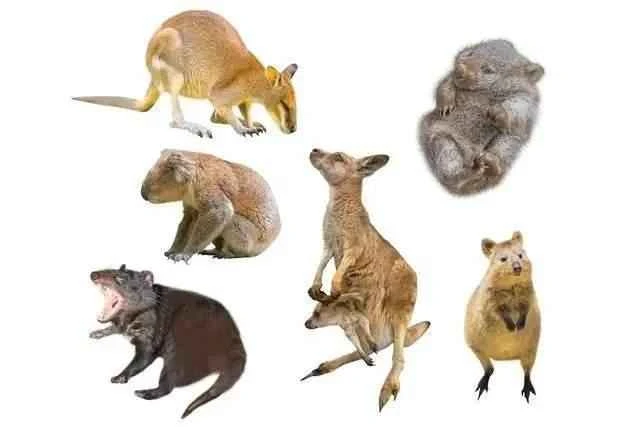
Marsupials are a unique group of mammals known for their distinctive parenting methods. The main characteristic of these animals is that the female possesses an abdominal pouch called a "brood pouch" or "bag" for raising her young. This pouch provides a relatively safe and warm environment for the young until they are mature enough to survive independently in the outside world.
Main features
Nursery pouch : Female marsupials have a special pouch on their abdomen used to protect and feed their young. The pouch contains nipples where the young nurse.
Placental development : Unlike placental animals, marsupials have less developed placentas, and the offspring have a shorter development period in the womb. The young are usually very immature at birth and need to continue developing within the pouch.
Reproduction : Female marsupials typically have two uteruses and two vaginas, which are different from the reproductive systems of placental animals.
Dental structure : Marsupials have diverse dental structures adapted to different food sources. They typically have a large number of premolars and molars.
Size and lifestyle : Marsupials range in size from small kangaroos to large wombats, and their lifestyles are also diverse, including herbivorous, carnivorous and omnivorous.
The evolution of marsupials
The evolutionary history of marsupials can be traced back to the Cretaceous period, approximately 100 million years ago. Their evolutionary process involved multiple stages, from early primitive marsupials to the diverse modern marsupials. Below are some key stages in marsupial evolution:
1. Early Evolution (Cretaceous Period)
Early Ancestors : The earliest ancestors of marsupials appeared in the Late Cretaceous period, and they shared many characteristics with other early mammals. The earliest marsupials may have resembled other primitive mammals, but they already exhibited some unique features, such as a simple pouch.
2. Evolutionary differentiation (early Cenozoic)
Differentiation Stage : In the early Cenozoic era, marsupials began to differentiate into different species. As continents broke apart and climate changed, they gradually adapted to various environments, from forests to grasslands, and even deserts and cold regions.
Southern Hemisphere Expansion : Marsupials are mainly distributed in the Southern Hemisphere, particularly in Australia and New Guinea. In these regions, they have adapted to a variety of ecological niches, including herbivorous, carnivorous, and omnivorous.
3. Modern evolution (late Cenozoic to present)
Australia's diversity : In Australia, marsupials have undergone tremendous diversification, resulting in numerous species such as kangaroos, koalas, and wombats. The region's relative isolation and unique ecological environment facilitated the evolution of marsupials.
South American marsupials : South American marsupials, such as koalas and anteaters, also demonstrate adaptations to different environments. These species played an important role in the evolutionary history of South America, although there are relatively few marsupial species in modern South America.
4. Modern Challenges and Conservation
Survival challenges : Modern marsupials face numerous challenges, including habitat destruction, climate change, and invasive species. These factors affect their survival and reproduction.
Conservation efforts : To protect the diversity and ecological functions of marsupials, many countries and regions have implemented conservation measures and projects, including the establishment of protected areas, habitat restoration, and legal protection.
Marsupials are renowned for their unique parenting methods and rich evolutionary history. Their evolutionary processes demonstrate the complexity of natural selection and environmental adaptation, enabling them to survive and thrive in a wide variety of ecosystems. Understanding the evolution of marsupials not only helps us comprehend the history of these remarkable animals but also helps us develop effective conservation strategies to ensure their future.
Marsupials are a diverse group of mammals, primarily distributed in Australia, New Guinea and surrounding islands, as well as parts of South America. Below is a detailed list of the major marsupials by classification:
1. Family Macropodidae
Red kangaroo (Macropus rufus) : The world's largest kangaroo, living in the grasslands and deserts of Australia.
Grey kangaroo (Macropus giganteus) : Commonly found in the forests and grasslands of eastern Australia.
Tree kangaroo (Dendrolagus spp.) : Lives in the tropical rainforests of New Guinea and Australia, and is adapted to an arboreal lifestyle.
2. Koala (Phascolarctidae)
Koala (Phascolarctos cinereus) : an arboreal animal that mainly inhabits eucalyptus forests in Australia.
3. Wombat family (Vombatidae)
Common wombat (Vombatus ursinus) : Lives in the forests and grasslands of Australia.
Northern wombat (Lasiorhinus krefftii) : also known as woolly wombat, it is found in the northern regions of Australia.
4.Petauridae
The breviceps (Petaurus breviceps) : also known as the short-nosed breviceps, lives in trees in Australia and New Guinea.
5. Koala family (Phalangeridae)
Long-tailed koala (Phalanger orientalis) : Lives in the forests of New Guinea and Australia.
Comb Wombat (Cuscus spp.) : Mainly distributed in New Guinea, with some species also found in northern Australia.
6. South American marsupials
Glyptodon : An extinct giant marsupial that once lived in South America.
Anteater kangaroo (Myrmecophaga tridactyla) : also known as giant anteater, it mainly lives in the tropical forests of South America.
7. Tasmanian devil family (Dasyuridae)
Tasmanian devil (Sarcophilus harrisii) : lives on the island of Tasmania and is known for its powerful bite and carnivorous nature.
Tasmanian devil (Dasyurus spp.) : including the common Tasmanian devil (Dasyurus viverrinus) and the yellow Tasmanian devil (Dasyurus geoffroii), distributed in Australia.
8. Tarsipedidae
The possum flying squirrel (Tarsipes rostratus) : also known as the long-beaked possum, mainly inhabits the forests of Australia.
9. Burramyidae
Small glider (Burramys parvus) : A small glider that lives in the high mountain regions of Australia.
10. Family: Cuscus
Black glider (Phalanger orientalis) : Inhabits the tropical forests of New Guinea and Australia.
11. Macropodidae (street kangaroos)
Stray kangaroo (Macropus fuliginosus) : Commonly found in forests and grasslands of Australia.
12. Peramelemorphia (Humpbacked Wallabies)
Humpbacked kangaroo (Perameles nasuta) : also known as the humped kangaroo, it is mainly distributed in the wetlands and forests of Australia.
13. Family: Hemibelideus lemuroides
Long-tailed glider (Hemibelideus lemuroides) : Found in the tropical rainforests of Australia.
14. Marsupialia (family Marsupialia)
Bag raccoon (Arctictis binturong) : Lives in the rainforests of Southeast Asia and has a distinctive scent.
These marsupials demonstrate an extremely rich range of ecological adaptability and evolutionary diversity, from small arboreal animals to large grassland animals, covering a wide range of lifestyles and environmental needs.
The cooking methods for marsupials vary due to cultural traditions in different regions. In some countries, particularly Australia and New Guinea, marsupial meat is used as a traditional food. Here are some common ways to cook marsupial meat:
1. Kangaroo meat
Kangaroo meat is favored for its low fat and high protein content. Here are some common cooking methods:
Roasting : Cut the kangaroo meat into thick slices and marinate with olive oil, salt, pepper, and your favorite spices. Preheat the oven to 200°C (392°F), place the marinated meat in a baking dish, and roast for 15-20 minutes, depending on the thickness of the meat and your desired level of doneness.
Pan-frying : Cut the kangaroo meat into small pieces or slices. Heat a pan with a little oil and pan-fry until the outside of the meat is golden brown. Since kangaroo meat dries out easily, it is recommended to pan-fry it to medium-rare to retain its juiciness inside.
Stewing : Cut the kangaroo meat into chunks, add vegetables such as onions, carrots, and potatoes, and an appropriate amount of liquid (such as broth or red wine), and stew in a slow cooker for 2-3 hours, until the meat becomes tender.
2. Koala meat
Koala meat is relatively rare in modern diets, mainly due to the koala's protected status. Even so, if legally sourced, koala meat is cooked similarly to other marsupials:
Stewing : Stew koala meat chunks with onions, carrots, potatoes, etc., using beef or chicken broth, for several hours until the meat becomes very tender.
Stew : Cut koala meat into small pieces and stew with various vegetables and spices to make a nutritious soup.
3. Wombat meat
Wombat meat is also quite common in Australia, and it can be cooked as follows:
Roasting : Marinate the wombat meat with herbs and spices, then roast it in the oven. Wombat meat is high in fat, so wrap it in aluminum foil while roasting to keep it moist.
Stewing : Similar to stewing other meats, wombat meat is stewed with vegetables and seasonings, making it suitable for making hearty stews.
4. Other marsupials
For other marsupials (such as marsupials, koalas, etc.), they can usually be cooked in the following ways:
Stewing : Cut the meat into chunks and stew it with vegetables and seasonings over low heat until the meat is tender.
Pan-frying : Marinate the chopped meat with salt, pepper and other seasonings, then pan-fry until golden brown on the outside and tender on the inside.
Precautions
Meat preparation : Marsupial meat is usually quite tough, so special care is needed when preparing it. Different cooking methods can help keep the meat tender.
Food safety : Ensure that meat comes from legal and hygienic sources and is thoroughly handled and cooked before cooking to avoid foodborne illnesses.
When handling and cooking marsupial meat, it is crucial to understand local laws, regulations, and cultural customs to ensure the legality and safety of the food.