The process of identifying the first land animals on Earth takes us back hundreds of millions of years, delving into the fields of paleontology and evolutionary biology. Understanding this topic not only reveals the origins of terrestrial life but also provides insights into how life evolved over billions of years.
Evolutionary Background
The transition from water to land is one of the most significant events in Earth's history. This transition began approximately 375 million years ago in the Devonian period, when early vertebrates began adapting to terrestrial environments. These adaptations were crucial for survival, leading to the development of limbs and lungs, enabling organisms to migrate to land.
Early land animals
While it's difficult to pinpoint exactly which was the "first" land animal, the earliest known terrestrial vertebrates are considered to be tetrapods. These creatures evolved from pectoral fish and began utilizing shallow-water environments. These adaptations were crucial for survival, leading to the evolution of limbs and lungs.
Tiktaalik: Transitional fossil
Discovered in Canada in 2004, Tiktaalik roseae is often considered a key species in the transition from water to land. This ancient fish possessed both aquatic and terrestrial characteristics, such as gills and lungs, as well as strong, limb-like fins. Living approximately 375 million years ago, Tiktaalik is one of the earliest known tetrapods. Its anatomy illustrates the gradual transition from aquatic to terrestrial life.
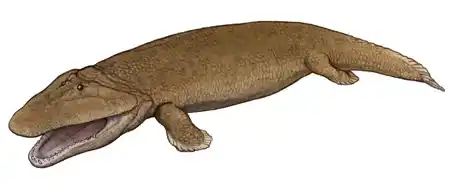
Acanthostega: Early tetrapod vertebrates
Acanthostega is another important species in this evolutionary narrative, living around the same time as Tiktaalik. Unlike Tiktaalik, Acanthostega possessed fully developed limbs, but its adaptations were still primarily suited to aquatic life. Its limbs have eight fingers, indicating that the evolution of fingers and toes was underway.
The first true land animal
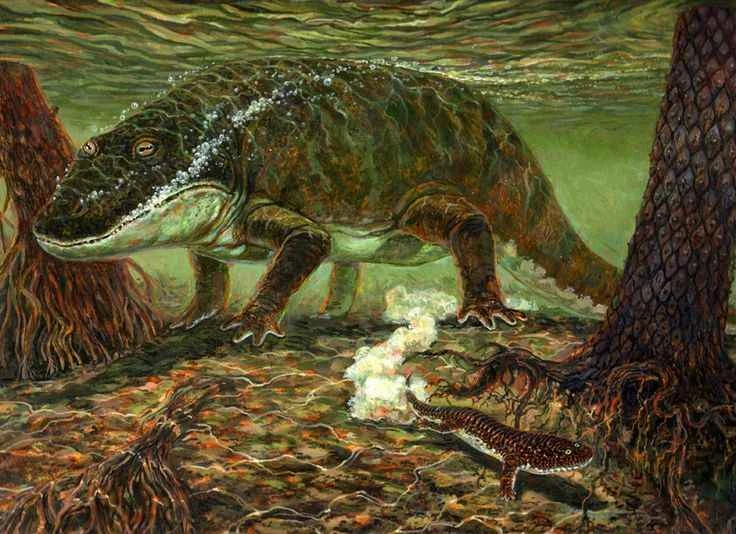
Although Tiktaalik and Acanthostega represent a transitional phase, the first truly terrestrial animals likely appeared during the Carboniferous period (approximately 360 to 300 million years ago). Early amphibians, such as Eryops, began to exhibit more adaptations to terrestrial life, including improved limb structures and skin capable of preventing dehydration.
The role of arthropods
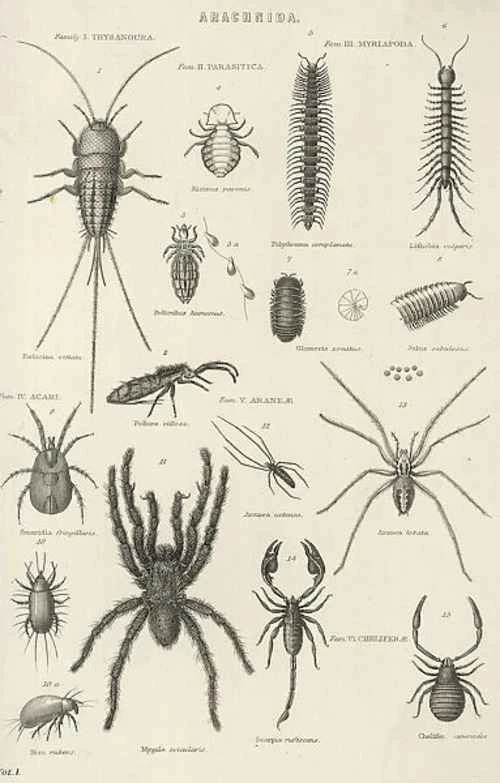
It is worth noting that, although tetrapods are often emphasized, the first land animals may also have included terrestrial arthropods such as millipedes and scorpions, which appeared in the Ordovician period about 450 million years ago. These invertebrates were among the earliest organisms to colonize the land, demonstrating the diverse evolutionary paths of this crucial period.
Impact on ecosystems
The emergence of terrestrial animals has had a profound impact on Earth's ecosystems. As these organisms adapted to terrestrial environments, they began to influence plant life, soil formation, and nutrient cycling. The evolution of terrestrial animals paved the way for the complex web of life we see today, including mammals, birds, reptiles, and ultimately, humans.
in conclusion
Identifying the first land animals on Earth involves understanding a complex series of evolutionary changes. From the pioneering adaptations of early tetrapods like Tiktaalik and Acanthostega to the emergence of true terrestrial vertebrates and arthropods, the journey to land shaped the trajectory of life on our planet. This evolutionary milestone reminds us of the resilience and adaptability of life, highlighting the complex bonds that connect all living things.
Frequently Asked Questions
1. What were the characteristics of early land animals?
Early land animals exhibited adaptive features such as limbs for locomotion, lungs for breathing air, and skin to prevent water loss.
2. What are the modern descendants of the first land animal?
Yes, modern amphibians, reptiles, birds, and mammals can all be traced back to these early terrestrial creatures.
3. What impact did the shift to land have on animal evolution?
This transformation led to species diversification and the colonization of various terrestrial habitats, resulting in the complex ecosystems we see today.
Understanding the origins of terrestrial life provides valuable insights into our place in nature and the ongoing story of evolution.