Clistopyga crassicaudata, commonly known as the giant stinging wasp or scorpion wasp, is a recently discovered species primarily found in the transitional zone between the Andes Mountains and the Amazon rainforest lowlands. This wasp mainly inhabits the rainforests of countries such as Colombia, Ecuador, Bolivia, and Peru. Due to its unique biological characteristics and lethal ability, this parasitic wasp has attracted considerable attention from scientists. Discovered in 2018 by a research team from the University of Turku in Finland and their Latin American counterparts, this wasp exhibits characteristics distinctly different from other parasitic wasps.
Appearance description and classification
*Clistopyga crassicaudata* belongs to the family Ichneumonidae, a large family of parasitic wasps. A distinctive feature of this family is the unique second repetitive vein on its forewings. Like other parasitic wasps, it does not directly consume its host, but rather uses the host as a living incubator and food source to ensure the growth and development of its offspring.
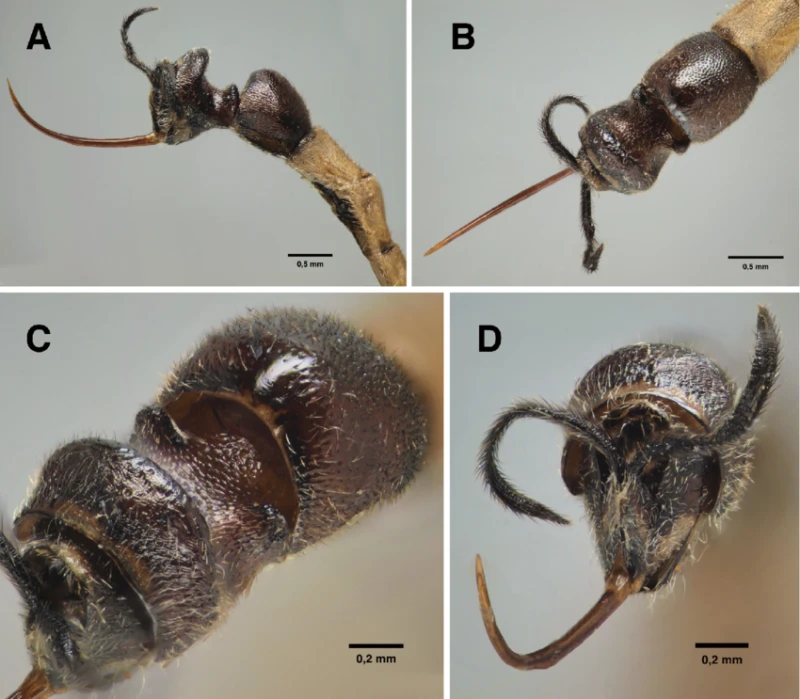
The most striking feature of this wasp is its long, thick ovipositor, often referred to as its stinger. This organ has a dual function: it can inject venom to paralyze prey, and it can also be used to lay eggs inside or on the surface of the host. C. crassicaudata typically lays its eggs in spiders or spider egg sacs hidden in tree cavities. These spiders, paralyzed by the venom, become food for the wasp larvae.
lethality and parasitic behavior
While there are over 50,000 species of parasitic wasps in the order Hymenoptera, *Clistopyga crassicaudata* stands out for its deadly, precise attacks. This species is an "idiobiont," meaning it completely paralyzes and exploits its host, ultimately leading to the host's death. Unlike simple parasitic insects, parasitic wasps rapidly incapacitate their prey before consuming it.
The venom injected through its ovipositor is extremely potent, rapidly paralyzing spiders or their egg sacs, after which the wasp lays its eggs on the host. The larvae hatch and feed on the paralyzed spider or its eggs, ensuring a plentiful food supply to promote their growth. While this process is fatal to the spider, it demonstrates the astonishing adaptability of parasitic wasps in their survival strategies.
Discovery and Importance
The discovery of *Clistopyga crassicaudata* adds significant material to parasitic wasp research. Researchers, including Professor Ilari E. Saaksjarvi and his team, have described this species for the first time, noting its unusually long ovipositor. While not the largest wasp (that title belongs to the Asian giant hornet *Vespa mandarinia*), *Clistopyga crassicaudata* possesses one of the longest ovipositors in the parasitic wasp family.
As a newly discovered species, detailed information about its behavior, population, and ecological impact remains limited. However, as research continues, scientists are gradually revealing the role of this wasp in its habitat.
The difference between wasp stings and bee stings
Understanding the stinging mechanism of *Clistopyga crassicaudata* also helps distinguish wasps from bees. Bees have barbs on their stingers; when a bee stings its prey, the stinger embeds itself into the prey and carries away a portion of the bee's abdomen, ultimately causing the bee's death. Therefore, a bee can only sting once.
Wasps, on the other hand, have smooth, retractable stingers that don't get stuck in their prey. This allows them to sting repeatedly without threatening their lives. Wasp stings are used not only for defense but also for hunting and laying eggs.
Ecological role and importance
Clistopyga crassicaudata plays a vital role in the ecosystem, regulating spider populations by preying on spiders. Spiders are important predators in the ecosystem, but excessive numbers can disrupt the ecological balance. The parasitic wasp, through its parasitic behavior, helps maintain a balance in spider populations, thus supporting biodiversity in the rainforest.
Although parasitic wasps are often misunderstood or feared because of their parasitic behavior, wasps like *Clistopyga crassicaudata* provide important services to ecosystems. By preying on spiders, they help maintain the health of ecosystems, preventing the overgrowth of any one species and thus promoting ecosystem balance and diversity.
The giant stinging wasp, *Clistopyga crassicaudata*, is a fascinating example of parasitic behavior in the wild. Its discovery in 2018 opened new avenues for studying the diversity and evolutionary adaptations of parasitic wasps in the South American rainforest. With its deadly sting, precise hunting techniques, and unique role as a parasitic spider, this wasp is both a marvel of nature and an integral part of its ecosystem. As research continues, we will learn more about this fascinating species and its role in one of the world's most biodiverse regions.