When people think of black-feathered birds, many think of crows and ravens. Because of their similar appearance and behavior, they are often confused, but they are actually different species, each with its own unique characteristics. This article will guide you through a detailed understanding of the differences between crows and ravens, analyzing their physical characteristics, behavior, habitats, and symbolic meanings.
1. Crow vs. Raven: Physical Differences
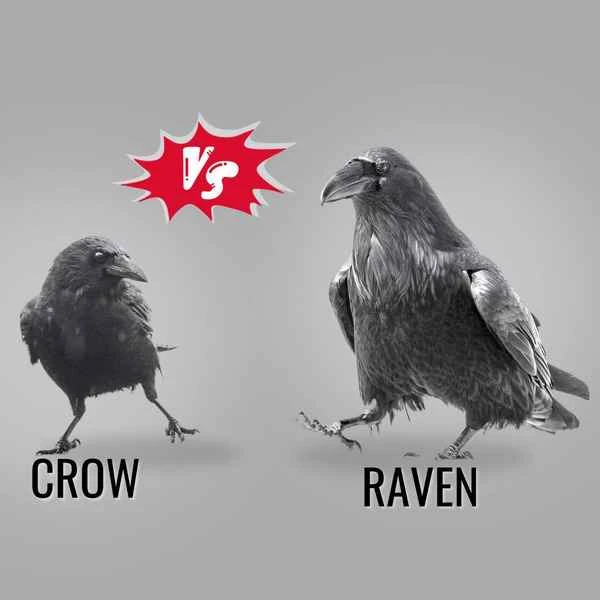
Although crows and ravens may look similar at first glance, there are several key features that can help distinguish them.
| feature | crow | Raven |
|---|---|---|
| body shape | Medium size, approximately 17 inches | Larger, over 24 inches |
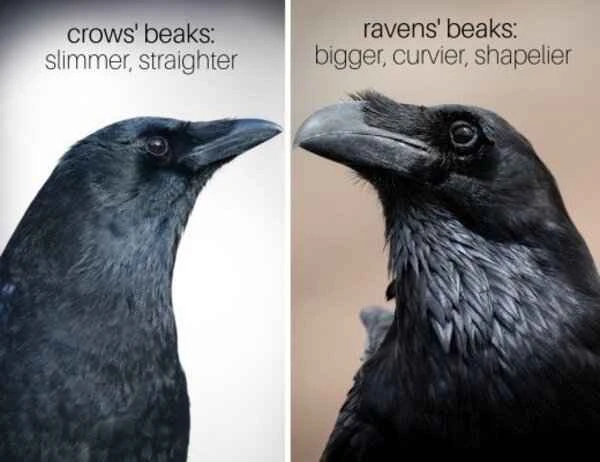
| beak | Smaller, slender and pointed | Larger, thicker, and curved ("Roman-style" beak). |
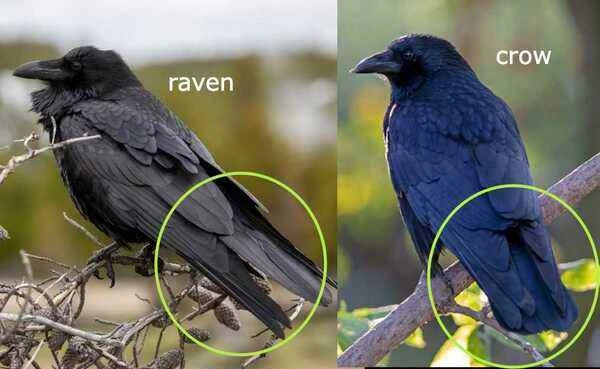
| Tail shape | Its tail is fan-shaped during flight. | wedge-shaped or rhomboid tail |
| Neck feathers | Smooth, feathers close together | Loose, with feathers resembling a "collar". |
One of the most noticeable differences is size: ravens are significantly larger, sometimes even mistaken for eagles from a distance. They also have thicker, curved beaks, making them appear more robust. Crows, on the other hand, are typically more slender, with thinner, straighter beaks.
2. Sounds and calls
Both crows and ravens are known for their distinctive calls, which are an important way for birdwatchers to identify them.
Crows are known for their distinctive "caw-caw" call, which is usually sharp, loud, and repeated frequently.
Raven: Its voice is deeper, making a "caw" or "gull" sound with an echo, which sounds low and mysterious.
Crows are more likely to "chat," especially when they are in flocks, they often make calls; while ravens have a wider variety of calls, but these are relatively infrequent.
3. Habitat and distribution range
Crows are highly adaptable and can survive in a variety of environments, from cities to forests, farmlands and even mountains, and are found almost all over the world (except for polar regions and some isolated islands).
Ravens prefer more remote areas and are less fond of urban environments. They are more commonly found in open areas such as mountains, deserts, and forests, but can also be occasionally seen in some large cities. Ravens are mainly distributed in the Northern Hemisphere, such as North America, Europe, and Asia.
4. Social Behavior and Intelligence
Crows and ravens both belong to the Corvidae family, a group known for its intelligence, but they differ in their social behaviors:
Crows: Highly social, they usually live in flocks, which are called "murders." They are highly cooperative, often foraging together and protecting their territory together.
Ravens: Relatively independent, they tend to live in pairs or alone. They are known for their strong pair bonds, and once paired, they usually stay together for life.
Both crows and ravens are highly intelligent, possessing the ability to use tools, solve problems, and even remember people who are unfriendly to them. Crows are known for recognizing faces and their complex social structures; ravens, on the other hand, demonstrate extraordinary creativity and problem-solving skills, even creating their own toys or skis for their own amusement.
5. Dietary Habits
Both crows and ravens are omnivorous and scavengers, meaning they will eat almost any food available, but they do have some preferences in their choices:
Crows: They prefer insects, seeds, and small animals, and will also eat food discarded by humans in urban environments.
Ravens: Prefer meat and often feed on animal carcasses. In the wild, ravens also hunt small mammals and birds.
They all play an important role in cleaning up the ecosystem, especially ravens, which excel at cleaning up carrion in the wild.
6. Symbolism and Mythology
Crows and ravens hold a profound place in culture, mythology, and symbolism.
Ravens: In many cultures, ravens are seen as tricksters, symbolizing wisdom and adaptability. However, in some Western cultures, ravens are associated with misfortune, death, and mystery, often appearing in folklore as either helpers or pranksters.
Ravens: Ravens are often seen as symbols of mystery and wisdom. In Norse mythology, Odin, the king of the gods, kept two ravens named Huginn and Munnn, symbolizing thought and memory. Ravens are also seen as symbols of prophecy and protection in different cultures.
7. Lifespan and Reproduction
Ravens have a longer lifespan than crows; some ravens in the wild can live to be over 20 years old, while crows typically live to be around 7-10 years old. Both nest in trees or on cliffs.
Ravens are known for their elaborate courtship rituals, which include aerial acrobatics and sharing food with their mates. Crows are also monogamous, but their courtship behavior is relatively simple.
Comparison Table: Raven vs. Crow
| feature | crow | Raven |
|---|---|---|
| body shape | Medium size, approximately 17 inches | Larger, up to 24 inches or larger |
| beak shape | Slender and pointed | Thick and curved |
| Tail shape | sector | wedge or rhombus |
| Cry | "Caw caw" | A deep "quack" |
| Social behavior | Highly social, often acting in groups (murder) | More independent, usually acting in pairs |
| Habitat | Diverse (urban, rural, mountainous, etc.) | More remote areas, such as mountains or forests |
| life | 7-10 years in the wild | In the wild, they can live for more than 20 years. |
| Symbolic meaning | Resourceful and adaptable | Mystery, wisdom, prophecy |
Although crows and ravens are often confused, there are actually many differences between them—from size and calls to social behavior, and even their symbolic meanings in different cultures. Whether you encounter a nimble crow in a park or a solitary raven in a quiet forest, these birds are all charming and play important roles in the ecosystem.
Which is smarter, a crow or a raven?
When it comes to "intelligent birds," crows and ravens are definitely at the top of the list! But who is smarter? Actually, they are about the same in intelligence , after all, they are the top sages of the corvid family.
Crows : Smaller in size, they are good at problem-solving . They can use twigs as tools and can also learn to "feed and trade" with humans (such as exchanging pebbles for food).
Ravens : Large in size and quick-witted, but they prefer to use their brains to play pranks . Ravens can mimic sounds and even call on wolves to eat prey so they can get a share.
In short, they are evenly matched in intelligence, but each has its own strengths in different scenarios!
The survival competition between crows and ravens
Crows and ravens are related, but they inevitably have some minor conflicts over territory and food.
Territorial disputes : Ravens prefer cold regions and are frequent visitors to forests and mountains in North America and Europe; crows are more adaptable and can be found in cities, countryside, and even tropical regions.
Food competition : Both are omnivorous , eating a wide variety of foods—fruits, insects, small animals, and even carrion. So if they appear in the same area, the raven will have a slight advantage because it is larger and can sometimes bully the crow.
Adaptability Showdown : Crows' adaptability allows them to thrive in the city, while ravens prefer the wilderness environment; each has its own survival advantages!
In general, ravens are larger, but crows always manage to find their own space to survive thanks to their adaptability and resourcefulness.
The evolutionary history of crows and ravens
Crows and ravens are both ancient members of the corvidae family, with ancestors dating back 50 million years .
They evolved from arboreal birds in their early stages, gradually developing a high level of intelligence and becoming "genius birds" capable of surviving in various environments.
Crows have a wider distribution and have evolved over millions of years into several species that have adapted to different climates and terrains, such as the large-billed crow and the house crow.
Ravens have evolved to be stronger and have gradually adapted to cold climates, and are now mainly distributed in northern forests and wilderness.
Their evolutionary story is a dual evolution of intelligence and survival skills!
Five common misconceptions about crows and ravens
Misconception 1: Crows and ravens are the same size.
Wrong! Ravens are significantly larger, with denser plumage, and fly somewhat like small birds of prey, while crows are much "smaller".
Misconception 2: Crows and ravens are bad omens.
Actually, this is a cultural bias! In some cultures, they symbolize wisdom , protection , and even bring good luck!
Misconception 3: Crows and ravens are pure black.
In fact, if you look closely under the sunlight, their feathers will shimmer with purple , blue or metallic sheen , which can be described as a natural "highlight" beauty!
Misconception 4: They only eat carrion.
Although they eat carrion, they are omnivores , enjoying fruits, seeds, and small animals with great relish!
Misconception 5: They don't know how to use tools.
That's completely wrong! Crows can solve complex problems using twigs and pebbles; ravens also utilize their environment, such as playing with snowballs, demonstrating high intelligence!
10 Interesting Facts About Crows and Ravens
High intelligence : Crows have an intelligence equivalent to that of a 7-year-old child , and ravens are not far behind, making them "super learners" among birds.
Crows are vengeful : They have an amazing memory and can remember people or animals that threaten them, and may even rally their companions to "take revenge".
Ravens can play pranks : they can imitate animal calls, and even human voices, to trick other animals.
Strong family values : Crows and ravens are both very family-oriented and will take care of their young together, showing a strong sense of family affection.
Crows understand trade : Sometimes crows give humans "gifts," such as twigs or shiny trinkets, in exchange for food.
Ravens understand "cooperation" : Ravens will cooperate with wolves, helping them find prey and then sharing the food with them.
A genius at mimicking sounds : Ravens can imitate the sounds of wolves, cats, and even humans, making them veritable "voice actors" of the bird world.
Loves skiing : Northern ravens roll snowballs and ski on snow slopes, purely for fun.
They hold "funerals" : When crows see a companion die, they gather together in a manner similar to "mourning," which scientists believe may be a way of learning warning messages.
Extremely long lifespan : Crows and ravens have very long lifespans, living 10-15 years in the wild, and even more than 30 years in protected environments!
In conclusion, crows and ravens are not only the "wise men" of the bird world, but also highly individualistic and fascinating animals. They can adapt to both urban environments and soar freely in the wilderness. Next time you see them, pay closer attention; you might just experience their charm too!