Wolves are fascinating creatures that have captivated the human imagination for centuries. As apex predators, they are renowned for their intelligence, strength, and complex social structures. The wolf family encompasses a wide variety of species and breeds, each with its own unique characteristics and temperament. This article will delve into the largest wolf species, introducing various wolf breeds and comparing them based on their conservation status, population size, distribution area, country of origin, predators, and especially ranking them by aggression from highest to lowest.
Wolves: Fascinating Wildlife
Wolves have long captivated the human imagination. These intelligent and highly adaptable predators are indispensable members of the global ecosystem. From their signature howls to their complex social structures, wolves are considered among the most threatening creatures in nature. In this article, we will explore the world of wolves—examining their physical characteristics, behavior, different species, and their roles in the wild. We will also discuss their conservation status and the challenges they face in the modern world.
What is a wolf?
Wolves belong to the family Canidae, which also includes domestic dogs, foxes, and coyotes. The gray wolf (Canis lupus) is the largest member of this family, known for its strength, intelligence, and social structure. Wolves are carnivores, primarily preying on large ungulates such as deer, moose, and bison, but they also exhibit opportunistic foraging behavior, hunting smaller prey or scavenging when necessary.
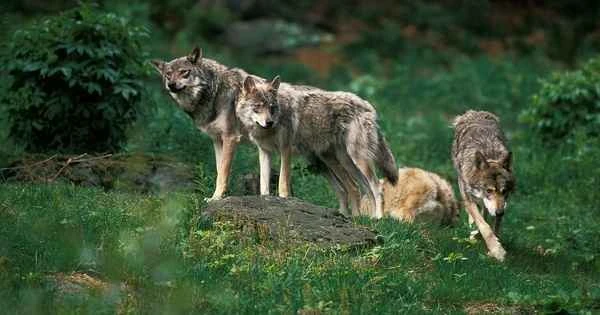
Wolves are highly social animals, typically living in packs that help them hunt, raise cubs, and defend their territory. A wolf pack is usually led by a pair of alpha wolves (the dominant wolves), who are usually the only members with reproductive rights. The alpha wolves are responsible for leading hunts and making decisions, while the other members help care for the cubs and support pack activities.
physical characteristics of wolves
Wolves are known for their large size and robust physique, making them extremely effective predators. Wolves vary in size depending on subspecies and region, but a typical adult gray wolf (Canis lupus) stands about 66 to 81 centimeters tall at the shoulder and weighs approximately 23 to 50 kilograms (50 to 110 pounds). Individuals living in cold climates, such as the Arctic wolf, can weigh over 79 kilograms (175 pounds).
Main features:
Fur : Wolves have thick fur, which helps them survive in cold environments. The color of a wolf's fur can range from white and gray to black, depending on the environment, and usually has a mixed-color appearance.
Eyes : Wolves usually have yellow or amber eyes, although some wolves have lighter-colored eyes.
Teeth : Wolves have very strong jaws and sharp teeth, especially their canines, which are used to grasp and tear prey.
Claws : Wolves have large claws, which are well-suited for walking on snow and rugged terrain.
Wolves: Types and Subspecies
There are several different types of wolves in the world, the most well-known being the gray wolf (Canis lupus). Wolves are widely distributed in parts of North America, Europe, Asia, and the Middle East. Different wolf species and subspecies in different regions may have different physical characteristics and behavioral habits.
Main wolf species and subspecies:
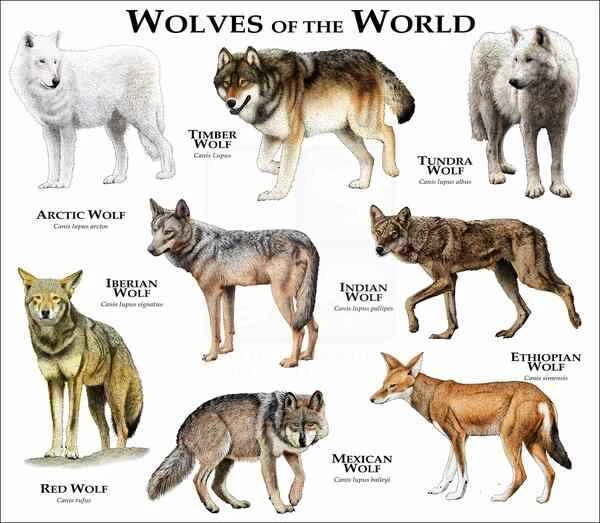
Gray Wolf (Canis lupus)
The most widely distributed wolf species, found in parts of North America, Europe, and Asia.
Gray wolves are highly adaptable and can survive in various environments such as forests, grasslands, deserts, and even the Arctic tundra.
There are several subspecies of gray wolf, including the Arctic wolf, Mexican wolf, and Mackenzie Valley wolf.
Red Wolf (Canis rufus)
They are mainly distributed in the southeastern United States. Red wolves are smaller and more slender than gray wolves.
The red wolf was once thought to be extinct in the wild, but it is now a focus of conservation efforts.
The red wolf is currently listed as an endangered species, with only a few wild individuals remaining.
Ethiopian wolf (Canis simensis)
It is found only in the highlands of Ethiopia and is the rarest of all wolf species.
It is smaller than other wolf species and mainly hunts small prey, such as rodents.
The Ethiopian wolf is currently listed as critically endangered, with fewer than 500 individuals remaining in the wild.
Arctic wolf (Canis lupus tundrarum)
They live in the Arctic and subarctic regions and have adapted to the cold climate.
Arctic wolves are larger than temperate gray wolves and typically hunt large prey, such as reindeer, within their packs.
Mexican wolf (Canis lupus baileyi)
This is a subspecies of gray wolf that was once widely distributed in parts of the southwestern United States and Mexico.
The Mexican wolf was declared extinct in the wild in the 1970s, but reintroduction programs have brought a small number of individuals back into the wild.
The Mexican wolf remains an endangered species and faces numerous conservation challenges.
Wolf behavior and social structure
Wolves are highly social animals, living in structured groups. A wolf pack typically consists of a family unit, with the alpha wolf (the dominant wolf) at the top. The alpha wolf is the primary breeder, while other pack members help care for the cubs. Pack size can vary, but usually remains between 4 and 12 wolves.
Group dynamics:
Hierarchy : Alpha wolves lead the pack and make decisions, but other members of the pack also play important roles in hunting and territorial defense. Wolves communicate through vocalizations (such as howls), body language, and scent marking.
Hunting : Wolves hunt in packs, which enables them to catch large prey. Pack members typically have specific roles, working together to surround and capture the prey.
Territory : Wolves are territorial animals. They establish and maintain their territorial boundaries through vocalizations (howling) and scent marking, and often clash with other wolf packs.
The role of wolves in the ecosystem
Wolves play a vital role in maintaining healthy ecosystems. As apex predators, wolves help control herbivore populations, prevent overgrazing, and ensure the healthy growth of plant communities. By hunting weak or sick animals, wolves help improve the overall health of their prey populations.
Wolves also create a "trophic cascade," meaning their presence influences the behavior of other animals in the ecosystem. For example, when wolves are present, herbivores like deer may avoid certain areas, providing opportunities for plant regeneration. This promotes biodiversity and helps new plant species flourish.
The threat and protection of wolves
Despite their vital role in the ecosystem, wolves face numerous threats. Historically, they have been persecuted due to human fear and misunderstanding. Habitat destruction, hunting, and the expansion of human settlements have drastically reduced wolf populations in many areas. In some places, wolves continue to be subject to illegal hunting and capture.
Threats facing wolves:
Human-wildlife conflict : Wolves are often seen as a threat to livestock, leading to conflicts between them and farmers and herders. As a result, wolves continue to be hunted or relocated in some areas.
Habitat loss : Urbanization, deforestation, and land development have reduced the habitat of wolves.
Poaching : In some areas, wolves are illegally hunted for their fur, and poaching remains a problem.
Conservation efforts:
Reintroduction programs : In places like Yellowstone National Park in the United States, wolves were wiped out in the 20th century, but reintroduction programs have successfully reintroduced them and restored wolf populations. These programs have achieved remarkable success in restoring wolf populations and rebuilding ecosystems.
Legal Protection : Wolves are now protected by law in many countries. The Endangered Species Act in the United States helps protect certain wolf species, while similar laws exist in Europe and Canada.
Public awareness : Conservation organizations and researchers are working to raise public awareness of the importance of wolves in the ecosystem and to promote wolf conservation.
Wolves are awe-inspiring creatures with complex social structures, exceptional hunting abilities, and vital roles in ecosystems. From the gray wolf of North America to the rare Ethiopian wolf, every wolf species and subspecies contributes to the Earth's biodiversity. Despite numerous threats to wolves, conservation efforts are yielding significant results, helping to ensure the survival of these apex predators in the wild. As we learn more about wolves and their importance, it is our responsibility to continue protecting their habitats and ensuring their continued existence.
Largest wolf species: Top five
Wolves vary in size, with some breeds being significantly larger than others. Below are the five largest wolf breeds, listed from largest to smallest:
Gray Wolf (Canis lupus)
Size : Up to 6.5 feet long (including tail) and weighing up to 175 pounds.
Agility : Powerful and fast, capable of traversing vast areas quickly.
Aggressive : Known for its strong territoriality and protectiveness of its wolf pack.
Distribution areas : North America, Europe, Asia, and the Middle East.
Conservation status : It has been listed as an endangered species in some areas, mainly due to habitat loss and human hunting.
Natural enemies : humans, large bears, and sometimes other wolf packs.
Mackenzie Valley Wolf (Canis lupus occidentalis)
Size : Up to 7 feet long and weighing about 175 pounds, it is the largest subspecies of gray wolf.
Aggressive : Extremely aggressive and dominant within the group.
Distribution area : North America, especially Canada and Alaska.
Protection level : Low risk, although their numbers have decreased due to human activities.
Natural enemies : bears, humans, and other wolves.
Alaskan Inland Wolf (Canis lupus pambasileus)
Size : Weight can reach 150 pounds, and body length can reach 6 feet.
Aggressiveness : It is particularly protective and aggressive in winter.
Distribution area : Mainly distributed in Alaska.
Protection level : Low risk, but considered threatened in some areas.
Natural enemies : bears, humans, and large predators.
Tundra Wolf (Canis lupus albus)
Size : Medium to large, about 6 feet long and weighing about 130 pounds.
Aggressive : Especially aggressive during the hunting season.
Distribution area : Mainly distributed in the Arctic regions of Canada and Russia.
Protection level : Their numbers are threatened in some areas due to climate change and habitat loss.
Natural enemies : large predators, especially brown bears.
Eastern Wolf (Canis lycaon)
Size : Smaller than a gray wolf, weighing approximately 110 pounds.
Aggressiveness : Very territorial and shows a strong protective instinct towards the wolf pack.
Distribution area : Mainly distributed in Canada and the northeastern United States.
Conservation status : Listed as an endangered species, mainly due to hybridization with coyotes and conflicts with humans.
Natural enemies : coyotes, large wolf packs, and humans.
Wolf species comparison: key differences
Besides size and aggression, different wolf species also differ in their protection levels, population sizes, and distribution areas. Below is a table comparing the most aggressive wolf species and breeds, highlighting their key characteristics.
| wolf species | Protection level | Current population size | Distribution area | Countries of distribution | Natural enemies | Aggressive |
|---|---|---|---|---|---|---|
| Gray Wolf (Canis lupus) | Endangered to Vulnerable | Approximately 200,000 worldwide | North America, Europe, Asia, Middle East | United States, Canada, Russia, Scandinavia, Mongolia, China | Bears, humans, and other wolf packs | high |
| Mackenzie Valley Wolf (Canis lupus occidentalis) | Low risk | Approximately 40,000 | North America (Canada, Alaska) | Canada, United States (Alaska) | Bears, humans, and other wolf packs | Very high |
| Alaskan Inland Wolf (Canis lupus pambasileus) | Low risk | Approximately 15,000 | Alaska | United States (Alaska) | Bears, humans, large predators | high |
| Tundra Wolf (Canis lupus albus) | endangered | Unknown (scarce population) | Arctic regions of Canada and Russia | Canada, Russia | Bears, large predators | high |
| Eastern Wolf (Canis lycaon) | endangered | Approximately 1000 | Canada, Northeastern United States | Canada, Northeastern United States | Coyotes, large wolf packs, humans | Medium and high |
Wolves' natural enemies
Although wolves are apex predators in most habitats, they do face some natural enemies, especially from larger predators. The main predators of wolves include:
Humans : Human activity is the biggest threat to wolves. Habitat loss, hunting, and conflict with livestock have led to a decline in wolf populations.
Bears : Especially large bears such as brown bears, they can sometimes overpower or even kill wolves.
Other wolf packs : Violent clashes between wolf packs during territorial disputes can result in casualties.
Wolf protection work
Wolf conservation efforts vary depending on the species and habitat. In areas where wolf populations are endangered, such as the eastern wolf , proactive conservation measures have been implemented to monitor and protect the species. Organizations such as the Defenders of Wildlife and the World Wildlife Fund (WWF) are actively involved in wolf conservation projects, dedicated to protecting habitats, reducing conflict with humans, and ensuring the survival of endangered wolf species.
Wolves are very special creatures, with each species possessing unique characteristics. The largest and most aggressive species, such as the Mackenzie Valley wolf and the gray wolf , play crucial roles in their respective ecosystems. However, they also face threats from habitat loss, human conflict, and other predators. Understanding the characteristics, distribution, and behavior of different wolf species not only helps us better appreciate these amazing animals but also ensures that conservation efforts continue so that future generations can witness their existence.