In short : the coral snake (venomous) commonly found in North America looks very similar to the scarlet king snake/milk snake (non-venomous). A relatively reliable distinction can be made within seconds by observing details such as the order of the clasps, the color of the snout, and whether the clasps are wrapped around the body —but remember that this rhyme doesn't apply in all regions.
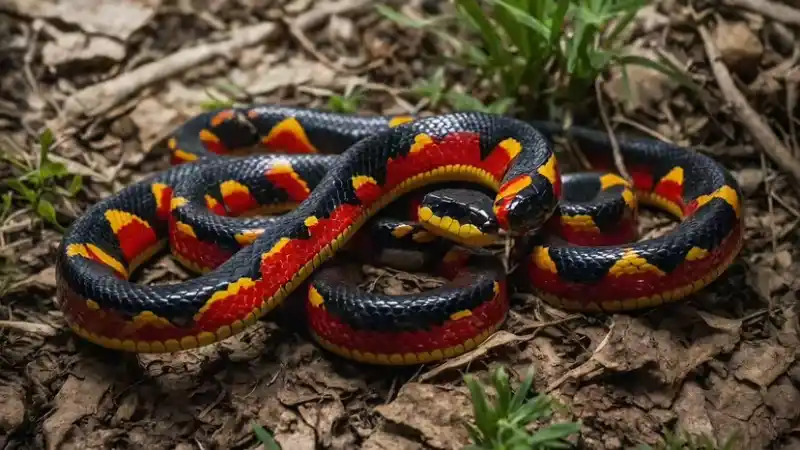
Table of contents
10-second fast recognition (North American scenario)
Coral snakes: appearance, distribution, habits and bites
King snakes (including scarlet king snakes/milk snakes): appearance, distribution, habits
The pitfall of the rhyme: When is the saying "red is poisonous when it's associated with yellow" unreliable?
Coral snake vs. King snake: Quick reference chart
Common "face-matching" species in North America
Safety Guide: What to do if you encounter/are bitten
Frequently Asked Questions
10-second fast recognition (North American common scenarios)
Circular contact sequence
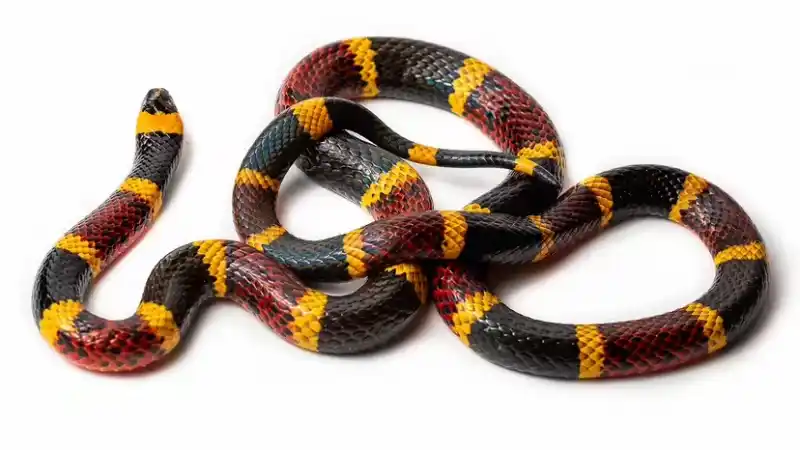
Coral snake (Micrurus) : Red–yellow–black–yellow–red (commonly "red with yellow"); the bands on the sides and tail are mostly full circles .
The scarlet king snake/milk snake (Lampropeltis) is red-black-yellow/white-black-red ("red on top of black"), with black often separating red from yellow/white.
Mouth, nose and head
Coral snake : The snout and the front part of the head are often covered by a single black "mask".
King snake : Its mouth and nose are mostly red or mixed colors , and rarely a solid black.
Ring shape and width
Coral snake : The yellow color is relatively narrow and clear , and it is mostly a symmetrical circle .
King snakes : The black bands are often wider , the yellow/white bands may be lighter, and the belly may not be a full circle .
If you're unsure, don't catch it . Young snakes or snakes with changing color patterns can interfere with your judgment.
Coral snake ( Micrurus ; New World species)
Appearance features
Glossy, smooth scales with typical red-yellow-black tricolor bands; common species in the United States (Eastern Coral Snake M. fulvius ; Texas Coral Snake M. tener ) are mostly red with yellow bands .
The black muzzle is prominent; the rings often wrap around the body and tail in a complete loop .
Distribution and Habitat (United States)
Southeast to the Gulf Coast : Sandy pine forests, dwarf forests, shrubs, and the edge of the litter layer.
Texas : It can be found in everything from pine forests to coastal grasslands and shrublands.
Behavior and Diet
They are mostly secretive and active at dawn/dusk; their diet consists mainly of small snakes and lizards .
Toxicity and bites
Potent neurotoxicity : May cause muscle weakness, ptosis, slurred speech, respiratory involvement, etc.; pain may not be obvious at first, but the course of the disease can progress.
Human bites are rare , but if one occurs, seek immediate medical attention and treat it as a critical snakebite.
King snake ( Lampropeltis ; constricting type, non-venomous)
Appearance features
Scarlet King Snake (L. elapsoides) / Milk Snake Complex : Red, black , and yellow/white, commonly red with black trim ;
Other kingsnakes (California kingsnake, Eastern kingsnake, etc.) have varied patterns: rings, stripes, spots, etc., and commonly black/brown with white/cream.
Distribution and Habitat
Widely distributed in North America : forests, grasslands, rocky slopes, farmland, desert edges, etc., highly adaptable, often found in fallen trees, rocks, and marginal ecological niches.
Behavior and Diet
It constricts and kills its prey; its diet is broad, including rodents, lizards, and birds, and it can also prey on other snakes (including venomous snakes) . It has a certain tolerance to many snake venoms.
Risk of being bitten
Non-toxic . Even if the animal resists being held captive, gentle biting or expelling of its odor-causing liquid poses no toxic risk.
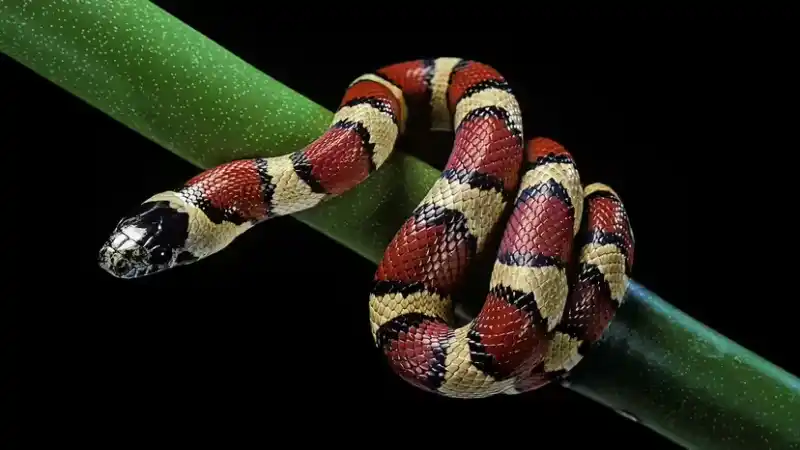
The pitfall of the rhyme: When is it unreliable to say "red is poisonous when it is associated with yellow"?
The saying " Red with yellow is poisonous, red with black is not poisonous " is only generally applicable to species commonly found in the United States .
Various types of Micrurus with atypical color sequences exist in Latin America (Mexico, Central and South America) ;
Kingsnakes/milk snakes in North America may also exhibit disturbances such as whitish/yellowish discoloration and incomplete clitellum rings .
Principle : If you are unsure, don't blindly follow rumors . Keep your distance, take photos as evidence, and consult professionals.
Coral snake vs. King snake: Quick reference chart
| feature | Coral snake (Micrurus) | Kingsnake/Scarlet Kingsnake (Lampropeltis) |
|---|---|---|
| Is it poisonous? | Toxic (neurotoxic) | Non-toxic (entanglement/killing) |
| Circular contact (common in the United States) | Red stickers yellow | Red sticker black |
| Is the ring a complete circle? | Mostly a complete circle around the body and tail | Not necessarily a complete circle ; the ventral surface often breaks or becomes shallower. |
| Facial features | Black mouth and nose/mask are common | Mouth and nose are mostly red or mixed colors , rarely a solid black patch. |
| Scale luster | glossy and smooth | Glossy to silky feel |
| Behavior | It is stealthy and rarely attacks proactively; when subdued, it has a powerful bite. | Highly adaptable; may shake its tail, exhale foul odors, or bite lightly in self-defense. |
| feeding habits | Mainly small snakes and lizards | Wide diet, including venomous snakes |
| North American distribution | warm zones such as Southeast and Texas | Widely distributed across various ecotypes in North America |
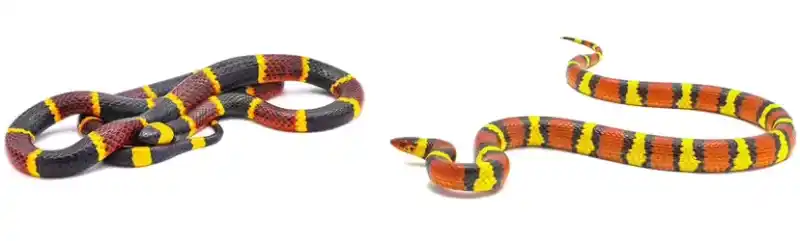
Common "lookalike" species in North America
Scarlet King Snake ( L. elapsoides ) vs. Eastern Coral Snake : A classic confusing pair. Pay close attention to the clitellum contact and the black snout .
Milk snake complex ( L. triangulum ) : Some color patterns are red/black/light-colored tricolor; red with black is still the most common.
Young rat snakes, hognose snakes, grass snakes, etc.: Patterns may be misleading in low light - return to the three key points: contact of the clitellum, whether it is a complete circle, and the color of the mouth and nose .
Safety Guide: What to do if you encounter/are bitten?
meet
Maintain a distance of at least twice your body length ; do not drive them away, and certainly do not attempt to kill them.
Photos can be taken from a safe distance for easy identification.
Let them leave on their own; take good care of children and pets .
Suspected coral snake bite
Call emergency services immediately .
Stay calm and minimize movement ; immobilize the injured limb with a splint , positioned at heart level .
Remove rings/watch straps to prevent swelling and pressure buildup.
Do not cut, suck, apply ice, or use a tourniquet.
Get the patient to the hospital as soon as possible for evaluation and supportive treatment such as antivenom .
Bitten by a king snake/non-venomous snake
Clean and disinfect the wound with soap and water; if the wound is deep or the species cannot be identified, it is also recommended to seek medical evaluation.
Frequently Asked Questions
Q: Do all coral snakes have "red patches on yellow"?
A: This is true for most common species in the US , but there are exceptions ; this saying is unreliable in Latin America/the Old World . Don't touch them with your bare hands if you're unsure.
Q: Are king snakes considered "beneficial snakes" near my home?
A: Yes. King snakes can control the populations of rodents and some venomous snakes , and are generally beneficial to the human environment and are non-venomous .
Q: Do coral snakes need to "chew" to inject venom?
A: Coral snakes have short, strong fangs , which often require a firm bite to inject venom more easily, but a quick bite can also inject venom. Any suspected coral snake bite should be treated as an emergency snakebite .
Q: Is it useful to look at the pupils/head shape?
A: This "lookalike" pair isn't very practical . More reliable indicators are the contact sequence of the rings, the color of the mouth and nose, and whether the rings complete a full circle .
Summary of key points on site
Coral snake : venomous; red and yellow stripes ; black mouth and nose ; multiple rings around its neck; elusive and rarely seen.
King snake/Scarlet king snake : Non-venomous; red with black markings ; mouth and nose mostly red/variegated; clitellum not necessarily complete; highly adaptable.
Uncertainty equals reluctance . Taking photos for recognition or consulting local experts is a safer approach.