Shortest conclusion : "Panther" is not a separate species . In the context of the wild, it usually refers to a melanistic leopard ( Panthera pardus ) or jaguar ( Panthera onca ). That is to say, "panther" is actually a color variant : the same feline species whose fur is black due to genetics, making it appear "pure black".
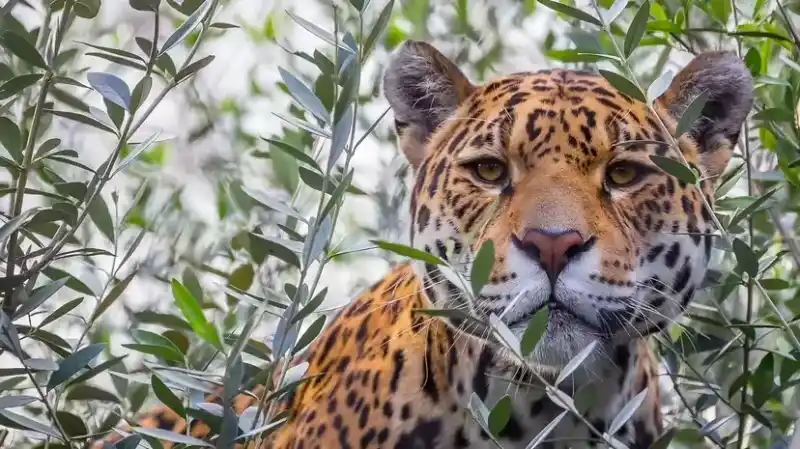
Table of contents
What exactly is "Black Panther"?
Key points about jaguars (distribution, size, habits)
Leopard vs. Jaguar: How to tell them apart at a glance
Why are there "all-black" big cats? — A brief analysis of melanistic genes
Habitat and Geographical Differences
Hunting methods and bite force
Quick checklist for on-site inspection (field/image)
Jaguar vs. Leopard: Comparison Table
Common Misconceptions
FAQ
Why is it important to distinguish between a "black panther" and its species (conservation)?
What exactly is "Black Panther"?
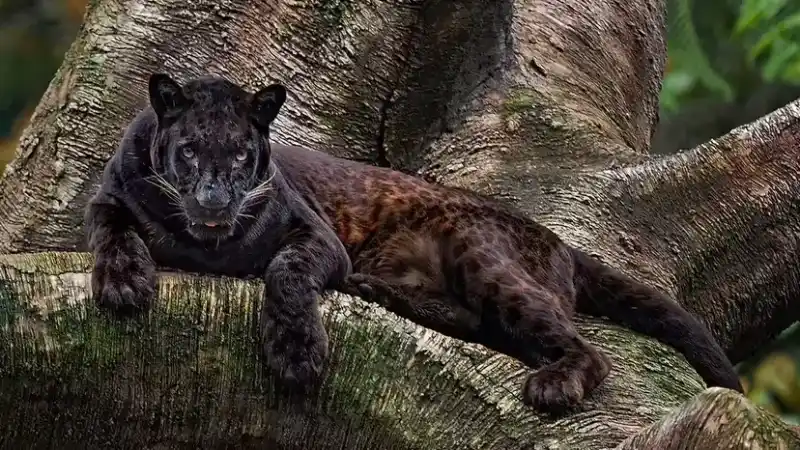
It is not a species name . It is mostly used as a common name/nickname, specifically referring to a leopard or jaguar with black fur .
In the Americas , when you hear "black panther," you're most likely referring to a black jaguar .
When you hear "black panther" in Africa or Asia , you usually mean a black leopard .Even in complete darkness, as long as the angle of light is right, you can still vaguely see rosettes – those are their original markings, only "darkened" by the high content of melanin.
Key points about jaguars (distribution, size, habits)
Scientific name : Panthera onca
Geography : Currently, they are mainly distributed in Mexico-Central America-Northern South America , and historically they have reached as far north as the southwestern United States (there are occasional records of wandering males in Arizona/New Mexico).
Size : The largest cat in the Americas , with a robust and sturdy build , adults typically weigh 45–113 kg (100–250 lbs) .
Habitat : Typically found in tropical rainforests , but can also adapt to wetlands, savannas, and arid woodlands ; good swimmer .
Society : Mostly solitary and territorial, with females raising 1–2 cubs.
Predation : From turtles and armadillos to deer, wild boars (tapio/guinea pig/pig/capybara) and even caimans ; known for its strong bite , often directly crushing skulls/piercing shells to kill.
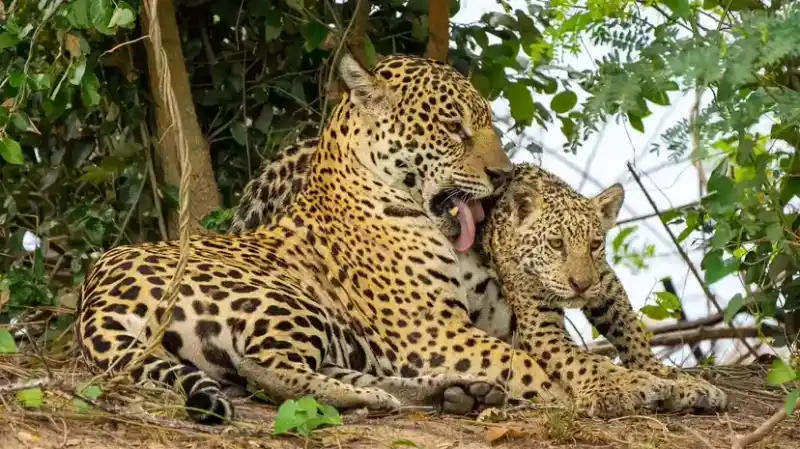
Leopard vs. Jaguar: How to tell them apart at a glance
Both belong to the Panthera genus (lions, tigers, leopards, and jaguars all belong to this genus), and both can exhibit melanistic individuals. Key distinguishing features:
Marks and body shape
Jaguar : Large and complex rose spots, often with a "central dot" ; more robust overall, with a thick chest and back, and a broad skull.
Leopards : have smaller and denser rose spots, usually without a central point ; they have a more slender body and a longer tail (which gives them a clear advantage in tree climbing).
Behavior and Hunting
Jaguar : Powerful, amphibious ambush predator; prefers to subdue large prey on the spot, with a fatal head/shell piercing strike.
Leopard : an expert in concealment and climbing , adept at dragging prey up trees to avoid competitors such as lions/hyenas; a "jack-of-all-trades" broad-spectrum hunter.
Why are there "all-black" big cats? — A brief analysis of melanistic genes
Melanism is a dark coat phenotype caused by increased melanin production .
In leopards , recessive inheritance is the most common trait.
In jaguars , dominant alleles are often expressed.
Potential advantages : Better concealment and ambush in dense forests/nighttime environments. Even in complete darkness, its rose-colored blue pigment remains , only becoming visible under backlighting or oblique light.
Habitat and Geographical Differences
Jaguar : Found only in the New World (America) , with rainforests and wetlands being the most representative habitats, but overall they are quite adaptable.
Leopards are distributed across Africa, the Middle East, South Asia, Southeast Asia, and parts of the mountains in South and Central China , making them one of the cat species with the largest geographical span : they can live in rainforests, savannas, mountains, and semi-deserts.
Hunting methods and bite force
Jaguar : For a feline relative to its size, it has an extremely strong bite force per unit weight , capable of penetrating tortoise shells/caiman skulls .
Leopard : Emphasizing stealth and mobility , its typical move is to carry prey up trees to avoid scavengers and large competitors.
Quick checklist for on-site inspection (field/image)
When encountering a "large black cat" and the patterns are unclear, you can use this method to determine its identity:
Location : Americas → Jaguar is the first choice; Africa/Asia → Leopard is the first choice.
Physical profile : robust and square, with a large head and thick chest → more like a jaguar ; slender, with an even longer tail → more like a leopard .
Behavioral cues : hunting in/near water → high probability of jaguar; dragging up trees → typical leopard.
Upon close inspection of the markings (in light): Large rose spots with internal dots → Jaguar; Small and dense spots without internal dots → Leopard.
Jaguar vs. Leopard: Comparison Table
| Dimension | Jaguar ( Panthera onca ) | Leopard ( Panthera pardus ) |
|---|---|---|
| distributed | The Americas (Mexico → Argentina), historically extending north to the southwestern United States | Africa, West Asia/Middle East, South Asia, Southeast Asia, and parts of East Asia |
| body shape | Sturdy and robust , with a broad head and thick chest | Long and flexible , with an even longer tail |
| Rose spots | Large and complex, often with a central point | Small and dense, mostly without a central point |
| habitat advantage | Rainforest/wetland representative, also adaptable to dry forest/grassland | From rainforests to savannas and even mountains/semi-deserts |
| Representative behavior | Ambush in the water, skull crushing and shell penetration | Climbing trees to hide food, avoiding the strong and seeking out the weak. |
| The nickname "Black Panther" | The "black panthers" in the Americas are mostly melanistic versions of it. | The "black panther" in Africa/Asia is mostly its melanistic form. |
Common Misconceptions
"The black panther is a separate species."
No. "Black Panther" is usually just a common name for a melanistic leopard/jaguar ."Black panthers have no spots"
Yes. The rosacea is still there , but it's covered by melanin; it's visible when the light is right."All big black cats are the same."
No. Geographical location, body shape, and behavior are the three key elements for accurate identification.
FAQ
Q: Are there any behavioral differences between melanized individuals and spotted individuals?
A: Species characteristics remain unchanged . Melanosis is merely a difference in fur color; core behaviors/ecological niches still follow the species attributes of jaguars or leopards .
Q: Which is bigger?
A: Generally speaking, jaguars are more robust and heavier ; leopards are more slender, have longer tails , and are more agile in climbing.
Q: Do jaguars and leopards coexist in the wild?
A: No. Jaguars belong to the Americas , while leopards belong to Africa and Asia ; their natural distributions do not overlap .
Q: Is a "black panther" always black?
A: In everyday speech, "black panther" often refers to a melanistic individual, but the same species can also have spotted individuals . An accurate description should specify the species and whether the panther is melanistic .
Why is it important to distinguish between a "black panther" and the species (conservation)?
Policy and Monitoring : Treating the "black leopard" as a species would confuse data and affect scientific research, patrols, and legislation .
Threat Differences :
Jaguars are primarily affected by deforestation, habitat fragmentation, and illegal hunting .
Leopards in Africa and Asia face multiple pressures, including habitat loss, human-wildlife conflict, and prey decline .
Accurate identification helps to allocate limited resources to the right areas and species , thereby improving conservation effectiveness.
Take away in one sentence
"Black Panther" refers to a blackened leopard or jaguar; to distinguish them, please refer to : geographical location (America = jaguar; Africa/Asia = leopard) + body shape (stout vs. slender) + rose spots details (whether there is a center point) + behavioral clues (ambushing in water vs. climbing trees to hide for food).