As the largest land mammal, the image of the elephant is deeply ingrained in our minds: a huge body, a long trunk and tusks, and large, fan-like ears. However, paleontologists have discovered through fossils that prehistoric elephants did not look exactly like this.
Elephants belong to the order Proboscidea, a group of mammals. Currently, there are only two genera and three species: the Asian elephant and the African elephant. However, fossil records show that a great many species of proboscideans once inhabited the Earth, including 10 families, 44 genera, and approximately 180 species or subspecies. Today, elephants are found only in Africa and southern Asia, but historically, their distribution was very wide, appearing on every continent except Antarctica and Oceania. It can be said that elephants flourished in prehistoric times.
The earliest elephants were about the same size as rabbits.
The earliest representative of the elephant family is the Dawn Elephant, which was discovered in Morocco, Africa, about 60 million years ago. At that time, it weighed only 3 to 8 kilograms, about the size of a rabbit, and showed no signs of being the king of the land.
About 5 million years later, the Phosphorus elephant was discovered in the same region. It was 60 centimeters long and weighed 10 to 15 kilograms, resembling a small pig in size and shape. Its upper and lower second incisors began to enlarge, and in the future, these enlarged incisors would evolve into true tusks, becoming one of the typical characteristics of modern elephants. However, the most important feature, the long trunk, had not yet appeared in the Phosphorus elephant.
Around 47 million years ago, a member of the Proboscidea order known as the "Elephant" lived in what is now Egypt. It was over 2 meters long and weighed over 500 kilograms. It had an elongated nose on its face, very similar to the modern tapir.
Some might ask, why did the early members of the elephant family look so strange? There's a Chinese saying: "A pig with a scallion stuck in its nose—pretending to be an elephant." Does this mean elephants really evolved from pigs? Actually, elephants are neither rabbits, pigs, nor tapirs. Among extant groups, the closest relatives to elephants are manatees and dugongs. Hard to imagine, right? Elephants have an aquatic distant relative! Manatees also possess tusks similar to elephants, as well as replacing cheek teeth, all indicating a close kinship. Another extant group closely related to elephants is the hyrax, found in Africa and the Arabian Peninsula. Despite its name containing "rabbit," it is not related to rabbits at all.
bizarre appearance that defies common sense
Around 30 million years ago, a species resembling modern elephants appeared on the African continent—the ancient mastodon. It stood over 2.2 meters tall at the shoulder and weighed over 3 tons, similar to modern Asian elephants, even sharing similar physical characteristics. It had a long trunk and short tusks. The only difference from modern elephants was its prominent lower jaw, giving it a slightly protruding "underbite," a condition commonly known as an "protruding tusk." This jaw structure was due to the mastodon's preference for eating tender leaves from trees; the prominent jaw helped to tear leaves off trees in large pieces, increasing its feeding efficiency.
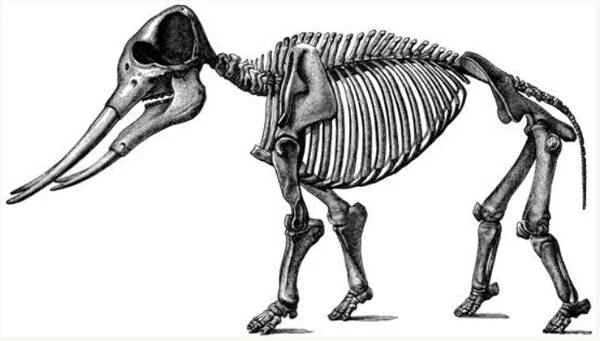
This characteristic of the ancient mastodons was well inherited and further developed by their descendants, the gossameroids. Around 15 million years ago, the shovel-tusked elephant, a unique species within the elephant family, appeared. The shovel-tusked elephant's lower jaw protruded extremely far forward, almost as long as its trunk. Viewed from above, its lower jawbone resembled a large shovel, hence its name. One can imagine the shovel-tusked elephant feeding, its massive lower jawbone acting like a basket, waiting to be filled with leaves plucked from its trunk.
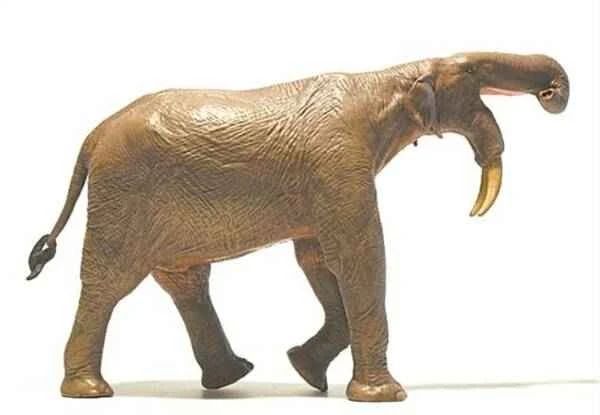
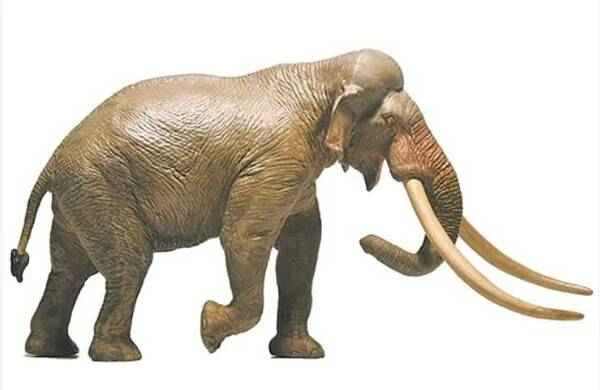
Of course, if we're talking about sheer oddity in appearance, there's another member of the elephant family that truly defies common sense: the deinoelephant. While other elephants have elongated upper incisors, the deinoelephant lacks them, instead possessing a pair of lower incisors that curve downwards into hooks. Experts have many theories and debates about the function of these lower incisors. Some believe they were simply used for display to attract mates, others think they were for peeling bark from trees, and still others believe they were used to support the head while sleeping…
Of course, elephant tusks not only look imposing, but also serve a practical purpose: defending against predators and aiding in feeding. The saber-tusked elephant, for example, maximized the use of its tusks, making its lower incisors longer and forming two pairs of "great swords" with its upper incisors, deterring predators.
Prehistoric relatives of living elephants
Around 7 million years ago, members of the Elephantidae family, to which modern elephants belong, appeared on the African continent. They not only evolved into African elephants, Asian elephants, and Paleodon, but the latter two also migrated westward to Asia.
The archaea shares skull features with extant Asian elephants, leading to its long-held belief that it was an extinct subgenus of the Asian elephant. However, accumulating morphological evidence, especially recent ancient DNA evidence, suggests that the archaea should be considered a separate genus, and more closely related to African elephants (rather than Asian elephants).
Interestingly, both the largest and smallest species of the true elephant family appear in the Paleodontidae. The Paleodontidae Rissmannii, found in Africa, and the Paleodontidae Archaeopteris, found in Europe, both reached a shoulder height of 4 meters and weighed over 12 tons. However, the Paleodontidae Fassmannii, which lived on the island of Malta in the Mediterranean Sea, was about the size of a domestic pig, with an adult shoulder height of less than 1 meter, a body length of less than 2 meters, and a weight of less than 200 kilograms.
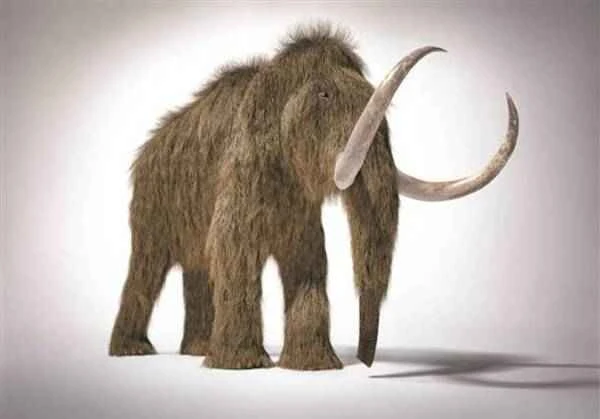
After reaching Asia, the mammoth family did not stop their advance. The mammoths we are more familiar with arrived in Siberia, where the cold weather caused them to grow long hair and thick layers of fat. Mammoths even crossed the roads and bridges of the time to reach North America, evolving into the gigantic Columbian mammoth and Steppe mammoth, becoming the kings of the North American plains.