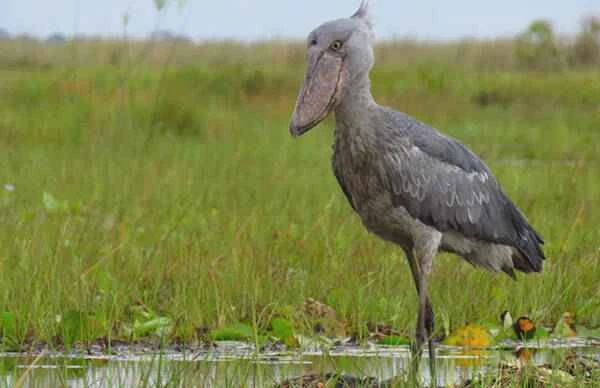
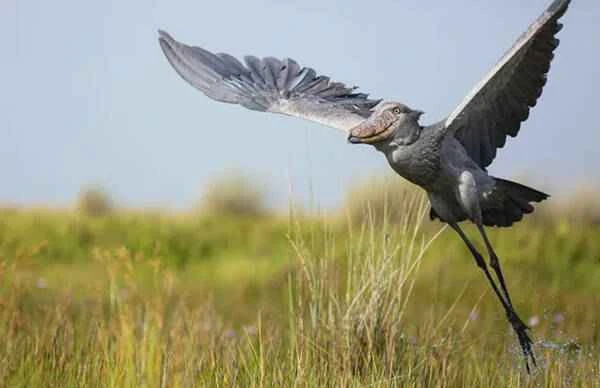
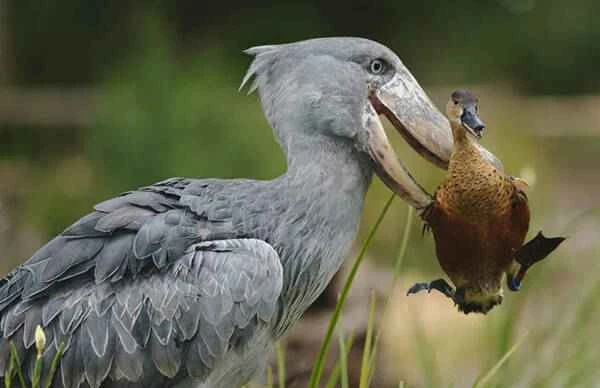
The shoebill is the largest bird with the largest head on Earth, and it is the only species in the genus *Shoebill* within the family Shoebillidae. Named for its powerful beak, the shoebill is a large bird closely related to storks, averaging 1.2 meters in height, weighing 4000-7000 grams, and with a wingspan of up to 2.6 meters. Similar in size to a white stork, its head is particularly enormous, making it the largest living bird with the largest head. Its broad and robust beak is the widest bird beak in the world, measuring 12 centimeters wide, with a hooked tip. The beak plays a crucial role; not only is the tip exceptionally sharp, but the edges are also as sharp as a knife, capable of piercing the thick skin of a crocodile. The two mandibles clamp down on prey like a workpiece clamped in a fitter's pliers.
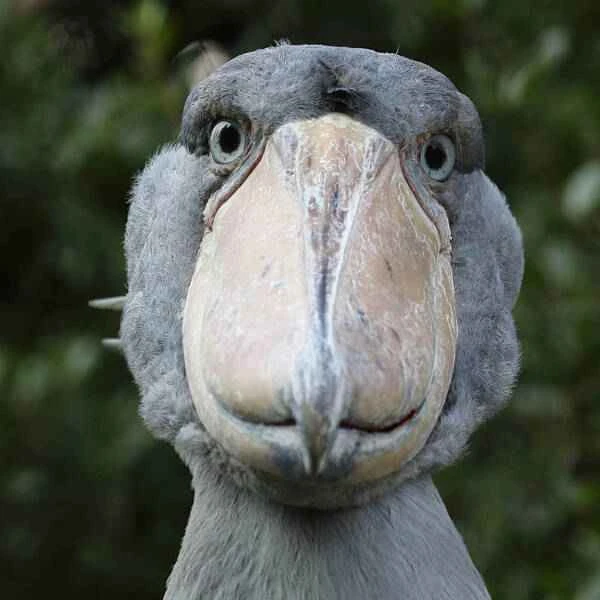

The shoebill stork has a very interesting and endearing face. Its huge, mottled beak adds to its charm. The massive beak resembles the head of a whale, with eyes located at the front of the head, on the same plane as an owl's eyes. Its plumage is slate grey with a green sheen on the back. It has a short tail and a short crest on the back of its head. Its most prominent features are its large head and its thick, large, boot-like beak. However, despite its heavy appearance, the beak is actually quite light. Males and females have similar plumage, differing only in size, with females being slightly smaller. Juveniles are mostly brown with a lack of green sheen on their backs. The beak is yellowish-green, the iris is white to pale yellow, and the legs are black.
Currently, bird conservation organizations and the International Union for Conservation of Nature (IUCN) classify the shoebill stork as 'Vulnerable' (VU). According to IUCN data from 2016, there were still 3,300 to 5,300 adult shoebills in the wild, a decrease from 5,000 to 8,000 in 2008. Due to habitat degradation and loss, the impact of human activities, and the illegal bird trade, the shoebill population is estimated to continue to decline.

In addition, over the past five years, the local government has introduced many wetland restoration and wildlife protection measures, which are expected to allow each shoebill stork to live freely in the marsh wetlands.