The most mimicking birds on Earth belong to the genus *Acrocephalus* in the family Sylphidae. They are common insectivorous birds found in reed marshes and swamps. The most common species in China is the Great Reed Warbler (*Acrocephalus sarundiaceus*), the largest of the warblers. Other species include the Black-browed Reed Warbler (*Acrocephalus bistrigiceps*), the Far Eastern Reed Warbler (*Acrocephalus tangorum*), the Blunt-winged Reed Warbler (*Acrocephalus concinens*), the Oriental Great Reed Warbler (*Acrocephalus orientalis*), the Thick-billed Reed Warbler (*Acrocephalus aedon*), the Loud Reed Warbler (*Acrocephalus stentoreus*), and the Brown Fan Reed Warbler (*Cisticola juncidis tinnabulans* Rafinesque). This bird is the most mimicking bird in the world, capable of imitating the calls of more than 60 different animals.
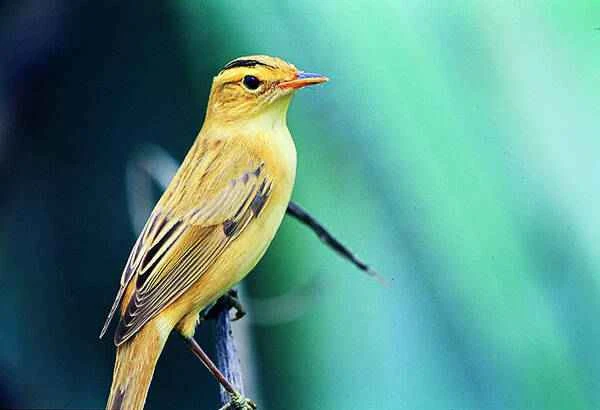
Even the most experienced birdwatchers struggle to distinguish reed warbler species with the naked eye. The best way to differentiate between different species of reed warblers and other warblers is by their calls. This is perhaps also the primary method by which they identify each other within their own group. Reed warblers inhabit the marshy reed beds of Eurasia. They are also frequently found in the Tamsui River and Kaohsiung in Taiwan.
The Great Reed Warbler, also known as the Great Reed Bush Warbler, Reed String Warbler, and Reed Grasshopper, has brownish-gray back feathers with a pale yellow supercilium, pale white underparts, and indistinct grayish-brown longitudinal stripes on its chest. They are a typical dominant species near reed marshes and puddles, but also frequent nearby shrubs, bushes, and grasses. Their song is high-pitched and loud, resembling "karra-karra-karreet-karreet-karret" or "brit-iprt-pritik," which from a distance sounds like a continuous "ga, ga, ji-," often mistaken for a frog's call.
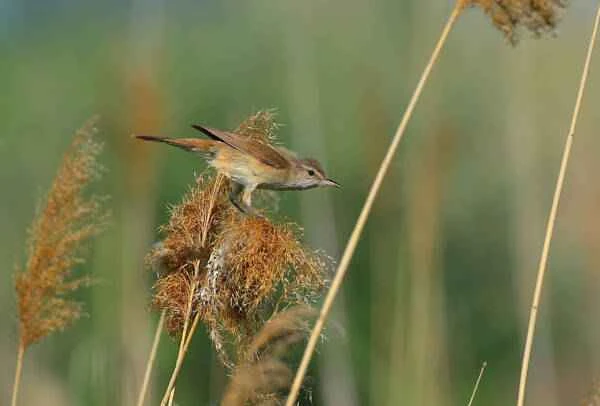
The Reed Warbler is a globally vulnerable species. A recent article published in IBIS indicates that large numbers of Reed Warblers stop over in the wetlands of northwestern France to replenish their energy as they migrate from their breeding grounds in Europe to winter in Africa. The article states that Reed Warblers migrate throughout the summer, with the peak migration occurring in the third week of August, although some do not stop en route. The authors point out that there is no evidence of two separate migratory routes for Reed Warblers, one in the Atlantic and one in the Mediterranean. Reed Warblers found along the Mediterranean coast of Spain migrated from the Atlantic coast of France. Reed Warblers pass through 30 designated protected areas in France, but none are specifically designated for this species. A working group is implementing efforts to improve the quality of Reed Warbler habitats.
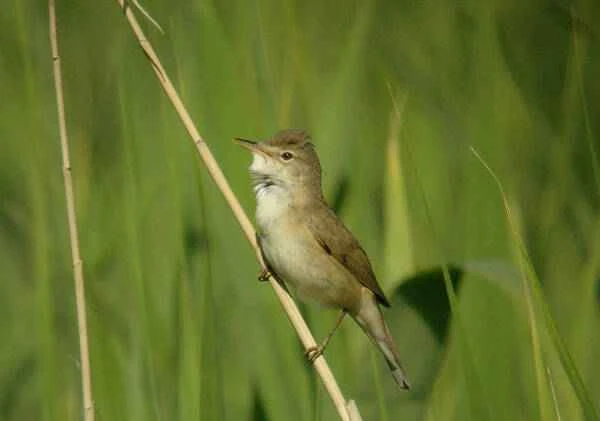
List of Class II Protected Wild Animals: Distribution Map of the Sylviidae Family
Acrocephalus sorghophilus
Black-browed Reed Warbler (Acrocephalus bistrigiceps)
Far Eastern Reed Warbler (Acrocephalus tangorum)
Acrocephalus concinens
Oriental Great Reed Warbler (Acrocephalus orientalis)
Thick-billed Reed Warbler (Acrocephalus aedon)