The Bearded Vulture (scientific name: *Gypaetus barbatus*), also known as the Bearded Vulture, Bearded Eagle, Bearded Vulture, and Partridge, is a large bird of prey in the family Accipitridae, belonging to the monotypic genus *Gypaetus*. As the only bird species globally that primarily feeds on bones, the Bearded Vulture is not only biologically unique but also a significant subject of ecological research due to its diet, predation behavior, and ecological role. It is wary and fierce, often solitary, flying and soaring slowly over mountaintops or slopes, searching for animal carcasses on the ground, frequently feeding alongside vultures and ravens. The following will discuss in detail the Bearded Vulture's morphological characteristics, diet, reproduction, and behavioral habits, providing a comprehensive perspective for understanding this species.
The bearded vulture (Gypaetus barbatus) belongs to the following scientific classification level:
Kingdom: Animalia
Phylum: Chordata
Class: Aves
Order: Accipitriformes
Family: Cervus (Accipitridae)
Genus: Gypaetus
Species: Bearded Vulture (Gypaetus barbatus)
Zoological History: The Evolution and History of the Bearded Vulture
The bearded vulture is a rather unique species within the vulture family, significantly different from other vultures. Its evolutionary history is quite ancient; scientists believe its ancestors appeared around the Pleistocene epoch of the Cenozoic era and have lived and bred in open, high-altitude environments ever since. Unlike other birds of prey in its family, the bearded vulture is unique in its reliance on bones, which makes its hunting strategies and ecological role distinctive.
Despite their long history, the bearded vulture's population has declined dramatically worldwide due to habitat destruction and dwindling prey resources, particularly in parts of Europe and Asia, where numbers plummeted in the 20th century. To protect this species, numerous countries and regions have implemented a range of conservation measures, including habitat protection, monitoring, and anti-poaching efforts.
Morphological characteristics of the bearded vulture
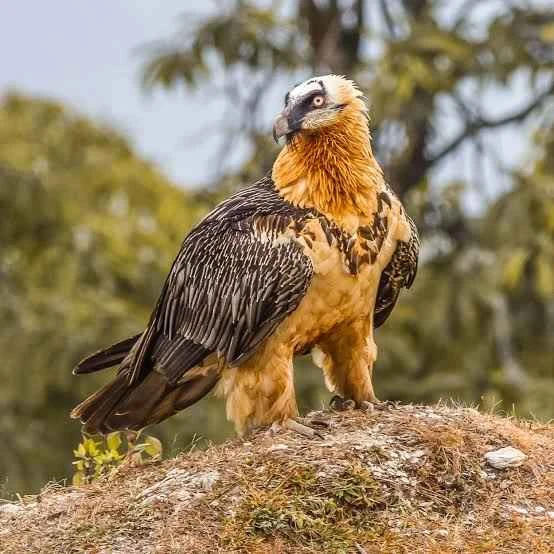
The Bearded Vulture (Gypaetus barbatus) is a large bird of prey with unique and distinctive morphological features. Its unique body shape and plumage set it apart from other birds of prey. The following are its main morphological characteristics:
1. Body size and length
The bearded vulture is one of the world's most unique birds of prey, possessing a majestic and typically large physique. Adult bearded vultures typically range in length from 90 to 115 centimeters, with a wingspan of 2.3 to 2.8 meters. This makes it a very striking presence in flight.
Weight: Adult male bearded vultures weigh approximately 4.5 to 7 kilograms, while females are slightly heavier, typically reaching 6 to 8 kilograms. This is a relatively large size, and is considered above average weight among birds of prey.
2. Feather color and appearance
The bearded vulture has very distinctive and striking plumage. Its feathers are predominantly dark brown, with a dark back and wings, while the belly and chest are lighter, often with orange-yellow hues. Bearded vulture chicks are born completely featherless, gradually developing full plumage as they grow. Juveniles are mainly dark brown with pale shaft streaks on their upperparts, a predominantly black head and neck, and black "whiskers" on their chin. They typically develop the same plumage as adults around 4-5 years old, with their underparts gradually fading until adulthood, but never turning brown. The iris is pale yellow. The beak is grey, and the toes are lead-grey.
Facial plumage: One of the most distinctive features of the bearded vulture is its distinctive facial plumage. It has prominent white and yellow feathers on its face, forming a beard-like appearance, hence its name "beared vulture." This distinguishes it from other birds of prey.
Eyes: Bearded vultures have dark eyes, usually dark brown or black, with a ring of bare skin around the eyes, which adds to their fierce appearance.
3. Beak and claws
Beak: The bearded vulture has a very powerful, hooked, and dark black beak. This beak shape allows it to easily handle bones, especially harder ones, making it a particularly important tool in its diet. The lower part of the beak is wider and hooked, making it ideal for grasping and tearing food.
Claws: The bearded vulture has very strong, curved claws that allow it to firmly grasp prey or scavenger in flight. Its claws are also well-suited for climbing rocks or nesting in cliffs.
4. Wings and the ability to fly
The bearded vulture has very broad, long, and sharp wings, adapted for long-duration flight and high-altitude gliding. Its flying ability is exceptional, especially its gliding prowess; when searching for food, it can glide hundreds of meters at high altitudes to find bones and other animal carcasses.
Wingspan: The wingspan is approximately 2.3 to 2.8 meters, which provides it with very strong flight capabilities.
Flight skills: Bearded vultures mainly glide at high altitudes, usually flying over rocky cliffs and mountainous areas, and can easily cross high mountains and cliffs.
5. Tail
The bearded vulture has a long, wedge-shaped tail, which helps stabilize its flight. The shape of its tail plays a crucial role in its flight stability during gliding and circling.
6. Adaptive characteristics
Bone-eating diet: The bearded vulture's most prominent adaptation is its bone-eating diet. It is the only bird in the world whose primary food source is bone, capable of rapidly breaking it down and extracting nutrients through its highly efficient digestive system. This characteristic is not only reflected in its powerful digestive system but also in its strong stomach acid, with a concentration close to pH 1, sufficient to digest hard bones.
Global distribution and habitat
Bearded vultures are mainly distributed in the mountainous regions of Europe, the Middle East, Asia, and Africa. They prefer to inhabit high-altitude mountainous areas, especially those with cliffs, rocks, or precipices. These terrains not only provide them with a good habitat but also offer natural protection for breeding.
The specific distribution areas include:
The Alps: mainly distributed in France, Italy, Switzerland and Spain.
The Himalayas: located in parts of India, Nepal, and China.
Ethiopian Highlands: Especially inhabiting the rocky areas of the highlands.
African Plateau: Also distributed in the southern and eastern regions, especially in the Cape Plateau and some mountainous areas.
It is distributed in western Xinjiang, Qinghai, Gansu, Ningxia, southwestern Sichuan, and Tibet in China. It inhabits bare rocky mountain areas at altitudes of 500-4000 meters.
These regions share common characteristics: high altitude, sparse population, abundant wildlife, and relatively undisturbed ecosystems. Bearded vultures often inhabit remote areas, making them a species that is relatively difficult to study and protect.
Ecology and Behavior
The bearded vulture is a typical scavenger, relying primarily on dead animals for food. Unlike other vultures, its particular need for bones and marrow makes it an important scavenger in the ecosystem. Bearded vultures feed on the carcasses of large mammals such as wild sheep, goats, and deer, with a particular preference for thicker, fatty bones such as sheep leg bones and deer spines.
Bearded vultures primarily feed on bones. They possess a powerful digestive system that rapidly dissolves bones, and their gastric juices have a pH as high as 1, effectively breaking down minerals and fats in bones. Their most common hunting behavior involves dropping large bones from hundreds of meters in the air, using the impact to crack the bones and expose the marrow.
Bearded vultures also prey on live animals. Although they do not often actively hunt live prey, when necessary, they will fly to carry smaller animals such as turtles and antelopes to high places on cliffs and smash them to break their shells or bones.
Migration patterns
Unlike many birds, the bearded vulture does not undertake long-distance migrations. Because it inhabits high-altitude areas, its habitat typically has relatively fixed resources, and it generally stays within its designated area. However, bearded vultures sometimes slightly adjust their activity range according to seasonal changes and the distribution of food resources, especially between winter and the breeding season.
Since bearded vultures are mainly distributed in high-altitude areas, their migratory behavior is not as pronounced as that of other birds. They tend to stay within fixed areas and do not engage in long-term seasonal migrations.
Daily activities and social behavior of the bearded vulture
Bearded vultures (Gypaetus barbatus), as large birds of prey, possess unique daily activity patterns and social behaviors. They are not merely scavengers but also exhibit complex behavioral characteristics, especially in foraging, reproduction, and social interaction.
1. Foraging and Flight
Bearded vultures are typically solitary foraging birds, although they sometimes share food with other vultures. They spend most of their time in mountainous and cliff-lined areas, especially in open high-altitude regions. Their foraging techniques are unique, as they are the only birds that primarily feed on bones. They fly between cliffs and mountains, searching for animal carcasses or bones. For larger, harder bones, they drop them from high altitudes, using gravity to help break the bones and expose the marrow and other nutrients. Their flight is highly efficient, allowing them to fly at low altitudes, maintaining a height of about 2 to 4 meters, quickly searching for food sources.
Bearded vultures sometimes display remarkably precise foraging skills. They typically glide for extended periods during flight, rarely flapping their wings and relying on updrafts for sustaining their flight. This ability to glide and fly at high altitudes allows them to cover a wide area foraging.
2. Social Behavior and Territoriality
Bearded vultures have a relatively independent social structure, but they also exhibit strong territoriality. Each pair of bearded vultures maintains a defined territory within its habitat, especially during the breeding season when the territory typically expands. They protect their territory by displaying flight and aerial combat. This behavior includes wing flapping, aerial somersaults, and talon-locking maneuvers, a typical breeding season behavior for bearded vultures, usually displayed to mates or other members of their own species.
Aside from competing for territory with other bearded vultures, they typically live solitary lives or exist in pairs. Adult bearded vultures are monogamous during the breeding season, with both males and females jointly raising the offspring. Their breeding season is relatively long, usually lasting several months, which is one of the reasons why they can only produce one chick per year.
3. Interaction with other animals
Bearded vultures exhibit social behavior not only with their own species but also indirectly with other animals. Particularly during foraging, they sometimes display social competition by competing for food with other scavenging birds. Furthermore, when attacking or killing live animals, bearded vultures will ram them from their flight or slam them to the ground from high altitudes, causing injury or death. While this behavior is relatively rare, it demonstrates their apex predator status in the food chain.
The bearded vulture's daily activities and social behaviors showcase its unique characteristics as a top-ranking scavenging raptor. From solitary foraging and territorial displays during the breeding season to sophisticated chick-rearing behaviors, the bearded vulture exhibits complex and precise behavioral patterns. Furthermore, its flight capabilities and foraging skills enable it to adapt to a variety of environments, making it one of the most successful creatures in nature.

Diet and foraging strategies of the bearded vulture
The Bearded Vulture (Gypaetus barbatus), a typical scavenging raptor, possesses a diet and foraging strategies quite unique among birds. Unlike most birds of prey that focus on catching live prey, the Bearded Vulture relies almost entirely on dead animals, especially bones and marrow. The evolution of its diet and foraging strategies has enabled it to play a crucial role in the ecosystem, effectively clearing away carcasses and maintaining ecological balance.
1. Diet: A specialist in eating bones.
The bearded vulture is a scavenger, primarily feeding on animal carcasses. Its diet consists of mammals (93%), birds (6%), and reptiles (1%), mostly medium-sized ungulates. It typically doesn't eat actual meat; 85-90% of its diet is bone, including marrow. It is the only extant bird species that exclusively feeds on bones. Meat and skin make up only a small portion of an adult bearded vulture's diet, but fragments of meat and skin constitute the majority of a chick's food. Bearded vultures can swallow whole or bite through brittle bones the size of a lamb's femur; their powerful digestive system can quickly digest large pieces of bone. The bearded vulture's primary food source is carcasses, especially the bones of various mammals, birds, and reptiles. Its diet is quite unique, with 70-90% of its food consisting of bones, primarily marrow and fat-rich bones (such as the femur and tibia). They not only consume the hard parts of the bones but also ingest large amounts of the fat and nutrient-rich marrow within them, providing the bearded vulture with ample energy and fat.
Bearded vultures utilize a powerful digestive system to process these tough bones. Their stomachs have extremely high concentrations of acid, with a pH of approximately 1, which rapidly dissolves most of the minerals in the bones. Even larger bones can be digested within 24 hours. While bones are more difficult to digest than muscle, the high energy value of their marrow and fat makes them a staple food for bearded vultures.
2. Powerful bone processing capabilities
Bearded vultures possess highly specialized foraging techniques, making full use of their flight capabilities during hunts. For large bones they cannot swallow, they will fly to a height of 50 to 150 meters and drop them onto hard rocks. This crushes the large bone fragments, exposing the marrow for consumption. This behavior, known as "bone-throwing," is a signature foraging strategy of the bearded vulture, typically requiring extensive practice to master; some young birds may take up to seven years to become proficient.
Bearded vultures are capable of carrying bones up to 10 centimeters in diameter and weighing over 4 kilograms, a skill crucial to their survival. For smaller bones, they can either swallow them whole or use their powerful beaks to crush and consume them.
3. Prey selection and food preferences
Bearded vultures prefer prey with abundant bones and marrow. Their diet typically consists of medium-sized ungulates (such as antelopes, goats, and deer), whose carcasses provide a significant amount of bone and marrow. They also consume small mammals (such as rabbits and rodents), birds, and occasionally reptiles (such as turtles).
They have a lower need for meat and skin, although in some cases, especially when feeding chicks, the proportion of meat and skin may increase relatively. In contrast, bearded vultures prefer to consume bones, especially long bones (such as the femur and tibia), which are rich in fat and oleic acid, and the nutritional value they provide is essential for the survival of bearded vultures.
4. Food Acquisition and Foraging Behavior
Bearded vultures demonstrate a high degree of adaptability and survival intelligence in their foraging behavior. They spend most of their time searching for food by cruising, typically flying along ridges and cliffs to find carcasses of dead animals. Because bearded vultures do not have a keen sense of smell as well as vultures, they rely on sight to locate food, usually observing the activities of other scavengers (such as vultures or foxes) while flying at high altitudes to pinpoint the location of the carcass.
Their foraging areas are typically very wide; a pair of bearded vultures may cover an area of 2-3 square kilometers, and their daily foraging distance can reach more than 2 kilometers. Due to their large size and strong flying ability, they can quickly cover large areas when searching for food.
5. Occasionally preying on live prey.
Although bearded vultures primarily feed on scavengers, they sometimes prey on live animals, especially when food is scarce. They show a strong interest in reptiles, particularly turtles, often tossing them into the air to crack open their shells and eat them. Bearded vultures have also been observed attacking other small mammals and rock rats, but these predatory behaviors are relatively rare and usually occur when food resources are limited.
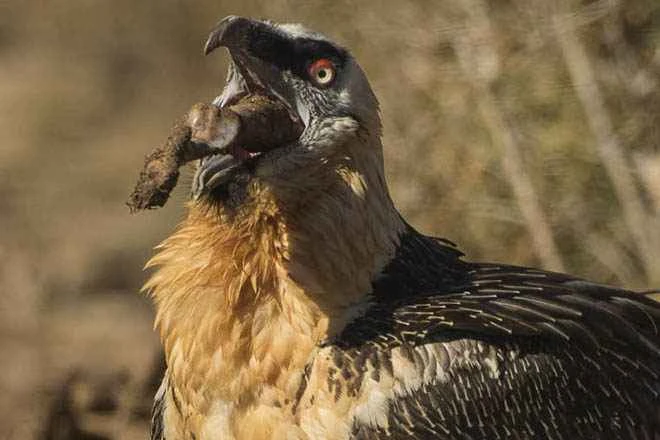
The bearded vulture's diet and foraging strategies demonstrate its unique adaptation as a scavenging raptor. Through sophisticated foraging techniques, such as aerial bone-throwing and efficient utilization of marrow, the bearded vulture is able to survive and reproduce in extremely barren ecosystems. Its dependence on bones and marrow, along with its efficient digestive capabilities, makes the bearded vulture an irreplaceable and vital scavenger in the ecosystem.
Bearded Vulture's Reproduction and Life Cycle
The bearded vulture (Gypaetus barbatus) demonstrates its unique adaptations as a apex scavenging raptor through its breeding and life cycle. Its reproductive behavior, brooding process, and various stages of its life cycle reflect its survival wisdom in complex ecological environments. Due to its long growth and breeding cycle, the bearded vulture's reproductive success rate and life cycle characteristics differ relatively from other birds of prey.
1. Breeding season and pairing
The breeding season for bearded vultures varies depending on geographical region. Typically, the breeding season begins in winter, with December to September in Europe; in the Indian subcontinent, it's November to June; and in southern Africa, it usually occurs between May and January. Despite these regional variations in breeding season, their breeding behavior and pairing patterns remain remarkably consistent.
Bearded vultures are typically monogamous birds; after pairing, both males and females cooperate in maintaining territory and raising their young. The pairings are very strong, with adult bearded vultures usually maintaining a lifelong partnership. This long-term, stable pairing ensures a high degree of cooperation during the breeding season, especially in food searching and nest building. Bearded vultures exhibit remarkable courtship displays, with males and females displaying their affections through aerial maneuvers, wing flapping, and body contact. This aerial dance and the act of mutually "locking their claws" during descent are hallmarks of their breeding season.
2. Nest construction and egg laying
Bearded vultures typically choose cliff faces, ridges, or tall rocky cliffs to build their nests, and the security of the nest is crucial to their reproductive success. The nest sites they choose are usually far from potential predators such as foxes or large felines. Nest construction is usually done jointly by both males and females. The foundation of the nest is made of twigs, hay, and animal remains. Over a long period of time, the nest can reach a diameter of 2.5 meters and a depth of 1 meter.
Bearded vultures typically lay one to two eggs per breeding season, though three eggs have been recorded in rare cases. The incubation period is 53 to 60 days, with the female responsible for most of the incubation time, while the male is primarily responsible for foraging and bringing food back to the nest.
3. Brooding and Chick Growth
Bearded vulture chicks develop relatively slowly from hatching to being able to fly independently. After hatching, the chicks spend 100 to 130 days in the nest, during which time they primarily rely on food provided by their parents. Unlike other birds of prey, bearded vultures do not regurgitate food; instead, they feed their chicks by bringing food directly back to the nest, usually appropriately sized bones or other remains of prey. In the first few months, in addition to relying on parental feeding, the chicks begin to learn how to catch and process food.
As the chicks grow, their flying ability gradually improves, and they typically begin flight training after 6 to 9 months. Even so, bearded vulture chicks remain dependent on their parents until they are about 2 years old before becoming fully independent. This is because bearded vultures have a long lifespan, and the young birds need a considerable amount of time to adapt to their complex foraging and survival skills.
4. Life Cycle and Lifespan
Bearded vultures have a relatively long lifespan, with an average lifespan of 21.4 years in the wild, and it is not uncommon for them to live for over 40 years. Once adults pair up, they maintain a lifelong partnership and breed annually or every two years. Due to their low breeding success rate (an average of only about 0.43 chicks hatch successfully per pair per year), their reproductive strategy is primarily slow reproduction to ensure sufficient care and survival opportunities.
Throughout their long lifespan, bearded vultures undergo multiple stages, gradually adapting to complex ecological environments from chicks to mature individuals. As they age, they become more experienced in reproduction, foraging, and social behavior, effectively utilizing their bone-gathering skills and superior flight abilities.
The bearded vulture's breeding and life cycle are unique. Their reproductive behavior involves stable pairings and meticulous chick care, with young birds requiring several years to become fully independent. Bearded vultures have long life cycles and relatively low breeding success rates, thus relying on a slow-growth strategy and efficient food processing skills to maintain population stability. This breeding and life cycle characteristic has helped the bearded vulture occupy an important position in its natural environment and become a top scavenger in many ecosystems.
Protection Status Quo and Measures
The bearded vulture is currently threatened globally. According to the IUCN Red List, it is listed as Near Threatened (NT), with major threats including habitat loss, food chain contamination, and poisoning. To protect this species, many countries and regions have implemented conservation measures, focusing on habitat protection, food resource restoration, and anti-poaching efforts to promote population recovery.
Ecological value
Bearded vultures, as scavengers, play a vital role in ecosystems. They help clean up animal carcasses in the natural environment, prevent the spread of disease, and provide stable support for biodiversity. Furthermore, bearded vultures are important indicator species of alpine ecosystems, and their survival status is often closely related to the health of the surrounding environment.
Related Culture
In some cultural legends and religious beliefs, the bearded vulture is regarded as a symbol of courage, resilience, and the power of nature. Especially in certain regions of Tibet and India, the bearded vulture is considered a guardian deity and has become a revered totem for the local people.
Economic value
Although the bearded vulture has no direct economic value, as a member of the ecosystem, it has the potential to boost the economy of industries such as ecotourism and birdwatching. A growing number of tourists and nature enthusiasts are showing great interest in the bearded vulture's habits, thereby driving economic development in the surrounding areas.
Closely related varieties (shown in a table)
| Species name | Distribution area | feature |
|---|---|---|
| vulture | Asia, Europe | They are relatively large, primarily feed on carrion, and inhabit high mountains and grasslands. |
| Indian Bearded Vulture | India, Nepal | Similar to the bearded vulture, but slightly smaller and with slightly different habitats. |
| Golden Eagle | Global distribution | A powerful predator, similar in size to the bearded vulture, but with a wider hunting range. |
The bearded vulture is one of the most unique birds of prey on Earth, and its bone-eating diet and contributions to the ecosystem are gradually being recognized worldwide. To ensure the survival of this species, each of us should do our part.