Weasels and stoats, two small predators, may look somewhat similar, but they are actually two different species. They both belong to the Mustelidae family, which includes animals such as otters, ferrets, and badgers. Although they are both small and fast, they differ significantly in habits, appearance, and habitat. Today, we'll explore the differences between weasels and stoats in detail so you can easily distinguish them!
Table of contents
Overview of the Mustelidae family
Size differences between yellow weasels and white weasels
Winter coat color changes: The weasel's "snow camouflage"
Personality and Behavior: Active and Agile
Food of yellow weasels and white weasels
Social structure: Solitary action or group activity?
Habitat: The habitats of weasels and stoats
Reproduction methods: How do they reproduce?
Ecological Role: The Ecological Contributions of the Yellow Weasel and the White Weasel
Conservation Status: The Conservation Status of the Yellow Weasel and the White Weasel
Lifespan of yellow weasel and white weasel
Comparison table of yellow weasel and white weasel
Conclusion: Which is more special, the yellow weasel or the white weasel?
1. Overview of the Mustelidae family
Both the yellow weasel and the white weasel belong to the large family Mustelidae . Mustelids are known for their cunning, agility, and formidable hunting abilities. This family includes a variety of animals, such as ferrets , otters , and badgers . Although these animals are generally small in size, they play a vital role in the ecosystem, controlling the populations of other small animals.
2. Size differences between yellow weasels and white weasels
One of the most obvious differences is their size :
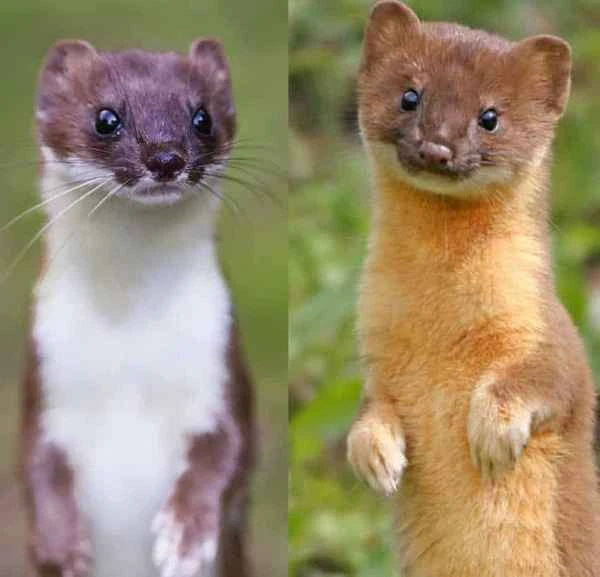
The yellow weasel ( Mustela erminea ) is usually larger than the stoat, with a body length of about 20 to 30 centimeters (8 to 12 inches) and a tail length of 10 to 15 centimeters (4 to 6 inches).
The stoat ( Musela nivalis ) is much smaller, with a body length of 15 to 25 centimeters (6 to 10 inches) and a shorter tail, usually only 4 to 7 centimeters (1.5 to 3 inches).
If you see a relatively large animal moving quickly, it is probably a weasel; while the small and agile ones are mostly stoats.
3. Winter Fur Changes: The Yellow Weasel's "Snow Camouflage"
The color changes of the fur of the weasel ( yellow weasel) and the stoat (white weasel) during winter are also a significant difference:
In winter, the yellow weasel 's fur turns white, forming a "snow camouflage." This change in fur color helps them blend into the snowy environment during the cold winter, thus avoiding predation by natural enemies.
The white weasel 's fur color doesn't change much; it maintains brown or gray fur year-round, unlike the yellow weasel which changes color.
4. Personality and Behavior: Active and Agile
Both the yellow weasel and the white stoat are very active and prefer to be active during the day. They are both intelligent and agile, possessing excellent hunting skills, but their personalities differ:
Weasels are generally quite bold ; they dare to challenge prey larger than themselves and can even hunt rabbits and birds. They can sometimes be relatively aggressive in protecting their territory.
Weasels , on the other hand, are more cautious and tend to hunt small prey such as mice, field mice, and insects. They are also very agile and adept at quickly hiding themselves.
5. Food of Yellow Weasels and White Weasels
The yellow weasel and the stoat share some similarities in their diet, primarily relying on animal matter. Their prey mainly consists of small mammals, birds, and insects.
Weasels are capable of catching relatively large prey, such as rabbits and birds, demonstrating their formidable hunting skills. They are typically very strategic when hunting, able to seize their prey with swift reflexes.
Weasels primarily hunt smaller prey, such as mice and field mice. Due to their small size, they rely more on quick and stealthy movements to hunt.
6. Social Structure: Solitary Action or Group Activity?
Both the yellow weasel and the white weasel are solitary animals and do not usually form groups outside of the breeding season.
Yellow weasels are typically solitary animals with a strong sense of territory, actively defending their domains. They generally live alone, only engaging in mating behavior during the breeding season.
Weasels have a relatively simple social structure. Although they usually act alone, they may temporarily gather in certain environments, especially in resource-rich areas.
7. Habitat: The habitats of the yellow weasel and the white weasel
Both the yellow weasel and the white weasel can adapt to a variety of habitats, but their habitats differ:
Yellow weasels typically live in forests , grasslands , and mountainous areas. They have a wide range of habitats and can adapt to various terrains.
Weasels prefer open grasslands , farmland , and forest edges. Their habitats are usually close to areas of human activity, and they are commonly found near rural areas and farmland.
8. Reproduction Methods: How do they reproduce?
In terms of reproduction, the yellow weasel and the white weasel have similarities:
The breeding season for weasels is generally in late spring or early summer. Female weasels can reproduce 1 to 2 times a year, giving birth to 6 to 12 pups each time. Their gestation period is relatively long, about 10 months, and they usually experience a delayed implantation process.
Weasels have a short breeding cycle, typically mating in the spring, and producing a small number of offspring, usually 4 to 6 per litter. The offspring grow quickly after birth.
9. Ecological Role: The Ecological Contributions of the Yellow Weasel and the White Weasel
Weasels and stoats play important roles in nature, serving as vital maintainers of ecological balance .
Weasels are able to control the population of large prey such as rabbits, preventing these animals from causing excessive damage to crops.
Weasels maintain a balance of small animals by preying on them, such as voles and mice, preventing their overpopulation from affecting the growth of crops and plants.
10. Conservation Status: The conservation status of the yellow weasel and the white weasel.
Currently, the numbers of weasels and stoats are relatively stable, but they still face some threats, especially habitat destruction and human disturbance.
Weasels are protected in some areas, but their habitats are still being destroyed, especially in areas of deforestation and urban sprawl.
The population of stoats is generally stable, and although they are threatened by hunting in some areas, their population is not in great danger overall.
11. Lifespan of the Yellow Weasel and the White Weasel
Weasels and ferrets have relatively short lifespans.
The lifespan of a yellow weasel is about 2 to 3 years . In the wild, their survival rate is low, but in captivity, their lifespan can be extended.
The lifespan of a ferret is usually 1 to 2 years . In the wild, the survival rate is low, but in captivity, it can sometimes live up to 4 years.
12. Comparison table of yellow weasel and white weasel
| feature | Yellow weasel ( Mustela erminea ) | Weasel ( Mustela nivalis ) |
|---|---|---|
| body shape | 20-30 cm | 15-25 cm |
| Tail length | 10-15 cm | 4-7 cm |
| fur color | In winter, it is white (for snow camouflage). | Maintain brown/grey color throughout the year. |
| food | Rabbits, birds | Mice, field mice, small insects |
| Behavior | Bold, aggressive | Cautious, secretive |
| Habitat | Forests, grasslands, and mountains | grasslands, farmland, and forest edges |
| life | 2-3 years | 1-2 years (up to 4 years in captivity) |
| Reproduction | Each litter contains 6-12 pups. | Each litter contains 4-6 pups. |
13. Conclusion: Which is more special, the yellow weasel or the white weasel?
By comparing the distinct characteristics of the weasel ( yellow weasel) and the stoat (white weasel), we can see that they each possess unique survival advantages and adaptations. The weasel's boldness and adaptability enable it to survive in a wider range of environments, while the stoat's agility and caution help it survive in diverse environments. Both play important roles in nature and serve as excellent examples for understanding ecological diversity.
Hopefully, this article will help you better understand the differences between yellow weasels and white weasels, and give you a deeper understanding of these small predators!