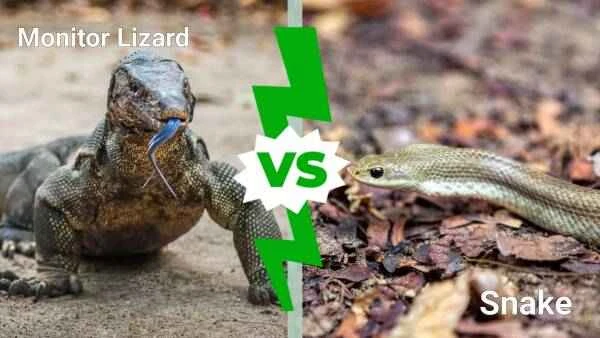
Monitor lizards and snakes are two types of reptiles that can be kept as pets or studied. Monitor lizards are lizards belonging to the genus *Variegata*, typically large in size with strong legs and long claws. Snakes are reptiles belonging to the suborder *Serpentes*, with slender bodies and no legs. These two animals may look completely different, but they share some important similarities.
1. Biology
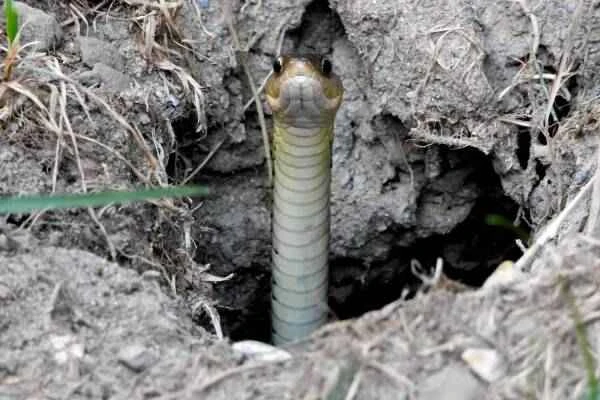
The small Gartner snake emerged from the hole.
Snakes may have lost their legs during evolution so that they could better adapt to confined spaces.
The most obvious similarity between monitor lizards and snakes is their biological relationship. Both are not only reptiles but also belong to the order Squamata, which includes all lizards and snakes. Lizards and snakes are classified in the same order because physiological and genetic evidence suggests that snakes evolved from lizards. The ancient ancestors of snakes had legs, like modern lizards, but over time they evolved to lose their legs and developed the ability to move by gliding. Snakes still share some physical characteristics with lizards, such as their scaly skin, which both reptiles shed as they grow.
Monitor lizards, in particular, may be close relatives of extant snakes. Some studies suggest that snakes evolved specifically from flat-headed lizards, a type of lizard that includes monitor lizards and several extinct species. While not all research supports this view, studies that do help explain other similarities between these two reptiles.
2. Diet
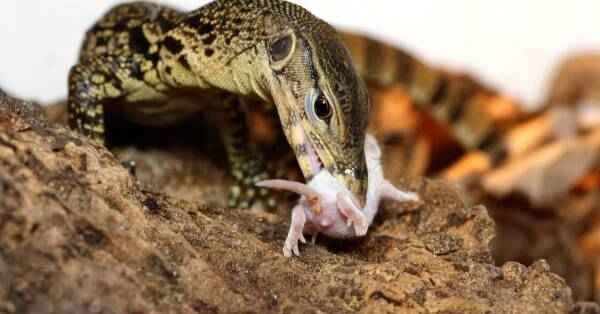
What do monitor lizards eat? – Water monitor lizards eat mice.
Most monitor lizards are carnivorous and eat a variety of small animals.
Another striking similarity between monitor lizards and snakes is their diet. Both snakes and monitor lizards are primarily carnivorous, meaning they eat only other animals.
Most monitor lizards are carnivorous, but some are omnivorous, eating plants and fruits in addition to animals. Many wild monitor lizards consume large amounts of carrion, i.e., dead animals. They also prey on small mammals, birds, other reptiles, amphibians, and crustaceans, as well as bird and reptile eggs. Some of the largest species, such as the Komodo dragon, prey on larger animals like deer, wild boar, or buffalo. Smaller species primarily eat small invertebrates such as insects, millipedes, and scorpions. Pet monitor lizards can eat certain foods sold to humans, such as chicken, turkey, fish, shrimp, eggs, and offal, as well as whole prey such as mice and rats. Smaller pet monitor lizards mainly eat insects such as crickets, mealworms, waxworms, or cockroaches. There are also commercial foods and supplements available for pet monitor lizards.
All snakes are carnivorous. They swallow their prey whole and, unlike monitor lizards, rarely eat carrion or human food. A snake's preferred prey varies depending on its species and size, but snakes may eat rodents, other small mammals, birds, other reptiles (including smaller snakes), amphibians, fish, insects, earthworms, slugs, or eggs. Some of the largest snakes, such as anacondas, will occasionally eat larger animals like deer, monkeys, or capybaras. Many snakes are opportunistic carnivores, meaning they will eat anything they can catch. Pet snakes need to be fed whole prey. For most snakes kept as pets, this prey is mice or rats, but some larger species may require larger prey such as rabbits or chickens.
3. Diversity
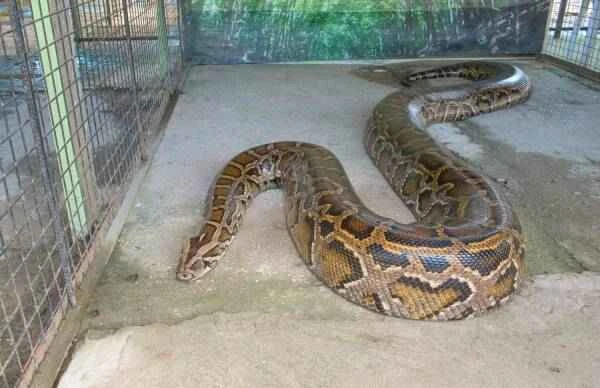
A close-up of a tiger reticulated python
The reticulated python is the longest snake, reaching over 20 feet in length.
Another similarity between snakes and monitor lizards is that they are not monotypic animals. Both are large and diverse categories, containing many different species. Even the selection of species kept as pets is varied.
There are approximately 80 species of monitor lizards. They are distributed in parts of Africa, Asia, Australia, and some islands in the Pacific and Indian Oceans. There are approximately 4,000 species of snakes, distributed throughout the world except Antarctica.
Diversity of sizes
Different species of monitor lizards and snakes differ in many ways, but one particularly striking variation is their size. The largest monitor lizard, and also the largest lizard, is the Komodo dragon. The largest known Komodo dragon was 10.3 feet long and weighed 366 pounds. The smallest monitor lizard is the Dampier Peninsula monitor lizard, weighing less than an ounce and about nine inches long. Which snake is the largest depends on how you measure them. The longest snake is the reticulated python, which can grow to over 20 feet long. The heaviest snake is the green anaconda, shorter than the reticulated python but larger, weighing up to 550 pounds. The smallest snake is the Barbados line snake, only 4.1 inches long. These size ranges are quite large, with monitor lizards and snakes falling between these extremes, showcasing their incredible diversity.
Habitat diversity
Another difference between different types of monitor lizards and snakes lies in their habitats. Monitor lizards primarily live in warm climates, but they can also be found in humid rainforests and arid deserts. Some species live in or around water, while others are arboreal. Snakes inhabit a wide variety of habitats, including deserts, grasslands, forests, and swamps. There are also aquatic snakes, which can be found in both saltwater and freshwater. Snakes can be found in all climates except for the cold polar regions. In temperate climates, snakes hibernate during the winter.
4. Danger
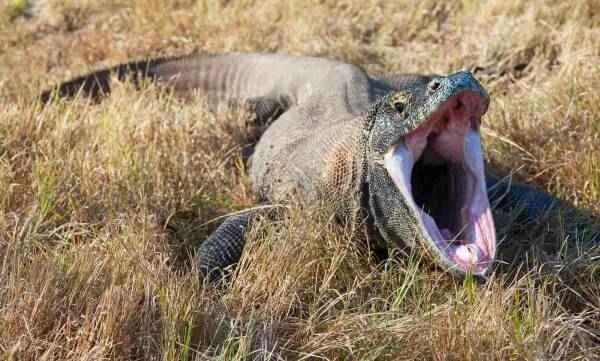
A Komodo dragon yawning. Rinca Island, Indonesia.
Monitor lizards have sharp teeth and their mouths are full of bacteria, so being bitten is very dangerous.
One final important similarity between snakes and monitor lizards is that both pose a potential danger to humans. However, it is safe to remain around them by taking appropriate precautions. The greatest threat to both reptiles is their bite, which, in some species, can be venomous.
Venomous snakes are generally the only snake species that pose a significant danger to humans, and only a small percentage of snakes are venomous. However, identifying venomous snake species can be difficult, so it's best to keep a safe distance from any wild snake unless you are absolutely certain what kind it is. Most non-venomous snakes are completely harmless to humans. They rarely bite, and even when they do, it usually causes little to no harm. Some types of snakes are pythons, meaning they kill their prey by constricting it and suffocating it. However, pythons rarely attempt to restrain humans. The most likely source of danger from pythons is accidental injury to humans when a large pet snake climbs onto them.
Some types of monitor lizards are venomous. Even non-venomous species can cause bites due to their sharp teeth and bacteria in their mouths. Fortunately, wild monitor lizards rarely attack humans, and because they are found in fewer places than snakes, you are less likely to encounter them. The risk of being injured by a pet monitor lizard is higher, especially if you handle the lizard improperly. They can not only bite, but also have sharp claws that can scratch. Even non-aggressive pet monitor lizards can accidentally injure humans while playing or climbing. This is why it is important to learn a lot about reptiles before adopting them as pets, especially potentially dangerous species like monitor lizards or large snakes.