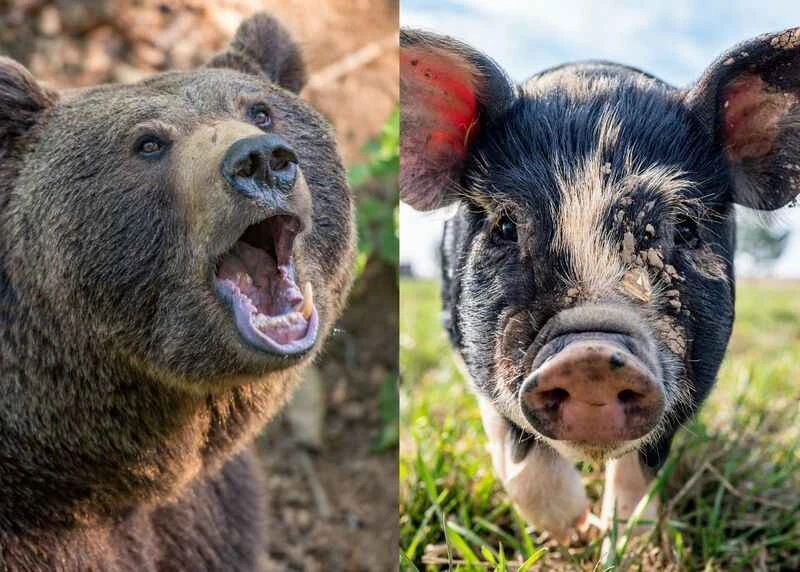
Bears and pigs—could these two mammals be related? At first glance, bears, large carnivores, and pigs, small omnivores with a keen sense of smell, seem unrelated. But a deeper study of evolutionary biology reveals some unexpected connections between them.
In short : Although bears and pigs share a common ancestor as placental mammals, they belong to different orders and have undergone completely different evolutionary paths over the past 65 million years. Therefore, from an evolutionary perspective, bears and pigs are not closely related.
Understanding evolutionary relationships between species
Taxonomy and phylogenetics
Taxonomy classifies organisms based on observable characteristics and assigns them a position in a hierarchical system. In contrast, phylogenetics explores deeper evolutionary relationships between species by comparing the similarities of their genomes.
By constructing detailed phylogenetic trees, scientists can reveal the points of divergence for each species and the time when their common ancestor appeared. The higher the genetic similarity, the closer the kinship between the two species.
Bears and pigs in the evolutionary tree
Molecular research and gene sequencing technologies have enabled scientists to construct complex evolutionary trees, revealing relationships between different species. For example, research has found that pigs share more genetic similarities with whales than with deer or cattle, overturning earlier classification results based on physical characteristics.
While bears and pigs may share some physical similarities, genetic evidence suggests that bears are more closely related to seals and dogs than to pigs. Therefore, bears and pigs share a common ancestor from ancient times, rather than being closely related.
The evolutionary history of bears
The Origin of Bears
The earliest ancestors of modern bears appeared during the Eocene epoch, about 38 million years ago. They belonged to two subfamilies:
Amphicynodontinae (primitive bear subfamily) : diverged about 38 million years ago, and were small arboreal mammals that mainly fed on fruits and plants.
Hemicyoninae (Half-dog bear subfamily) : Appeared about 32 million years ago, larger in size, and evolved into predators capable of hunting small terrestrial mammals.
During the Miocene (approximately 20 to 5 million years ago), these subfamilies further diversified, forming the ancestors of modern bears, such as the short-faced bear, the cave bear, and the ancestors of the giant panda and the Malayan sun bear.
Adaptive evolution of bears
Studies have shown that although bears and pigs share some similarities in characteristics, they are not closely related. Bears belong to the order Carnivora and share a more recent common ancestor with dogs, raccoons, weasels, and pinnipeds. Genetic studies indicate that the Ursidae family diverged from other lineages of Carnivora approximately 43 million years ago.
In contrast, pigs belong to the order Artiodactyla and are more closely related to deer, hippos, camels, and cattle. These two species have adapted to completely different ecological environments, developing unique survival strategies. For example, bears rely on their strong limbs to hunt and climb, while pigs use their flexible snouts to forage in the mud.
The evolutionary history of pigs
Origin of early pigs
The evolutionary origins of pigs can be traced back approximately 65 million years to hoofed mammals—anthracotheres—which share a common ancestor with hippos and whales. These early animals were herbivores and gradually spread from Asia to Europe and North America, evolving into various groups in different environments.
Around 40 million years ago, during the late Eocene epoch, ancient mammals evolved into early pigs, such as the long-nosed pig-like animals called Entelodonts. These omnivorous animals not only fed primarily on plants but also preyed on small animals or scavenged carrion.
The Rise of the Modern Pig
The direct ancestors of modern pigs appeared during the Oligocene epoch, about 35 million years ago, and spread rapidly across the globe. By the Miocene epoch (about 23 million years ago), different species of pigs were found on every continent, including wild boars in North America and ancestors of modern domestic pigs in Eurasia.
Around 10 million years ago, the genus * Sus *, to which modern domestic pigs belong, began to expand from Southeast Asia and rapidly adapted to various environments. Around 8,000 to 10,000 years ago, wild boars were independently domesticated by humans in the Near East and China, becoming the domestic pigs we know today.
Comparing the evolution of bears and pigs
Differentiation from a common ancestor
Bears and pigs share a common ancestor dating back 65 million years. However, the two species diverged around 40 million years ago. Bears gradually adapted to temperate forests and cold climates, becoming omnivorous predators; while pigs evolved primarily into omnivorous foragers in tropical regions.
This differentiation in ecological environments led to drastically different evolutionary pressures. For example, bears needed to store fat and hibernate during the cold winter, while pigs evolved sweat glands to adapt to tropical climates.
Different selection pressures and adaptations
Bears rely on their strong limbs and sharp claws to hunt, and have developed thick fur and camouflage abilities. Pigs, on the other hand, have shrunk their thick fur and focus more on efficient foraging, relying on their flexible noses and strong teeth to dig and grind their food.
Despite the distant kinship between bears and pigs, their adaptive evolution provides an interesting example for studying the effects of migration, climate, and diet on mammalian evolution.
Why are bears and pigs so different?
Comparison of diet and foraging strategies
Bears are omnivores, feeding on both plants and meat, and often hunting fish and large mammals; while pigs, although also omnivores, prefer plants and find food by digging in the soil with their noses.
Bears need vast territories and superior hunting skills, while pigs win by having high reproductive rates and social abilities, adapting well to the environment around humans.
Habitat differences
Bears are mainly distributed in the forests, mountains, and tundra of North America, Europe, and Asia, and are adapted to harsh climates, even hibernating for months. Pigs, on the other hand, originated in Europe and Asia, are widely distributed in warm regions around the world, and cannot tolerate extreme cold.
Bears' low reproductive rate makes them particularly vulnerable to habitat loss, while pigs' high reproductive rate makes them one of the world's invasive species.
in conclusion
Although both bears and pigs are placental mammals, they diverged 65 million years ago. Bears evolved into large omnivorous predators, while pigs evolved into highly adaptable social omnivores.
Their evolutionary histories demonstrate how natural selection shapes mammalian diversity under the pressures of diet, climate, and geographical distribution. This difference makes us even more awe-inspiring of the complex and intricate tree of life's evolution in nature.