Crocodiles and dinosaurs are two of the most fascinating groups of reptiles in the animal kingdom. Although often considered distinct entities, they are closely linked through branches of the evolutionary tree. This article will delve into their evolutionary history, anatomical similarities, and ecological roles to provide a comprehensive understanding of their relationship.
Evolutionary Background
Common Ancestor
Crocodiles and dinosaurs share a common ancestor that lived around 250 million years ago during the Triassic period. This ancestor belonged to a group of "dominant reptiles" called Archaeosuchians. From this lineage, two main branches diverged: Ornithischians (including pterosaurs and birds) and pseudocrocodilians (including crocodiles).
lineage differentiation
As the Mesozoic Era progressed, dinosaurs and crocodiles began to diverge significantly. Dinosaurs dominated terrestrial ecosystems, evolving into various forms, from massive sauropods to ferocious theropods. Crocodiles, on the other hand, were better adapted to aquatic and semi-aquatic life, utilizing rivers, lakes, and coastal environments.
Anatomical similarity
Skeletal structure
Crocodiles and dinosaurs exhibit many anatomical similarities, highlighting their common ancestor. Both groups of animals share similar skull structures, characterized by long snouts, sharp teeth, and powerful jaws. Furthermore, they show similarities in the arrangement of their skulls and limb bones.
skin and scales
Crocodiles, like many dinosaurs, possessed tough, scaly skin that provided protection against environmental factors and predators. While modern birds are the closest relatives of dinosaurs, the scaly skin of crocodiles serves as a reminder of their shared reptilian heritage.
Ecological role
Predation behavior
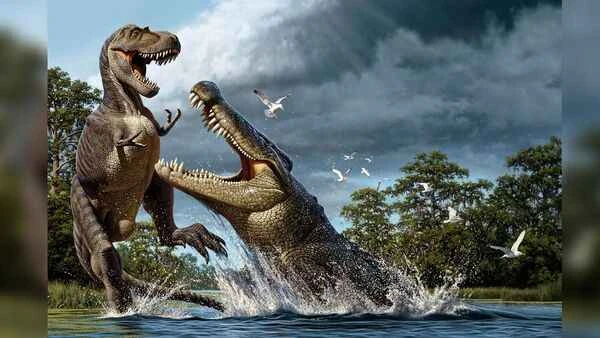
Crocodiles were apex predators in their ecosystems, a trait also found in many dinosaur species. Theropod dinosaurs like Tyrannosaurus Rex occupied a similar niche, preying on herbivorous dinosaurs. Both developed hunting adaptations, including sharp teeth and powerful jaws.
Habitat and Adaptation
Although dinosaurs were primarily terrestrial, crocodiles adapted to a semi-aquatic lifestyle, enabling them to utilize different ecological niches. This adaptation allowed crocodiles to survive multiple mass extinction events that led to the extinction of dinosaurs, demonstrating their resilience.
Extinction and Survival
In the mass extinction event at the end of the Cretaceous period, approximately 66 million years ago, most dinosaur species went extinct. However, crocodiles survived, primarily due to their adaptability and ability to survive in diverse environments. Today, crocodiles are considered "living fossils," retaining many characteristics of their ancient ancestors.
The relationship between crocodiles and dinosaurs is a fascinating testament to the complexity of evolution. Sharing a common ancestor, and despite different evolutionary paths, they retain anatomical and ecological similarities. Understanding their relationship not only reveals the history of reptiles but also highlights the resilience of life on Earth. By exploring the evolutionary links between crocodiles and dinosaurs, we gain a deeper understanding of the biological heritage that has shaped the world we live in today.
A comparison between crocodiles and dinosaurs: the amazing winner!
When we think of ancient reptiles, dinosaurs often take center stage with their massive size and diverse forms. However, a surprising competitor emerges: the crocodile! Let's delve into the comparison.
Evolutionary resilience
Crocodiles are known as "living fossils" because they have survived multiple mass extinction events, including the one that led to the extinction of the dinosaurs. Their ability to adapt to various environments ensured their survival, while the dinosaurs disappeared from history.
ecological niche
Crocodiles are apex predators in aquatic ecosystems, maintaining habitat balance. In contrast, dinosaurs occupied diverse terrestrial niches, ranging from herbivores to apex predators. Despite the awe-inspiring nature of dinosaurs, crocodiles' efficiency and resilience in specific environments gave them an advantage.
A comparative analysis of crocodiles and dinosaurs
| feature | Crocodile | Dinosaur |
|---|---|---|
| ancestor | Derived from ancient crocodiles | Also derived from ancient crocodiles |
| period | Late Triassic Evolution | Dominated from the Late Triassic to the End of the Cretaceous. |
| Habitat | Semi-aquatic, freshwater and coastal | Mainly terrestrial students |
| Body structure | A strong body, a long kiss | They come in various forms, including two-legged and four-legged. |
| skin | Tough, scaly skin with bony plates (osteoscales). | Diverse; some have feathers, many have scales |
| diet | Carnivorous; primarily feeds on fish. | Diverse; including herbivorous, carnivorous, and omnivorous species. |
| Reproduction system | Oviparous (laying eggs) | Oviparous (laying eggs) |
| Body temperature regulation | Ephemeral (cold-blooded) | Diverse; many may be warm-blooded |
| social behavior | Loneliness or small groups | Diversity; some species exhibit social behavior within groups. |
| Survival ability | Able to survive a mass extinction event | Most of them went extinct in the Cretaceous-Paleogene extinction event. |
| Modern relatives | Surviving descendants of modern crocodiles | Birds are considered modern descendants of theropod dinosaurs. |
This comparison highlights the stark differences and similarities between crocodiles and dinosaurs, providing a clear perspective for understanding their evolutionary paths and adaptations.
Anatomical features
Both share a common ancestor, but crocodiles possess unique adaptations, such as powerful jaws and specialized skin. While dinosaurs exhibited morphological diversity and structural innovation, crocodiles' efficiency and robustness gave them an advantage in survival.
Ultimate winner
While dinosaurs have captivated our imaginations, crocodiles are surprisingly superior in terms of resilience and adaptability. Their continued existence proves that sometimes, survival trumps size!