The bongo antelope ( Tragelaphus eurycerus ), also known as the African antelope, western or lowland antelope, or purple antelope , is a large, forest-dwelling antelope found in Africa. It has garnered significant attention due to its unique morphological characteristics, enigmatic habitat, and complex social behavior. While playing a vital role in the ecosystem, the bongo antelope faces severe challenges to its survival due to habitat loss, poaching, and climate change. This article will provide an in-depth analysis of the bongo antelope's scientific classification, morphological characteristics, habitat, diet, reproduction, and current conservation status, aiming to provide the public with comprehensive and professional knowledge about the bongo antelope and to advocate for greater attention to its conservation.
Scientific classification of Bongo antelope
The Bongo antelope ( Tragelaphus eurycerus ) belongs to the class Mammalia, order Artiodactyla, family Bovidae, and subfamily Bovini. Its scientific classification can be further subdivided into the following levels:
Kingdom : Animalia
Phylum : Chordata
Class : Mammalia
Order : Artiodactyla
Family : Bovidae
Subfamily : Bovini
Genus : Tragalaphus
Species : Bongo antelope ( Tragelaphus eurycerus )
The bongo antelope belongs to the genus * Tragelaphus *, and shares this classification with other well-known forest-dwelling antelopes such as the waterbuck ( *Tragelaphus spekii *) and the serow ( *Tragelaphus angasii* ). They typically inhabit dense forests or forest edges and possess unique biological and ecological characteristics. Based on different geographical distributions, the bongo antelope can be divided into two subspecies:
Western Bongo antelope ( T. e. eurycerus ) : Distributed in the tropical rainforests of West and Central Africa, such as Gabon and Cameroon.
Eastern Bongo Antelope ( T. e. isaaci ) : Inhabits the mountainous regions of East Africa, such as the high-altitude forests of Kenya.
These two subspecies differ in morphological characteristics and ecological habits, with the eastern Bongo antelope being less numerous and facing a more severe threat of endangerment.
Morphological characteristics and physical properties of the Bongo antelope
Characteristics of Bongo antelope fur
Fur color : The fur color of the bongo antelope varies depending on sex, age, and population. Generally, its fur is light brown or chestnut, but the color can differ in different parts of the body.
Males : As male ibex age, their fur gradually darkens, changing from a lighter chestnut color to a deep reddish-brown, especially noticeable on the front of their bodies. Adult males typically have a darker coat, signifying maturity.
Females : Female bongo antelopes typically have brighter, more vibrant fur with a lighter hue.
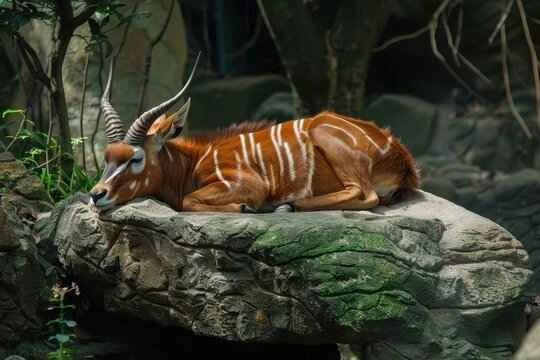
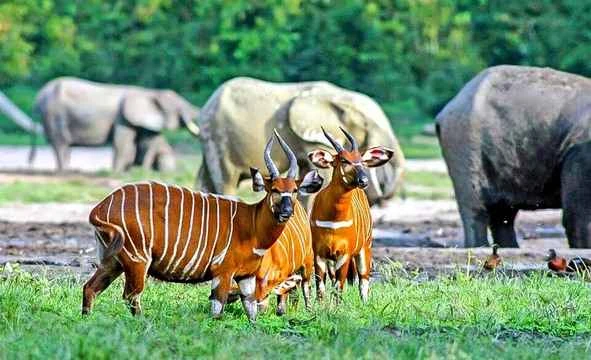
Striped pattern : Bongo antelopes have distinctive stripes on their fur, which are usually white or pale yellow and run vertically. They extend from the base of the neck to the rump, and there are usually 10-15 stripes.
These stripes are not perfectly symmetrical; the number and shape of the stripes on the left and right sides are usually different. This stripe pattern may be related to the camouflage behavior of the bongo antelope , helping them to hide themselves in grasslands and bushes and avoid being hunted by predators.
White V-shape : The bongo antelope has a very distinctive white V-shape marking on its face, appearing between its eyes, further enhancing its facial recognizability. In addition, the bongo antelope has two large white spots on each cheek, which also provide a visual marker for identification within the herd.
Back hair : This species also has a short, stiff, brown back hair ridge that extends from the shoulders to the rump. This back hair is usually stiff and helps protect the Bongo antelope's spine from predators.
Mouth and lip color : The bongo antelope 's lips have a striking contrast between white and black, with the lower part of the lips being white and the top being dark-colored. This striking color contrast is not only aesthetically pleasing but may also aid in visual communication among members of the group.
body shape
The bongo is a large antelope, reaching 2.15 to 3.15 meters in length (including tail), with a shoulder height of approximately 1.1 to 1.3 meters and a tail length of 45 to 65 centimeters. Adult males typically weigh between 220 and 405 kilograms, with males generally heavier than females, who weigh approximately 150 to 235 kilograms. It is the third largest animal in the Strepsicerotini family of bovines, weighing about 300 kilograms (660 pounds) less than both the common oryx and the oryx, and about 40 kilograms (88 pounds) heavier than the great oryx.
horn
It is the only antelope species in the family where both males and females possess horns. The horns are one of the most distinctive features of the bongo antelope, with the spiral shape being particularly prominent in males. Male horns are long and thick, measuring approximately 75 to 99 centimeters in length, while female horns are relatively smaller and more slender. The primary function of the horns is for fighting and defense, and they are also important organs for the bongo antelope to project an intimidating presence. African oryxes have complex social interactions and live in the dense forests of Africa. They are the third largest antelope species in the world.
Visual characteristics and biological adaptations
These fur characteristics and patterns of the ibex not only help it camouflage itself in complex environments, but may also play a role in social interaction and group identification. Especially in group activities, these colors and stripes allow individuals to quickly identify each other's presence and gender, maintaining the structure and order of the group.
Furthermore, the smoothness of their fur and the arrangement of their stripes likely help Bongo antelopes blend better into their surroundings in environments such as scrubland and grassland, reducing their chances of being spotted by predators. Although they do not rely on scent glands to identify each other like some species, physical differences remain an important part of their daily lives.
Sex differences and subspecies differences
Fur differences between eastern and western subspecies : The fur of the eastern Bongo antelope is darker than that of the western subspecies, especially noticeable in males. This color difference reflects their biological adaptations to different habitats.
In conclusion, the Bongo antelope, through its unique fur characteristics, demonstrates a wealth of biological adaptations that not only help it survive in its natural environment but also play an important role in social interaction.
Global distribution and habitat of the Bongo antelope
Habitat
Bongo antelopes primarily inhabit the tropical rainforests of West and Central Africa, with a particular preference for forests and dense woodlands. They are adapted to humid climates and typically appear in lowland forests below 1000 meters in altitude. In the mountain subspecies of East Africa, the Bongo antelope inhabits relatively higher altitudes and is more sparsely populated. These forests provide the Bongo antelope with abundant food sources and also offer them shelter.
threats to habitat
The Bongo antelope's habitat is facing multiple threats. Expansion into agriculture, logging, and illegal mining are causing large-scale destruction of forest habitats, leading to a shrinking range of living space for the antelope. The mountainous regions inhabited by the eastern Bongo antelope are particularly vulnerable, as the combined pressures of climate change and human activity are further exacerbating environmental degradation.
Diet and foraging strategies of the Bongo antelope
feeding habits
As herbivores, ibex feed on leaves, shrubs, vines, and occasionally fruits in the forest. Their food sources are abundant within their habitat, but they primarily rely on leaves and tender branches. Especially during the dry season, ibex supplement their water and mineral intake with fruits from the highlands and water sources in the forest.
Foraging behavior
Bongo antelopes are mostly nocturnal, foraging primarily at dusk and dawn. During the day, they hide in dense forests to avoid becoming prey for carnivores. Bongo antelopes are quite cautious when searching for food, typically relying on their sense of smell and hearing to assess the safety of their surroundings.
Social behavior and reproduction of bongo antelope
Social organization and behavior of bongo antelope
The bongo antelope is a unique animal that lives in dense forests and scrublands, and its social organization and behavior differ from other antelopes that live on the grasslands. Their social patterns, reproductive behaviors, and strategies for coping with threats are all distinctive. The following is an in-depth analysis of the social organization and behavioral patterns of the bongo antelope, particularly the eastern bongo antelope.
social structure
The bongo antelope has a relatively loose social structure, typically consisting of female groups and individual males. Male bongo antelopes are usually solitary, while females often form small groups, typically mothers and their offspring. Each group generally consists of 6 to 8 individuals, with groups exceeding 20 being quite rare. This social structure allows the bongo antelope to thrive flexibly in complex forest environments.
Male Behavior : Adult male ibex typically live solitary lives, seeking mating opportunities within groups of females. Interaction among adult males is usually limited, especially among males of similar size and age. They often avoid each other, but occasionally engage in ritualistic horn-fighting contests. These fights are not particularly intense, serving more as a visual display; males stretch their necks, adjust their eye angles, and make threatening gestures in the air with their horns.
Female Groups : Female Bongo antelopes typically live with their young. They form relatively stable small groups, with the mother responsible for caring for and feeding the calves. Females also maintain social connections, often foraging and caring for their young together. Group activity helps improve the survival rate of the calves, especially when facing predators.
Behavioral characteristics and threat response
Activity patterns : Bongo antelopes are mostly nocturnal, but they also become active at dusk or dawn. Although their peak activity period is at dusk, compared to other antelopes on the grasslands, the activities of Bongo antelopes are more influenced by their habitat.
Escape and Threat Response : Bongo antelopes are highly alert and react swiftly to threats, fleeing quickly. Although they inhabit complex environments filled with dense undergrowth, they are able to traverse these obstacles with remarkable speed. When encountering predators, they emit low bleating or snorting sounds to warn other members of the herd.
Social Signals and Communication : Bongo antelopes primarily communicate through sight and sound. Males display a threat to other males by stretching their necks, turning their eyes, and keeping their horns upright, thus avoiding unnecessary conflict. Females maintain contact with their calves through soft mooing, especially during the nursing period, when mothers regularly return to the calving grounds to feed their young.
Predator Threat : Bongo antelopes are prey for many large carnivores, including leopards and lions. When they sense a threat, they usually flee quickly into the depths of the forest or dense bushland to avoid being discovered by predators.
Reproduction and Childcare
Breeding Cycle : The gestation period for bongo antelopes is approximately 285 days (9.5 months), and they give birth to only one calf at a time. Mothers stay in designated calving grounds, which they typically choose consistently and do not change locations frequently. For several days after giving birth, the mother hides the calf in secluded places to avoid attracting predators. The mother returns periodically to nurse the calf until it is old enough to eat grass.
Early Life Development : Newborn antelope calves are highly dependent on their mothers' protection. For about a week after birth, they usually hide in relatively safe places to avoid external disturbances. As time goes by, the calves gradually grow and begin to move around with their mothers and other members of the group. Around six months later, they are weaned, begin to eat solid food, and gradually integrate into the group's life.
Sexual maturity : Both male and female ibex reach sexual maturity at approximately 20 to 27 months of age. Male ibex typically leave the herd to seek their own habitat, while females may remain connected to the herd until they are capable of reproduction.
The social behavior and reproductive patterns of the bongo antelope demonstrate its unique adaptability. Through distinctive social structures, reproductive strategies, and a high degree of alertness and escape abilities, they survive and reproduce in the forest. Unlike other grassland animals, the bongo antelope's behavior relies more heavily on sophisticated adaptations to its environment; their interactions within groups and dependence on matrilineal herds enable them to better survive in the complex environment of the forest.
Bongo antelope species
The following is a table showing the different species of ibex and their characteristics:
| type | Distribution area | Body type | Color characteristics | Features of angles | Habitat |
|---|---|---|---|---|---|
| Eastern Bongo antelope | East Africa (especially Kenya and Tanzania) | They are large in size, with a shoulder height of about 1.2–1.4 meters and a weight of up to 400 kilograms. | Its body color is relatively bright, usually reddish-brown with distinct white stripes. | The male's horns are relatively long, spiral-shaped, and about 80–90 cm long. | Prefers dense forests and humid areas, commonly found in lowland rainforests and mountain forests. |
| Western Bongo Antelope | West Africa (such as Cameroon and Nigeria) | They are relatively small in size, with a shoulder height of about 1.1–1.3 meters and a weight that can reach 300 kilograms. | The body color is relatively dark, ranging from brownish-red to deep red, with more prominent white stripes. | The male's horns are slightly shorter, but still spiral-shaped, and about 60–70 cm in length. | Prefers humid tropical forest and shrubland areas |
annotation:
Eastern Bongo : Generally larger than their western counterparts, with brighter colors and more pronounced white stripes. They are better adapted to the forest environment of East Africa and exhibit strong territorial behavior during the breeding season.
Western Bongo : Smaller in size and darker in color, it lives in a relatively humid habitat and usually in the lowland rainforests of West Africa.
The table above clearly shows the differences between the two types of Bongo antelope, including their body size, color characteristics, horn shape, and habitat.
The current state of Bongo antelope conservation
Protection level
According to the International Union for Conservation of Nature (IUCN), the western ibex ( T. e. eurycerus ) is listed as Near Threatened (NT), while the eastern ibex ( T. e. isaaci ) is listed as Critically Endangered (CR). The eastern ibex population has dwindled to less than 200 individuals, and its habitat is threatened by illegal logging and agricultural expansion.
Population size
Currently, the global population of Bongo antelope is estimated at around 28,000, primarily residing within protected areas. However, due to ongoing habitat loss, the population has not recovered effectively. Particularly in the eastern Bongo antelope habitat, wild populations are nearing extinction, and conservation organizations are undertaking breeding and reintroduction programs.
Threat factors
The main threats facing the Bongo antelope include habitat destruction, illegal logging, poaching, and the spread of disease through contact with livestock. Their primary predators include large carnivores such as cheetahs and spotted hyenas, but due to their nocturnal and forest-dwelling habits, these predators have a low success rate in hunting them.
Bongo antelope conservation measures
Nature Reserves and Habitat Restoration
To protect the ibex, several countries have established protected areas and strictly control logging activities within their habitats. In Kenya, conservation projects such as the Mount Kenya Wildlife Conservancy are working on ibex population restoration and reintroduction. Through habitat restoration, reduced poaching, and environmental education, ibex populations within protected areas have been protected to varying degrees.
Anti-poaching and patrol
By strengthening forest patrols, raising awareness, and implementing anti-poaching operations, local governments and non-governmental organizations are working together to ensure that the Bongo antelope is no longer threatened by poaching and illegal trade.
The ecological and cultural value of the Bongo antelope
Ecological value
As an important herbivore in the forest ecosystem, the ibex plays a regulatory role in the forest's vegetation structure. Through their grazing behavior, they help control the reproduction of certain plant species, maintaining plant diversity. Their presence also provides a stable food source for predators in the forest food chain.
Cultural and economic value
In some African cultures, the bongo antelope is considered a sacred animal, a symbol of strength and protection. Its horns and leather play an important role in traditional crafts, and in some regions, its horns are even used to make ceremonial implements. Furthermore, the bongo antelope has significant ecotourism value, attracting numerous tourists for observation and research, thus generating sustainable income for the local economy.
Conclusion: Protect the Bongo antelope, protect nature.
As a unique and important forest species, the Bongo antelope faces significant threats and challenges to its survival. Through concerted efforts, raising public awareness of Bongo antelope conservation, and strengthening habitat restoration and species protection, we have the opportunity to ensure that this species can continue to thrive and maintain its vital role in the ecosystem in the future.