The Jabiru mycteria, also known as the American stork, is a large stork native to the Americas. A large wading bird belonging to the stork family, it is widely distributed from Mexico to Argentina, and is particularly common in the Pantanal wetlands of Brazil and the Chaco region of eastern Paraguay. The Jabiru is the only species belonging to the " Jabiru " family and is renowned for its powerful flight, unique foraging methods, and relatively large size. The following is a comprehensive introduction to the Jabiru, including detailed information on its scientific classification, morphological characteristics, habits, habitat, and conservation status.
Scientific classification and nomenclature
The American stork belongs to the order Ciconiiformes, family Ciconiidae, and genus Jabiru. Its scientific name is *Jabiru mycteria* , and it is the only member of the genus *Jabiru*. This species has a wide distribution, from Mexico to Argentina, and is commonly found in tropical and subtropical wetland environments.
Domain : Eukaryotes
Kingdom : Animal Kingdom (Animalia)
Phylum : Chordata
Class : Aves
Order : Ciconiiformes
Family : Ciconiidae
Genus : Jabiru
Species : J. mycteria
Latin name
Binomial nomenclature : Jabiru mycteria
The naked stork belongs to the family Ciconiidae and is closely related to other storks such as the American wood stork (Mycteria americana) and the black-necked stork (Ephippiorhynchus asiaticus). It is the only species in the genus Jabiru.
The naked stork, scientifically known as *Jabiru mycteria*, is a member of the family Ciconiiformes. This species was first described by the German zoologist Hinrich Lichtenstein in 1819. Its genus name, "Jabiru," comes from the Tupi-Guarani language and means "swollen neck," named for its distinctive bare, red neck. In Portuguese, the naked stork also has several local names, such as *tuiuiu* and *tuim-de-papo-vermelho*.
Morphological characteristics
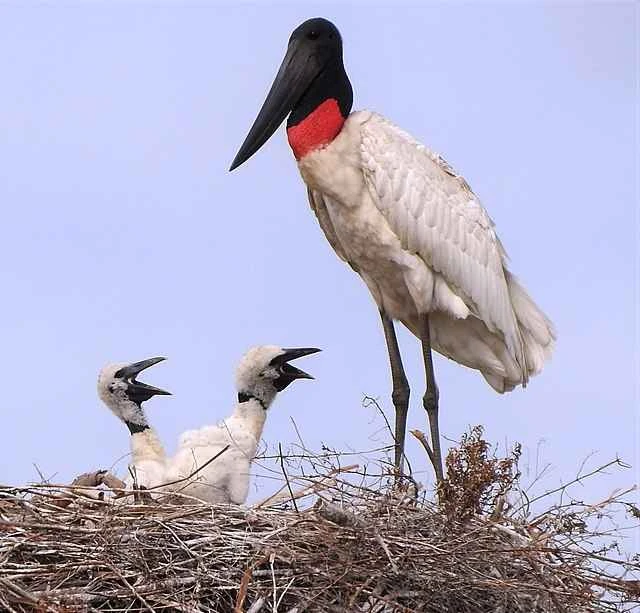
The naked stork is one of the largest storks in the Americas, with adults measuring 120-140 cm in length and having a wingspan of 2.3 to 2.8 meters. They typically weigh between 4.3 and 9 kg, with males about 25% heavier than females. Male naked storks can reach a height of 1.53 meters, with a 25-35 cm long, black, broad, and slightly upturned beak. Their plumage is mostly white, but the head and neck are black, with particularly striking red patches on the bare neck.
The naked stork's long tail and powerful wings make it exceptionally graceful and efficient in flight. Although they may appear clumsy on the ground, they are actually very powerful fliers, capable of long-distance flight and migration between habitats.
Habitat and Distribution
The naked stork is widely distributed in Central and South America, with habitats primarily consisting of open areas near swamps, wetlands, rivers, and lakes. They are mainly found from Mexico to Argentina, and are particularly common in the Pantanal wetlands of Brazil and the Chaco del Este region of Paraguay. Additionally, naked storks are occasionally spotted in Texas and other southern states of the United States, especially during migration season.
Ecology and Behavior
The naked stork is a gregarious bird that typically lives near wetlands and water, where food sources are abundant. They primarily feed on fish, frogs, snails, small reptiles, and invertebrates, and even during the dry season, they will scavenge carrion such as dead fish. The naked stork forages using touch rather than sight; they open their beaks at a 45-degree angle to the water's surface, and when they touch their prey, they quickly close their beaks and swallow it.
These storks are opportunistic predators; when animal populations surge in certain areas, naked storks gather in large numbers and prey on other animals, such as rodents and insects.
Reproduction and life cycle
The naked stork is a solitary nester, typically building large nests in tall trees. The nests are usually constructed of branches, reaching up to 1 meter in diameter and 1.8 meters in depth. Each year, the naked stork breeds in the same nest, incubating up to 2 to 5 white eggs. The parents take turns incubating the eggs and caring for the chicks as they grow. The chicks usually develop feathers around 110 days old, but still need to remain under their parents' care for about 3 months before becoming fully independent.
The breeding season for naked storks is mainly concentrated in August and September in the Southern Hemisphere, and their average lifespan can reach 36 years.
Protecting the status quo and threats
According to the International Union for Conservation of Nature (IUCN), the naked stork is currently classified as "Least Concern." In the past, the naked stork faced threats to its survival due to habitat loss and illegal hunting. However, since 1973, following conservation measures implemented in Belize and other regions, their numbers have rebounded. In the United States, they are also protected under the Migratory Bird Act. Nevertheless, the naked stork still faces threats such as habitat destruction, wetland pollution, and illegal hunting.
Major threats and natural enemies
The main predators of the naked stork include large birds of prey (such as vultures) and some carnivorous mammals. Their eggs and chicks are particularly vulnerable to predation by raccoons, other storks, and certain predators. Due to habitat destruction and climate change, the naked stork faces even greater challenges to its survival. Particularly in some areas, excessive water pollution and fluctuating water levels negatively impact the stork's reproductive success rate.
Protective measures
Currently, the naked stork is legally protected in many countries and regions. Their habitats, particularly wetlands and waterways, have been incorporated into ecological reserves, with regulations restricting human activity to prevent overexploitation and resource abuse. In some areas, conservation organizations also provide data support for conservation efforts by monitoring and studying the naked stork's habitat and population size.
Cultural and economic value
The naked stork holds an important place in local cultures, especially in the legends and beliefs of some indigenous tribes. Its majestic appearance and flying ability have made it a symbol of many cultures.
In addition, the naked stork is a significant attraction for ecotourism. Due to their beautiful appearance and unique habitat, the naked stork has become a popular subject of observation for bird enthusiasts and nature observers.
closely related varieties
The naked stork's closest relatives are mainly the black-necked stork (Ephippiorhynchus asiaticus) and other stork species, whose habitat habits and physical characteristics share many similarities with the naked stork. Below is a comparison of the naked stork and its close relatives:
| Species name | Body length (cm) | Wingspan (m) | Weight(kg) | Distribution area | Preserve the status quo |
|---|---|---|---|---|---|
| Bare-necked Stork (Jabiru mycteria) | 120-140 | 2.3-2.8 | 4.3-9 | From Mexico to Argentina | No danger |
| Black-necked stork (Ephippiorhynchus asiaticus) | 120-140 | 2.3-2.6 | 5-7 | India, Southeast Asia | Near Danger |
| Mycteria americana (Maguari Stork) | 110-130 | 2.5-2.9 | 4-6 | South America, mainly in Brazil and Argentina | Vulnerable |
Conclusion
The naked stork, an important bird species in the Americas, possesses unique biological characteristics, habitat, breeding habits, and ecological status. Although currently listed as "Least Concern," continued conservation measures are necessary to ensure its habitat is not excessively destroyed. By strengthening habitat protection and reducing human threats, we can hope to maintain the survival and prosperity of this species in the wild.