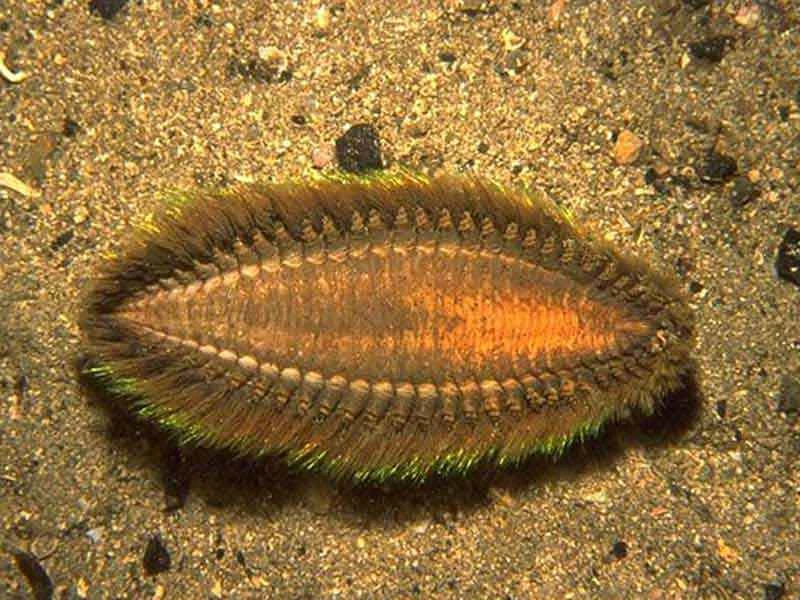
The scaly sandworm (scientific name: *Aphrodita aculeata*), commonly known as the sea mouse, is a unique marine creature that has garnered widespread attention due to its distinctive appearance and fascinating behavior. Belonging to the family Nematodae, it is widely distributed in shallow seas worldwide. The scaly sandworm is not only an important member of the marine ecosystem but also has certain connections with human culture and economic activities. This article will comprehensively analyze the scientific classification, morphological characteristics, habitat, and ecological behavior of the scaly sandworm.
1. Scientific taxonomy of the scaly sandworm
The scaly sandworm belongs to the phylum Annelida, order Amphinomidae, and its scientific name is *Aphrodita aculeata*. Its physical characteristics differ significantly from other sandworms, making it a unique species for the study of marine life.
Taxonomy
Kingdom: Animalia
Phylum: Annelida
Class: Polychaeta
Order: Amphinomidae
Genus: Aphrodita
Species: Aphrodita aculeata
The species is named "Aphrodita" after Aphrodite, the Greek goddess of love and beauty, perhaps because its graceful posture and colors on the seabed evoke the allure of the sea goddess.
2. Morphological characteristics and physical properties of the scaly sandworm
physical characteristics
The scaled sandworm has a flat, elongated body with a row of hard, spiky scales on both sides, giving it a very distinctive appearance, which can even be described as "hedgehog-like." Its body surface displays a vibrant green or red color, and it has pedipal appendages on its hindquarters, which help it move quickly on the seabed.
Body length: Generally can reach 10 to 20 centimeters.
Weight: Relatively light, usually not exceeding 50 grams.
Lifespan: Approximately 1 to 2 years, but the exact lifespan varies depending on environmental conditions.
physical properties
Hard, spiny scales: These are its most distinctive feature, and they serve a protective function, preventing predators from hunting it.
Glandular secretions: The scaly sandworm secretes fluid through its glands to help it glide on the seabed or stay moist.
These physical characteristics are not only an advantage for the survival of the scaly sandworm, but also allow it to occupy a place in the marine ecosystem.
3. Global distribution and habitat of the scaly sandworm
Global distribution
Scaled sandworms are widely distributed, mainly living in shallow sea areas such as the Atlantic Ocean, the Mediterranean Sea, and the North Sea. They typically inhabit the seabed at depths of 10 to 50 meters, preferring sandy or muddy seabeds.
Habitat
Polymorphous sandworms have high environmental requirements, preferring to inhabit warm seawater. They are highly adaptable and can grow in moist, organic-rich substrate environments. They are mostly distributed in beaches, intertidal zones, and shallow nearshore areas, where the water currents are relatively slow, providing abundant food sources for polymorphous sandworms.
4. Ecology and Behavior of the Scaled Sandworm
The ecological role of scaly sandworms is crucial in marine ecosystems. They are important benthic animals that convert organic matter into energy that can be used by other marine organisms through the food chain.
Behavioral characteristics
Nocturnal activity: Scaled sandworms are usually active at night, and during the day they protect themselves by burying themselves in sand or mud.
Rapid movement: They use their tiny feet to quickly traverse the seabed in search of food.
Migration patterns
Sandworms typically do not undertake large-scale migrations; they settle in suitable environments and rely on water flow and tides to change their local range of activity.
5. Diet and foraging strategies of the scaly sandworm
Sandworms are typical scavengers, feeding on organic matter on the seabed, such as decaying plants, dead marine life, and plankton.
Foraging strategies
Benthic food: The scaly sandworm uses its unique body structure to glide quickly across the seabed, searching for and ingesting organic debris from the seabed.
Filter feeding: Some of their long, thin appendages help them filter out tiny organisms in the water to obtain food.
6. Reproduction methods of the scaly sandworm
The scaled sandworm reproduces through external fertilization, with the female releasing eggs and the male releasing sperm for fertilization. The breeding season typically occurs in spring and summer, when water temperatures are suitable and food is plentiful.
Reproductive cycle
Egg laying: Female scaled sandworms lay their eggs in the deep layers of sand or mud.
Hatching: After the eggs hatch, the larvae will find a habitat in the mud and sand on the seabed and begin to live independently.
7. Current Status and Threats to the Conservation of the Scaled Sandworm
Protection level
Currently, the scaly sandworm is not listed as an endangered species, but it still faces certain ecological threats.
Main threats
Habitat destruction: The habitat of the scaly sandworm is threatened due to marine pollution and beach construction.
Fishing pressure: As an important part of the marine food chain, the sandworm is also affected by overfishing.
Protective measures
Currently, there are few conservation measures for the scaly sandworm, but scientists are actively researching feasible solutions for habitat protection and limiting overfishing.
8. Ecological and economic value of the scaly sandworm
Ecological value
As an important part of the marine ecosystem, scaly sandworms maintain the health of the marine benthic ecosystem by decomposing organic matter. In addition, scaly sandworms also provide a food source for other marine organisms.
Economic value
Although the direct economic value of polychaete is low, they are part of the fisheries ecosystem, providing an important resource for fishermen. Furthermore, research on polychaete is also of great significance to marine biology and environmental protection.
9. Close relatives of the scaly sandworm
| Species name | scientific name | Main features |
|---|---|---|
| Common sandworm | Nereis virens | Large in size and brightly colored |
| Spiny sandworm | Eunice aphroditois | Possesses strong offensive capabilities |
| Big Nereid | Arenicola marina | Large in size, inhabiting the intertidal zone |
Summarize
The scaly sandworm (Aphrodita aculeata) is a very unique marine organism whose unusual appearance and behavior make it play an important role in the marine ecosystem. They contribute energy to the marine food chain through scavenging and filtering microorganisms, but also face threats such as habitat destruction and fishing pressure. Understanding the ecology and conservation status of the scaly sandworm will help us better protect these precious marine species and maintain the diversity and stability of marine ecosystems.